
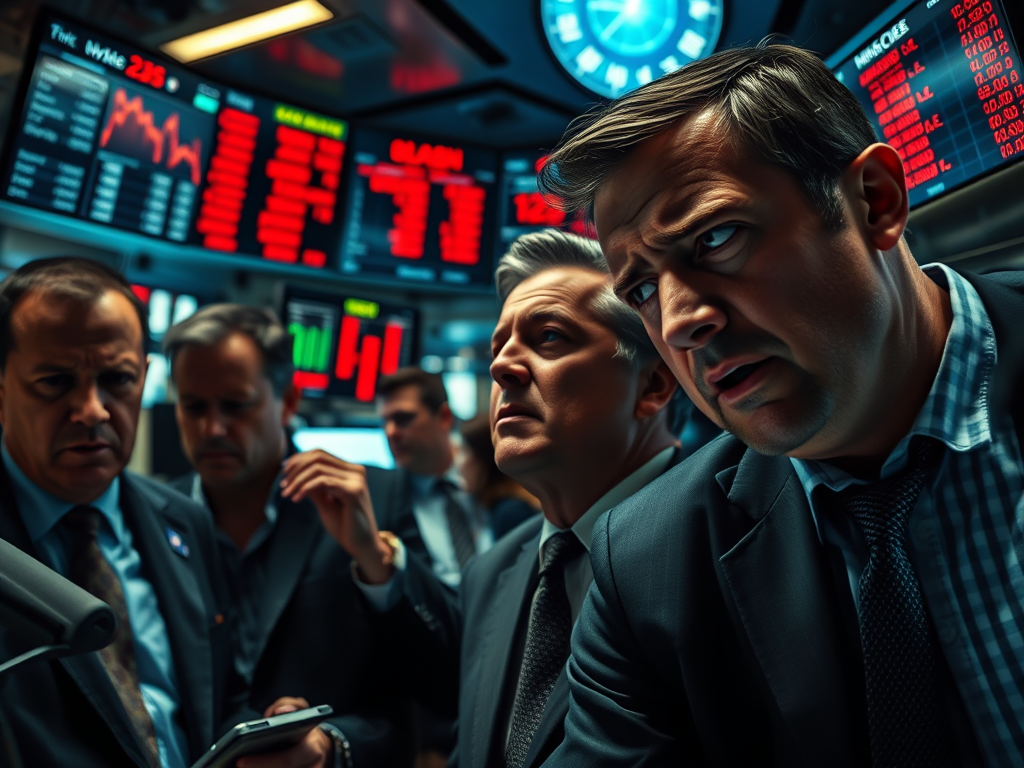

After a Blowout Week, Wall Street Decision Makers Brace for More Chaos

Wall Street had little reprieve over the weekend, as a wave of emotional and financial stress swept across the financial sector. Anger, anxiety, and fear dominated conversations behind closed doors, with the prevailing mood echoing the panic of past economic downturns.
Frustration mounted over the erratic and sudden implementation of tariffs by President Trump—an aggressive move that, in just two trading days, erased trillions of dollars from the stock market. There was widespread discontent among financial elites who felt increasingly powerless in influencing White House decisions. Private equity firms and global investment funds worried about how these developments would impact their global portfolios, with some fearing a more widespread financial unraveling.
The anxiety on Wall Street was palpable. Hedge funds calculated their mounting losses, and some even bragged if their losses were minimal compared to others. Bankers and corporate lawyers, who had already been struggling to secure deals, cleared their schedules further, anticipating that executives would be too cautious to move forward with major mergers or initial public offerings. Institutions ran crisis simulations, trying to predict which of their clients might falter in the escalating global trade conflict.

Speaking to The New York Times, traders, bankers, and executives shared that the speed and scale of the market decline reminded them of the 2007–2008 global financial crisis. In just two days, U.S. stocks fell by 10 percent—a pace of decline only matched during the collapse of Lehman Brothers. The sharp downturn extended beyond equities, dragging down commodities such as oil, copper, gold, and even digital assets like cryptocurrencies. Even the U.S. dollar wasn’t spared, with investors worldwide rushing to reassess their exposure.
This widespread financial damage triggered margin calls—requests from banks for traders to post more collateral if they wished to continue borrowing to make trades. While these calls have not yet reached crisis-level intensity, they introduced new fears among market participants, recalling past financial calamities.
The full extent of the damage remains uncertain. Hedge funds and private investors rarely disclose their holdings in real-time, and it may take days or even weeks to gauge the complete fallout. One venture capitalist, who preferred to remain unnamed, revealed that his portfolio had likely dropped by $1.5 billion—assuming his lightly traded assets could even be liquidated.
Ran Zhou, a hedge fund manager at Electron Capital in New York, noted that the weekend brought a grim sense of déjà vu. He canceled his personal plans and returned to the office to scour Chinese news sources in an attempt to get ahead of Beijing’s response to the tariffs. “It’s definitely reminiscent of 2008,” he said.
Unlike previous crises, however, this one seems less likely to be met with swift governmental intervention. The traditional web of global interdependence is being upended—by none other than the United States itself. With the White House tearing apart the rules-based international order it once championed, America’s role as a stabilizing force in global finance is now in question.
Mike Edwards, an adviser to a wealthy private investor, characterized the current economic suffering as largely self-inflicted. “This was a wound caused by the president himself,” he said. Over the weekend, he spent countless hours on conference calls with other investors. “This isn’t about math right now—it’s about psychology. What’s your neighbor doing? That’s what really matters.”
Historically, Wall Street has played a central role in shaping U.S. economic policy across party lines. Many financiers were hopeful that the appointment of Scott Bessent, a hedge fund veteran and former Democrat, as Treasury Secretary would secure the industry’s influence in the Trump administration. Yet Bessent has remained largely unbothered by the market turmoil. “People consistently underestimate Donald Trump,” he said on NBC’s Meet the Press on Sunday.

This dismissive tone has alienated even some of Trump’s former backers in the financial sector. Daniel S. Loeb, a prominent billionaire investor, posted a blunt message on X (formerly Twitter): “It was fun while it lasted”—a statement he later deleted. Meanwhile, outspoken Trump supporter William A. Ackman used the platform to express concern, calling for a pause in the rollout of tariffs. “Why wouldn’t a pause make sense?” he asked, warning that unchecked uncertainty could push the economy into a severe recession.
Ackman himself had recently invested in Nike, a company that had moved its supply chain from China to Vietnam. However, Trump’s tariffs hit Vietnam with a 46% duty, nullifying Nike’s strategic shift. Vietnam has since offered to drop its own tariffs on U.S. goods, in hopes of defusing the tension.
Despite the heavy atmosphere, some pointed to the resilience of the market’s infrastructure. Multiple bank and hedge fund executives noted that, although trading was frenzied, there were no technical glitches or system failures—something Scott Bessent emphasized in his NBC appearance. “Everything is functioning very smoothly,” he said.
One senior bank executive expressed a degree of relief following a Friday night call with regional heads: no major clients were showing immediate signs of collapse. Meanwhile, at Citadel, the $66 billion hedge fund, founder Ken Griffin had proactively dialed back leverage in recent weeks. His anticipation of volatility seems to have paid off—the fund remained flat during the downturn, according to two insiders.
Investment banks reported a surge in calls from corporate clients seeking advice on how to navigate the chaos. At Lazard, employees were instructed to be available but avoid making strong predictions, given the sheer unpredictability of the current environment.
The true economic cost remains to be seen. Bank of America has warned that profits for companies in the S&P 500 could fall by as much as one-third if foreign nations retaliate with tariffs of their own. However, some analysts believe the damage could be softened if the U.S. reaches trade agreements with key partners.
Even before the latest developments, U.S. deal activity had slowed. In the first quarter of the year, mergers and acquisitions dropped 14 percent compared to the previous year, according to LSEG Data & Analytics. Last week’s turmoil prompted the delay or cancellation of several high-profile public offerings, including those by Klarna and StubHub.
Faced with these setbacks, one senior bank executive said he planned to focus more on Europe, where deal-making remained more robust. Two private equity leaders expressed concerns that souring international relations and falling market confidence would hinder their ability to raise funds—a critical lifeline in a time when they’re already struggling to return capital to investors. Shares of major firms like Apollo and KKR plunged more than 20 percent during the week.
A well-known corporate lawyer confessed to being “stunned” by how far his clients’ share prices had fallen, while a Goldman Sachs executive summed up the general sentiment bluntly: “Someone needs to stop him,” referring to President Trump.

Despite the uproar, most top Wall Street figures have remained silent. JPMorgan Chase CEO Jamie Dimon, who once advised Americans to “get over” tariff fears, chose to spend his weekend preparing his annual shareholder letter and speaking with branch staff in Nashville. He declined to comment on the current crisis.
Steve Eisman, made famous by The Big Short for predicting the 2008 crash, urged the industry to adopt a more humble stance. “Everyone who went to college studied Econ 101 and learned that trade wars are bad,” he said. Yet Eisman suggested that the U.S., due to its economic size and strength, might fare better than expected.
As of yet, few corporations have made public statements on their forecasts since the tariffs were introduced. Investors are waiting for clarity from major banks like JPMorgan and Wells Fargo, which are expected to hold earnings calls later this week.
The uncertainty of the moment was perhaps best captured by Daniel Loeb, who, despite his earlier pessimism, posted again on Saturday: “Sometimes markets bottom when things look most bleak.” Then he added a note of caution: “Not a prediction—just keeping an open mind.”




Leave a Reply