
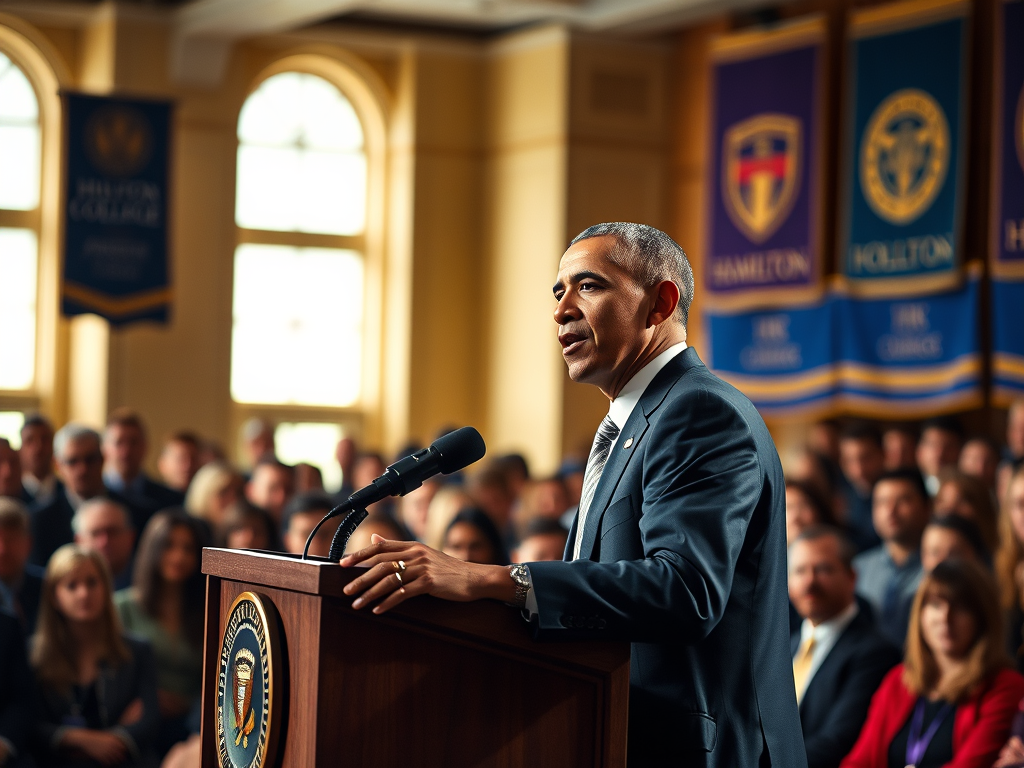

Obama Calls for Universities to Stand Up for Core Values

In a thoughtful and powerful conversation held on Thursday at Hamilton College in upstate New York, former President Barack Obama addressed the growing challenges faced by American universities, particularly in the current political climate. Speaking to an audience that included students, faculty, and community members, Obama emphasized the critical role higher education institutions must play in defending academic freedom and upholding their core values—especially when those values are under siege.
Obama’s remarks came at a time when several universities have been targeted by the federal government, particularly by the Trump administration, through threats of significant funding cuts. In recent months, institutions such as Columbia University, the University of Pennsylvania, and Harvard have faced the revocation or suspension of hundreds of millions of dollars in federal grants and contracts. These actions have sparked widespread concern about political interference in academic affairs and have raised alarms about the future of independent scholarship in the U.S.
Rather than respond with fear or silence, Obama encouraged universities to remain steadfast. “If you’re a university,” he said, “you have to ask yourself some hard questions. Are we doing what we claim to stand for? Have we lived up to our own stated values? Have we broken the law or violated our own standards in any way?”

He went on to clarify that if the answer to those questions is “no,” and the institution is being threatened solely for political reasons or to stifle dissent, then it’s time to push back. “You’ve got that big endowment,” he added with a touch of irony, “Use it.”
Obama’s call to action is timely. Just last month, the government withdrew $400 million in funding from Columbia, followed by a $175 million suspension for the University of Pennsylvania. Now, Harvard and its affiliated institutions are under review for nearly $9 billion in federal arrangements. These moves are widely viewed as retaliatory responses to perceived political misalignment between elite universities and the federal government.
Obama’s commentary also highlighted an internal challenge: the campus culture around free expression. While defending against external attacks, universities must also reflect on how well they are fostering environments that welcome diverse perspectives. “You can’t just blame the outside,” he noted. “Are we, as institutions, really committed to free and open dialogue? Are we creating spaces where all voices—including the ones we may disagree with—can be heard?”
His comments acknowledged that many universities are walking a tightrope. On one side is the imperative to stand against intimidation. On the other is the complex internal debate around cancel culture, speech codes, and the boundaries of acceptable discourse. Obama urged students and educators alike to be introspective and honest in navigating this terrain.

“The impulse to cancel a speaker you don’t like, to shout someone down rather than engage with their argument—that’s not what education is for,” he explained. “That’s not what America is about.”
The former president’s remarks were met with applause, particularly when he added, “Let them speak. And then, tell them why they’re wrong. That’s how you win the argument.”
The funding crisis has prompted various responses from academic leadership. Some university presidents, including those at Brown and Princeton, have declared their willingness to push back and defend the autonomy of their institutions. Princeton’s president, Christopher Eisgruber, went so far as to describe the federal crackdown on Columbia as “the most serious threat to American higher education since the McCarthy era.”
Harvard has been especially prominent in this controversy. The university has faced not only political scrutiny but also internal challenges, as it attempts to respond to concerns raised by Jewish students and faculty members over campus climate and governance. Over 800 faculty members have signed an open letter urging Harvard’s administration to take a firmer stance in defending academic integrity and institutional independence.
Despite the enormous resources many elite universities have, defending themselves is not a straightforward matter. Endowments—often seen as financial fortresses—are largely restricted in their use. Funds are typically earmarked for specific scholarships, research, or capital projects, making it difficult to deploy them as a general emergency resource.
Nonetheless, voices like Obama’s—and those of other former academic leaders—are pressing universities to reconsider. Larry Summers, the former president of Harvard and Obama’s own economic advisor, echoed this perspective in a guest essay published in The New York Times. “In extraordinary circumstances,” Summers wrote, “there are ways to access endowment funds, even those that have been designated for specific purposes. Universities must be willing to explore those options if their core mission is at risk.”
Another facet of the current crisis is the role of political perception. Critics on both the right and left argue that universities have lost credibility by appearing overly partisan or by failing to foster a genuine culture of ideological diversity. Some conservatives believe that higher education has become dismissive of their viewpoints, which has made it an easy target for political attacks. Obama acknowledged these concerns but cautioned against using them as a reason to compromise academic principles.

In addition to addressing universities, Obama extended his remarks to the legal profession, which has also faced pressure from the federal government. He implored law firms and lawyers not to back down from defending civil liberties and free speech, even if doing so might cost them business or clientele. Principles, he argued, must not be traded for convenience or profit.
Thursday’s conversation at Hamilton was not simply a policy discussion; it was a broader appeal to conscience. For students, it was a lesson in civic responsibility. For faculty and administrators, it was a reminder of their role as stewards of intellectual integrity. And for the public, it was a call to recognize the indispensable role of universities in a healthy democracy.
In the end, Obama’s message was about courage—moral, intellectual, and institutional. It was about the importance of standing firm in the face of coercion and of honoring the foundational values of education: inquiry, openness, and truth.
As universities across the country face both internal reckoning and external hostility, the former president’s words offer a guiding light. They are a reminder that while the challenges are real, so too is the power of principle. And in uncertain times, that might be the most important lesson of all.




Leave a Reply