
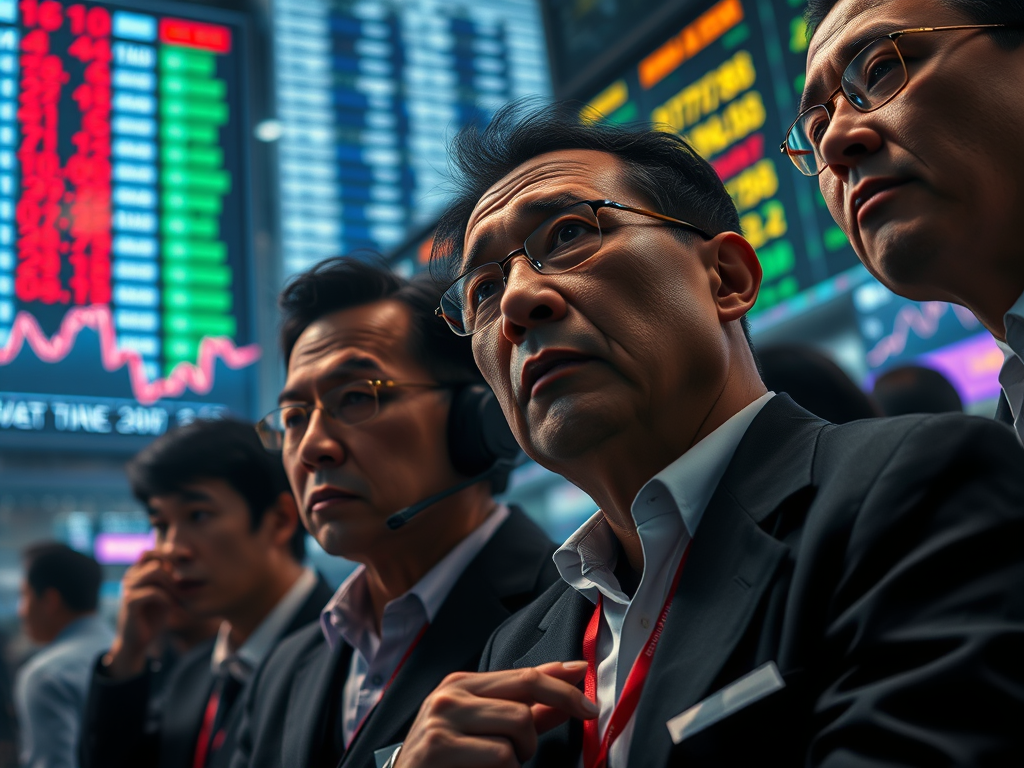

Stocks in Asia Fall Sharply, Extending a Rout Caused by Trump’s Tariffs

At the start of trading in Asia on Monday, financial markets were rocked by another dramatic wave of sell-offs, following rising concern among investors and economists that President Trump’s latest round of sweeping tariffs could push the global economy into a severe downturn.
The sell-off was swift and widespread. Japan’s stock market plunged more than 8 percent, while South Korea’s benchmark dropped approximately 5 percent. Australia also experienced heavy losses, with its stock index falling over 6 percent. The trading atmosphere was tense and volatile as market participants struggled to digest the implications of heightened trade tensions between the world’s two largest economies.
Over the weekend, analysts issued warnings that Asia would likely bear the brunt of the escalating tariff conflict between China and the United States. This is because many nations in the region — including major economies like Japan and South Korea — rely heavily on both countries for trade. A tit-for-tat pattern of retaliation could have especially harmful ripple effects throughout the region.
President Trump reignited market anxieties on Sunday evening by reaffirming his hardline stance. Speaking aboard Air Force One, he declared that he had no intention of rolling back tariffs on other nations unless the United States received significant compensation in return. He also downplayed the risk of rising consumer prices as a result of import taxes, stating, “I don’t think inflation is going to be a big deal.”
These comments came shortly after China announced a retaliatory 34 percent tariff on a selection of U.S. exports, mirroring the same rate President Trump had imposed on Chinese goods just days earlier. The tit-for-tat moves have reinforced fears that the trade dispute could quickly spiral into a full-blown economic conflict with global repercussions.

By Monday morning, Hong Kong and Taiwan’s stock markets had dropped sharply, each losing about 10 percent as trading opened. Meanwhile, mainland China’s markets registered losses of roughly half that magnitude.
Technology companies across Asia were among the hardest hit. Taiwan Semiconductor Manufacturing Company, the world’s leading producer of computer chips, saw its stock plunge nearly 10 percent. Foxconn, a major supplier for Apple and one of the largest electronics contract manufacturers globally, also dropped by 10 percent. In Hong Kong, prominent Chinese tech firms such as Alibaba, Tencent, and Xiaomi experienced significant losses as well.
The pain extended to South Korea, where Samsung Electronics — which produces a significant portion of its products in Vietnam — saw its shares decline by 4 percent. Japan’s Nintendo was also affected, falling nearly 5 percent after announcing delays in the launch of its new Switch console sequel. At the opening bell, its shares had dropped by as much as 10 percent.
The market turmoil was not limited to Asia. U.S. futures markets also reflected mounting anxiety. Futures contracts for the S&P 500 — which allow investors to speculate on the direction of the index before the official market opening — fell about 4 percent during Sunday night trading. Commodity markets joined the slide, with oil prices falling more than 3 percent, adding to sharp losses from the previous week. Copper, often viewed as a bellwether for overall economic health, dropped by over 5 percent.
Last Thursday and Friday, the S&P 500 recorded a cumulative decline of 10.5 percent — its steepest two-day fall since the early stages of the COVID-19 pandemic in 2020. According to Howard Silverblatt, a senior analyst at S&P Dow Jones Indices, the only comparable losses in recent history occurred during the 2008 global financial crisis and the 1987 market crash. In just two days, over $5 trillion in market value was erased, a record in dollar terms.

What’s particularly striking about the current downturn is that it’s not being triggered by natural disasters or financial system failures, but rather by deliberate policy choices. President Trump appears undeterred by the market reaction and the risk of economic fallout, continuing to double down on his protectionist approach.
Preston Caldwell, a senior U.S. economist at Morningstar Research Services, issued a stark warning in a recent blog post. He argued that if the newly announced tariffs remain in place, they could bring about a “self-inflicted economic catastrophe” for the United States.
Trump’s tariff announcement last Wednesday — imposing some of the highest duties seen in recent decades — caught markets off guard, disrupting previously optimistic forecasts for global growth. In response, major corporations are already sounding the alarm.
Executives at several consumer goods companies have cautioned shoppers to brace for higher prices on essential items, from clothing to groceries. Some consumers are responding by holding off on large purchases, while car manufacturers have begun scaling back production in overseas plants and announcing domestic layoffs. Meanwhile, major banks have revised their outlooks, increasing the probability of a U.S. recession within the next year.
As other countries responded with retaliatory tariffs of their own, the pace of the global sell-off only intensified. Bill Ackman, a prominent hedge fund manager, took to the social platform X on Sunday to express both support and concern. While he agreed with Trump’s efforts to address long-standing global trade imbalances, he urged the administration to pause for reflection.
“Call a 90-day time out,” he wrote. “Otherwise, we’re heading toward a self-induced economic nuclear winter. We need to start preparing. Hopefully, cooler heads will prevail.”
British Prime Minister Keir Starmer echoed similar sentiments, stating on Saturday that “the world as we knew it has gone,” and urging restraint among global leaders. He warned that retaliatory measures risk plunging the world into a dangerous and unnecessary trade war.
The sell-off has pushed the S&P 500 down 17.4 percent from its recent high in February — approaching official bear market territory, typically defined as a drop of 20 percent or more from a recent peak. The tech-heavy Nasdaq Composite has already entered a bear market, declining nearly 23 percent from its December peak. Likewise, the Russell 2000 index, which tracks smaller U.S. companies that are particularly sensitive to economic trends, has fallen more than 25 percent since its high in November.
Despite the gloom, a few investors maintain a sliver of optimism. Some believe that the U.S. economy, which showed strong momentum in the early months of the year, may be resilient enough to weather the tariff storm. They hope that, once the dust settles, the administration will shift focus toward tax reform and deregulation to stimulate growth and stave off a recession.
U.S. Treasury Secretary Scott Bessent struck a confident tone in a Sunday interview on NBC’s “Meet The Press.” He said there was “no reason” to anticipate a recession, suggesting that the underlying fundamentals of the economy remain strong.
However, market analysts remain cautious. Stuart Kaiser, an equity strategist at Citi, emphasized that the extent of damage will depend largely on how long elevated tariffs persist. Even after last week’s steep losses, he warned, stock valuations may still be too high given the current outlook.
“Earnings expectations and forecasts for economic growth haven’t yet fully adjusted to the scale of the tariffs announced,” Kaiser said. “There could be more room for the market to fall.”
As uncertainty looms and financial markets continue to reel, investors are left wondering how long the turbulence will last — and whether a resolution to the deepening trade conflict is anywhere in sight.




Leave a Reply