
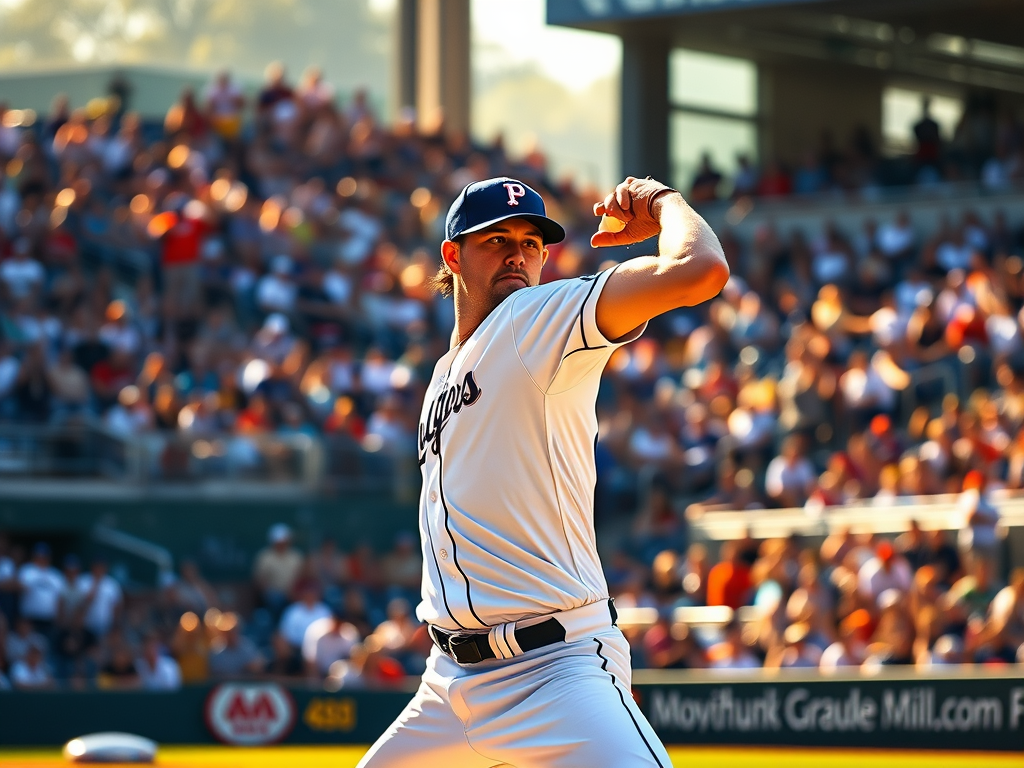

Every time Paul Skenes starts, an entire sport marvels — but also holds its breath

Nearly every week last summer, Jim Riggleman found himself glancing at the Pittsburgh Pirates’ schedule, eager to see when Paul Skenes would take the mound next.
Riggleman, a veteran of nearly five decades in baseball, managed five Major League teams and served as a coach for four others, though never for the Pirates. Yet, at 72 years old, long removed from the game, he found himself reaching for the remote at his home near Clearwater, Florida, tuning in to watch the last-place Pirates. Such is the magnetism of Skenes, the reigning National League Rookie of the Year and current frontrunner for the Cy Young Award.
“It just looks so effortless,” Riggleman remarked in a recent phone call.
His admiration was unmistakable, but so was his concern.
Every so often, a starting pitcher emerges and captivates the baseball world, exceeding expectations and baffling big-league hitters. Fans rush to the stadium to witness the spectacle. Names like Fernando Valenzuela, Dwight Gooden, and Dontrelle Willis come to mind. Riggleman himself managed two such prodigies: Kerry Wood and Stephen Strasburg. Hall of Fame manager Jim Leyland put it simply: “When these guys pitch, everybody feels good that day.”
Everybody, that is, except for the hitters.
Today, as Skenes takes the mound against the Tampa Bay Rays, he joins the ranks of these must-watch aces. The 22-year-old right-hander dazzled last season with a 1.96 ERA and an All-Star Game start, only a year after being selected first overall in the draft. He fired 100 fastballs exceeding 100 mph, but his most devastating weapons were his off-speed pitches—splinkers, sweepers, sliders, and curves—delivered at speeds ranging from 83 to 94 mph.
“You just don’t see stuff like that,” Leyland mused.

But Skenes has arrived at a time when the baseball world is acutely aware of how rare and fragile dominant starting pitchers have become. His emergence has stirred both awe and anxiety—fans marvel at his brilliance but fear that it may not last. Despite teams being increasingly cautious, arm injuries continue to sideline Cy Young contenders and potential Hall of Famers at an alarming rate.
Late last summer, Riggleman noticed that Skenes was being given extra rest and had limited pitch counts. It made sense, but it also highlighted how much the game had changed. “If they’re doing everything possible to protect a power pitcher and it still doesn’t work,” he said, “then what will?”
There was a time when dominant starters were viewed as invincible. Right now, Skenes sits in that rarefied air—an untouchable ace, one of baseball’s most exhilarating sights.
When asked recently if he recognizes his impact on today’s game, Skenes remained humble. “I’ll let everyone else talk about it,” he said. And talk they do. This spring, evaluators ranked him as the sport’s second-best starter, behind Detroit’s Tarik Skubal, who has already undergone two arm surgeries.
One executive put it bluntly: “There may be no single player whose arm health is more important to the game than Skenes.”
Neil Walker, a former MLB infielder, played alongside some of the best pitchers of his era: Gerrit Cole, Jacob deGrom, Noah Syndergaard, Luis Severino, Sandy Alcantara, Pablo López, Zack Wheeler, and Aaron Nola. Each of their starts brought a distinct energy to the ballpark. But nothing compared to what he felt at Nationals Park on June 8, 2010—Strasburg’s debut.
“Your first thought as a major leaguer is, ‘This guy can’t be as good as they say,’” Walker recalled. But as Strasburg breezed through three innings, Walker quickly realized the hype was justified.
After Delwyn Young’s fourth-inning home run, no Pirates batter reached base. Strasburg struck out two in the fifth, three in the sixth. Riggleman, then the Nationals’ manager, gathered his staff. Strasburg was supposed to pitch six innings, but he was dominant and barely breaking a sweat. General manager Mike Rizzo gave the green light for the seventh inning.

Strasburg struck out the side. The crowd erupted in a standing ovation.
Fifteen years later, Riggleman wonders: “Should we have sent him out for the seventh?”
The fact that he even checked with the GM reflected how baseball had evolved. When Riggleman managed the Cubs in 1998, young aces weren’t handled with such caution. Kerry Wood, in just his fifth career start, tied Roger Clemens’ record with 20 strikeouts. That summer, Wood averaged 109 pitches per start, sometimes reaching 133. No one criticized Riggleman for overworking him—if anything, fans wanted to see more.
By comparison, the Nationals handled Strasburg with extreme care. He never exceeded 100 pitches as a rookie. Yet both pitchers suffered elbow injuries in August of their debut seasons. Wood attempted a comeback before tearing his UCL the following spring. Strasburg underwent Tommy John surgery immediately.
In hindsight, Riggleman wonders if they should have been even more cautious. But has baseball’s conservatism actually solved anything? Arm injuries remain a persistent issue, even with pitchers like Skenes being monitored so closely.
Dallas Braden, the A’s broadcaster who threw the 19th perfect game in MLB history, has a routine with his podcast co-hosts from “Baseball is Dead.” Whenever Oakland’s fireballing closer Mason Miller begins warming up, he texts, “He’s up.” But on Skenes’ start days, the chat erupts with videos, GIFs, and memes showcasing his arsenal.
“It’s must-watch TV,” Braden said. “It’s the perfect blend of preparation and talent. We’re seeing a guy who can dial up 102 mph, masterfully manipulate the baseball, and constantly push himself to improve. That’s a terrifying combination for hitters.”
Skenes debuted at PNC Park on May 11 last year. Walker, now a Pirates analyst, wasn’t on the broadcast call that day. Instead, he bought club-level tickets—a rare experience for him since retiring. “I couldn’t miss it,” he said. “My brain reverted to being a seventh grader at Pine-Richland Middle School, just in awe of it all.”

Skenes’ significance to baseball was immediately apparent. After just 11 career starts, he was named the All-Star Game starter. When he was twice pulled from a no-hit bid, Hall of Famer Randy Johnson urged him to fight to stay in the game. Johnson, frustrated by baseball’s shift toward shorter outings for starters, saw hope in Skenes. “If your body is accustomed to a heavy workload,” Johnson advised him, “it will handle it.”
At 6-foot-6, 260 pounds, Skenes appears unbreakable. But no pitcher truly is. Even Walker admits, “You watch with your hands half-covering your face when a guy throws 100 mph for seven innings.”
Despite the concerns, Skenes has revitalized Pittsburgh baseball. He’s not just a local star—he’s a national sensation. When he takes the mound, as Leyland put it, “the whole world feels good that day.”
And yet, Braden finds it frustrating that the excitement surrounding Skenes is mixed with apprehension. “Why can’t we just enjoy this?” he lamented.
But he knows why. Baseball has conditioned fans to expect the worst. Time and again, those fears have been validated. When greatness so often comes with an expiration date, it’s hard to simply sit back and enjoy the ride.




Leave a Reply