
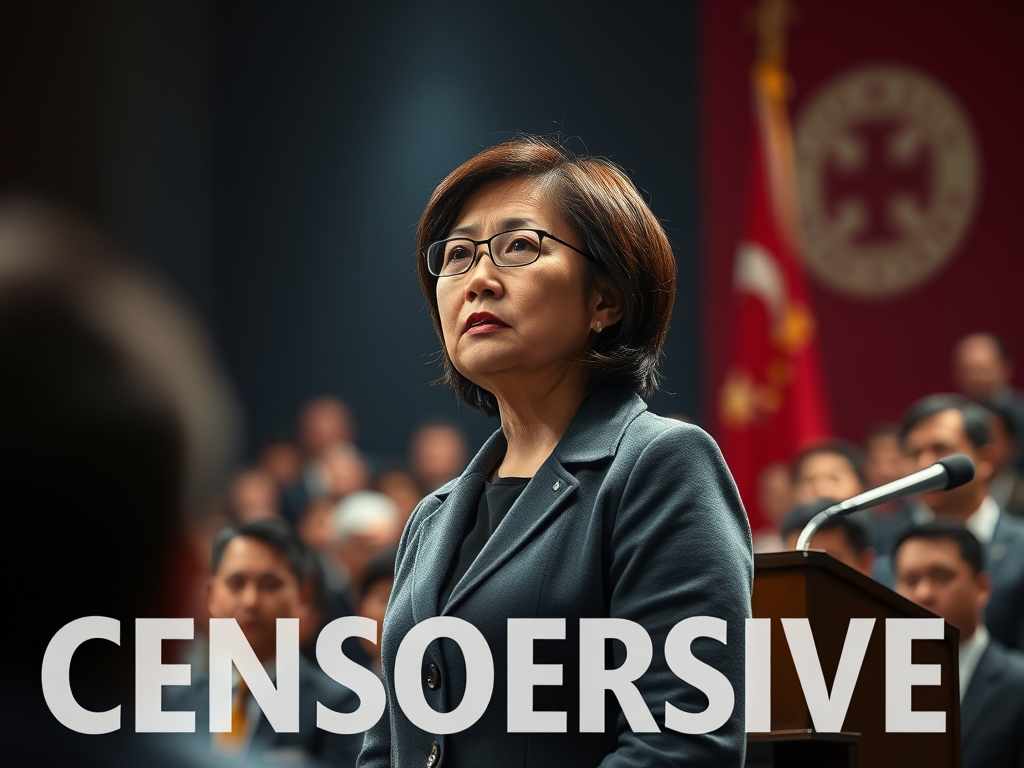

Dr. Liu’s Canceled Speech Highlights Higher Education Fears

On the evening before Dr. Joanne Liu was set to deliver a carefully prepared speech at N.Y.U. Langone Health—an institution affiliated with her alma mater—she received an unexpected phone call that left her stunned. A university official informed her that her presentation on humanitarian crises had been canceled.
According to Dr. Liu, the reason given for this abrupt decision was that her talk might be interpreted as critical of the government and antisemitic.
Dr. Liu, who serves as a professor at McGill University in Montreal and is also a pediatric emergency physician at Sainte-Justine hospital, saw the cancellation as an indication of the growing fear among U.S. university administrators of provoking the Trump administration. She viewed it as part of a broader climate of apprehension in higher education, particularly as the administration intensifies its scrutiny of academic institutions.

Dr. Liu had already made the journey from Montreal to New York for the scheduled speech on March 19. It was only after her arrival that she received a call raising concerns over specific aspects of her presentation. She was told that references to cuts in U.S.A.I.D. funding and a slide illustrating the number of aid workers killed in various global conflicts—including in Gaza, South Sudan, and Sudan—were problematic.
The official, whom Dr. Liu chose not to name, suggested that the slide could be seen as antisemitic because it mentioned casualties among aid workers in Gaza but made no reference to Israel. Dr. Liu, who led Doctors Without Borders as its international president from 2013 to 2019, offered to revise the three slides that had raised concerns. However, three hours later, she was informed that the event had been canceled altogether.
This decision took place against the backdrop of a series of executive orders and policy changes introduced by President Trump. These measures have prompted self-censorship among institutions concerned about potential funding cuts. Since the beginning of his second term, President Trump has emphasized a vision for higher education that prioritizes “the American tradition and Western civilization” while discouraging protests and certain types of academic research.
Threats of executive action and funding withdrawals have allowed the administration to pressure elite universities, law firms, and other institutions viewed as adversarial. In recent weeks, the federal government has rescinded hundreds of millions of dollars in funding from Columbia University and the University of Pennsylvania. Additionally, on Monday, the administration announced that it would conduct a review of approximately $9 billion in contracts and multiyear grants at Harvard University, accusing the institution of failing to protect Jewish students and prioritizing divisive ideologies over intellectual freedom.

Furthermore, in late February, lawyers representing NYU Langone Health—where Dr. Liu was scheduled to speak—suggested eliminating terms like “diverse students” and removing references to “marginalized” communities from official websites and policy documents. This information was detailed in a PowerPoint presentation obtained by The New York Times.
Steve Ritea, a spokesperson for NYU Langone Health, declined to provide a specific reason for the cancellation of Dr. Liu’s speech. He issued a statement noting that guest speakers are required to adhere to the institution’s policies. “Per our policy, we cannot host speakers who don’t comply,” Ritea stated. “In this case, we did fully compensate this guest for her travel and time.” However, when pressed for details on the exact guidelines in question, he did not provide additional clarification.
Dr. Liu, who had been invited to speak at N.Y.U. a year prior, described the university official who rescinded the invitation as visibly distressed and apologetic. She characterized the cancellation as symptomatic of a broader atmosphere of fear permeating American universities.
While acknowledging the difficult position faculty members find themselves in regarding funding, she expressed concern over the trajectory of academic freedom. “At the end of the day, that’s their job, their teaching, their life, their research,” she said. Dr. Liu has since spoken publicly about her experience, including in an essay for Le Devoir, a French-language newspaper in Montreal, to highlight what she sees as a troubling trend. Universities, she argued, should remain places where students are exposed to a range of perspectives and challenged to think critically.
The Trump administration’s pressure on academic institutions has already led at least one professor to leave the United States. Jason Stanley, a professor at Yale University, revealed in a recent NPR interview that he had accepted a position at the University of Toronto. Dr. Stanley, a philosophy scholar, stated that the administration’s actions follow a familiar authoritarian playbook, where intellectuals become primary targets. He warned that acquiescence by prestigious universities could set a dangerous precedent.
In the interview, Dr. Stanley further argued that by imposing restrictions on universities under the pretense of protecting Jewish students, the Trump administration was in fact fueling antisemitic sentiment among the public. “It’s going to create mass popular anger against Jewish people,” he cautioned. “If universities want to fight antisemitism, they need to stand up and say, ‘No, we are not threats to American Jews. You are threatening American Jews.’”
Dr. Liu’s canceled speech is just one example of the broader challenges facing academic institutions in the current political climate. As universities navigate an increasingly restrictive environment, the balance between academic freedom and political pressures remains precarious.




Leave a Reply