
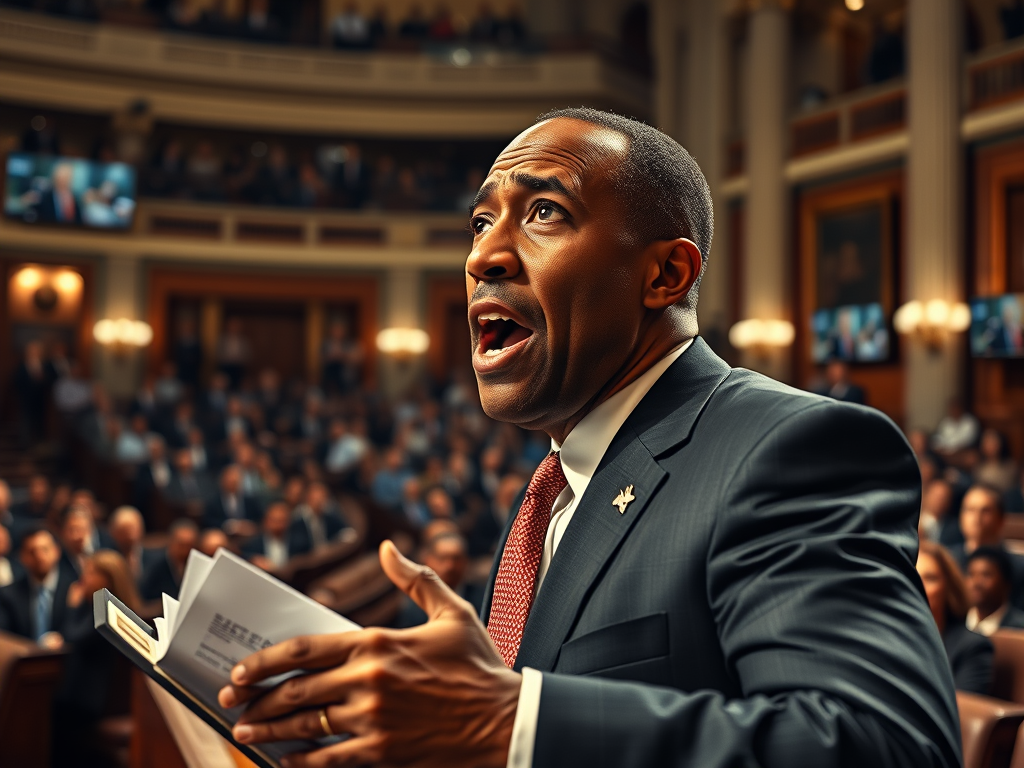

‘Finally Some Fire’: Cory Booker’s 25-Hour Speech Strikes a Chord at Home

Senator Cory Booker’s team grappled with a lingering worry as they spent a week compiling materials for 15 binders—enough content to sustain what would soon become a record-breaking 25-hour speech.
What if no one paid attention?
Their concerns quickly dissipated. By 11 a.m. on Tuesday, 16 hours into Mr. Booker’s impassioned critique of President Trump’s policies on the Senate floor, his office had already received approximately 14,000 voicemails, according to his aides. By the time he concluded his marathon address, the number had doubled to 28,000.
For an astonishing 25 hours and five minutes, the New Jersey Democrat—who turns 56 this month—remained standing, never once leaving the Senate chamber for food or even a bathroom break. His endurance shattered a 68-year-old record, previously held by Senator Strom Thurmond of South Carolina, who had spoken for nearly an hour less in an attempt to obstruct civil rights legislation.

Americans took notice. The tech-savvy senator live-streamed the speech on TikTok, where it amassed over 350 million likes. On YouTube, more than 110,000 viewers tuned in as Mr. Booker wrapped up his remarks much as he had started them—paying tribute to his mentor, the late civil rights icon John Lewis, a Georgia Democrat who dedicated three decades to Congress.
“Let’s get in good trouble,” he declared, echoing Mr. Lewis’s famous rallying cry.
Many viewers admired the senator’s resilience and determination.
“New respect for New Jersey,” a YouTube user commented in a live chat two hours before Mr. Booker finished speaking.
Since President Trump’s inauguration in January, during which he swiftly signed numerous executive orders aimed at reshaping the government—slashing federal agency budgets, firing employees, weakening law firms he opposed, and pushing for the deportation of international students who criticized Israel’s war in Gaza—Democrats have largely found themselves sidelined. Lacking a majority in both the House and Senate, their ability to effect legislative change has been severely constrained. However, polling and social media trends suggest that many frustrated Democratic voters have been urging their representatives to take stronger action.
“The Democrats have been acting like it’s okay for Trump to do whatever he wants, and it’s not,” said Angel Leston, 38, owner of Casa d’Paco, a restaurant in Newark—New Jersey’s largest city, where Mr. Booker previously served as mayor before his election to the Senate.
“Now,” he added, “there’s finally some fire.”

Vivian Cox Fraser, president of the Urban League of Essex County, also found herself drawn to Mr. Booker’s speech, checking in at different points throughout Monday and Tuesday. His fervor resonated with her.
“You have to show resistance in some way,” she said. “What I hope is that this becomes the spark for something bigger—for us to stand up.” She expressed particular concern about potential cuts to education, social services, and Medicaid, which she feared could negatively impact the families her organization supports.
Ryan Haygood, a civil rights attorney based in New Jersey, found Mr. Booker’s commitment inspiring. “Seeing someone put their entire self into something like this—it’s powerful,” said Mr. Haygood, who leads the New Jersey Institute for Social Justice. “We need voices at every level, fighting for the core values of this country.”
Governor Philip D. Murphy of New Jersey also took to social media to express his appreciation. “Thank you, Cory, for your dedication to protecting the principles our nation was built upon,” he wrote.
However, even some of Mr. Booker’s supporters acknowledged the risks of challenging a president known for wielding control over federal resources—and for his willingness to seek retribution.

“Trump will retaliate—without a doubt,” said Mr. Leston. His restaurant sits on a working-class street in Newark’s Ironbound neighborhood, a predominantly Latino area where Mr. Trump had a strong voter base in the previous election.
“He goes after anyone who criticizes him—why would New Jersey be any different?” Leston continued. “But that shouldn’t stop people from speaking out against his policies.”
Not everyone was impressed by Mr. Booker’s efforts. At Krug’s Tavern, a Newark landmark for nearly a century, most patrons were far more engrossed in the Yankees game than in the senator’s speech. When Mr. Booker officially surpassed Mr. Thurmond’s record at 7:19 p.m., their reactions were muted.
“The Democrats just can’t accept that they lost,” remarked Paul Wiener, 69, while the sound of sizzling food filled the background. “The work should have been done before the election, not after.”
“Booker is just another mosquito in the swamp,” he added dismissively.
Harrison Fields, a spokesperson for President Trump, was quick to mock the speech, referencing a moment from Mr. Booker’s questioning during the Senate confirmation hearings for Supreme Court Justice Brett Kavanaugh: “When will he realize he’s not Spartacus—he’s a spoof?”
Nonetheless, even some political adversaries acknowledged Mr. Booker’s tenacity.

“Regardless of where you stand politically, Cory is an impressive guy—smart, energetic, and genuinely good-hearted,” said Mike DuHaime, a Republican strategist who managed former New Jersey Governor Chris Christie’s campaigns. “You don’t have to agree with him on every issue to appreciate the fact that millions of people watched the former Newark mayor make history.”
Throughout his extended address, Mr. Booker covered a vast range of topics—both serious and lighthearted. He devoted most of his speech to detailed policy discussions, emphasizing his opposition to budget cuts in education, healthcare, and scientific research. He shared deeply personal stories, including his family’s struggle against redlining, his father’s battle with Parkinson’s disease, and the adverse effects of the Trump administration’s policies on his constituents.
“This is a moral moment,” he repeated time and again.
Yet, he also infused the speech with moments of levity. He mused about M&M’s—pointing out that they were first manufactured in Newark. He humorously revisited friendly rivalries from his days as a Stanford football player. He even tackled a classic New York sports debate.
“The Giants and the Jets play in New Jersey,” he quipped. “The only real New York football team is the Bills.”
Even after stepping off the Senate floor, Mr. Booker’s day was far from over. He spoke briefly with reporters at the Capitol, appeared on two national television broadcasts, and finally took a break to eat, according to his aides.
His preparation had been rigorous. Beginning Friday night, he refrained from eating, and by Sunday, he had stopped drinking water, ensuring he could go the full 25 hours without a restroom break.
Throughout the ordeal, staff members were bombarded with one recurring question: Was he wearing a catheter or an adult diaper? On Wednesday, an aide set the record straight: He used neither.




Leave a Reply