
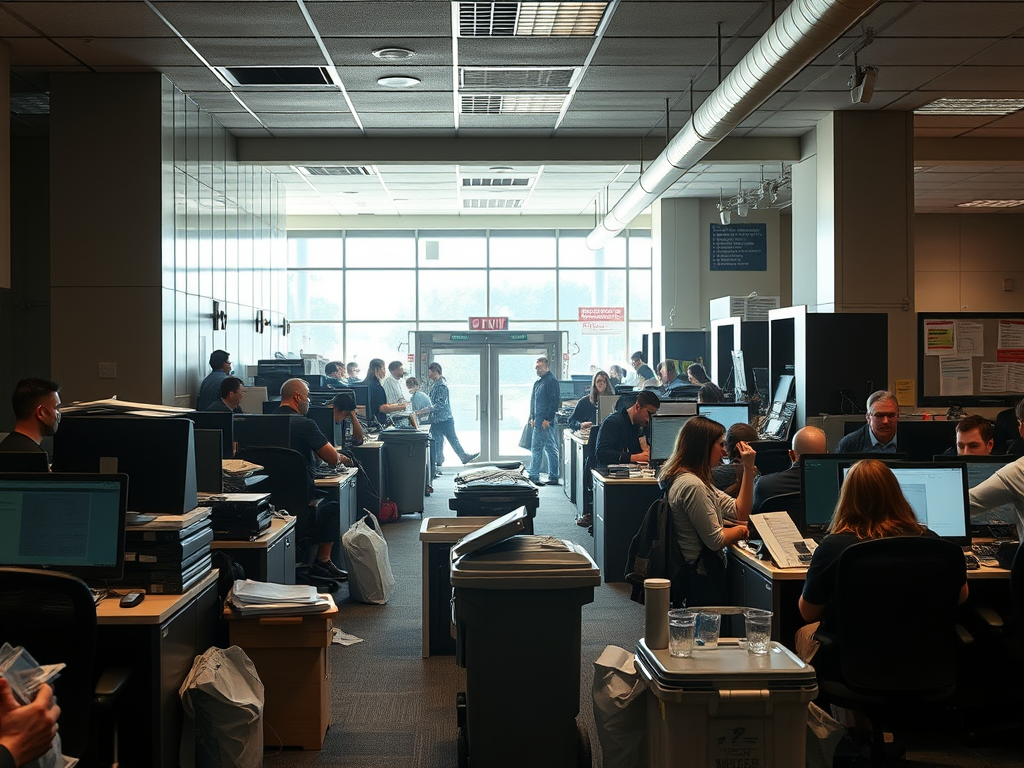

For many federal employees, the transition back to in-person work has come with unexpected challenges, including tasks far outside their job descriptions—such as taking out the trash and cleaning restrooms. Others have found themselves commuting to office buildings only to spend their workdays engaged in virtual meetings, essentially replicating their remote setups from a different location.
Challenges of Federal Employees Returning to Office

Some employees arrived at their offices only to be promptly sent home, while others found themselves without available seating despite arriving early. At the Federal Aviation Administration, workers returned to buildings where lead contamination had been detected in the water supply. Meanwhile, budgetary constraints have led to shortages of basic supplies like toilet paper in certain federal offices.
The staggered return of federal workers has been unfolding since President Trump mandated it immediately after taking office. His rationale for the policy was twofold: to ensure employees were fulfilling their job duties and, potentially, to downsize the government by encouraging attrition.
“We anticipate that a significant number of employees simply won’t show up, leading to a smaller and more efficient government,” President Trump stated.
However, for those who have resumed in-office work, the transition has been chaotic. A lack of clear planning and coordination has resulted in widespread confusion, diminishing morale, and, ironically, increased inefficiency. Interviews with numerous federal employees—most of whom spoke on condition of anonymity due to concerns over job security—highlighted logistical hurdles, overcrowding, and supply shortages that have made the return far from smooth. Prior to this shift, nearly a million federal employees had been working in hybrid or fully remote arrangements. According to the Office of Personnel Management, as of early 2024, the civilian federal workforce was approximately 2.3 million strong.

The Food and Drug Administration’s White Oak campus near Washington became a prime example of these logistical challenges when employees returned on March 17. Parking spaces were scarce, and security checkpoint lines stretched around the block. Inside the building, basic necessities quickly ran out—bathrooms lacked toilet paper and paper towels, the cafeteria was understocked, and there was a shortage of office supplies.
One scientist, initially hired for a remote position, now finds herself sharing an office while working on sensitive and proprietary projects, raising ethical and practical concerns about confidentiality.
Similarly, at the Centers for Disease Control and Prevention in Atlanta, employees were warned about limited parking at two of the agency’s campuses. Signs on the internal network advised workers to drive to an overflow building, where they would need to work from laptops using a Wi-Fi connection. At peak hours, leaving the parking lot can take as long as 90 minutes due to congestion. One CDC employee pointed out that the agency’s headquarters was never designed to accommodate all employees working on-site simultaneously. Over the past decade, the agency had reduced its reliance on leased office space by shifting toward remote work. However, the Trump administration’s policy eliminated that option.
The Internal Revenue Service has faced similar setbacks. Retired IRS manager Jeff Eppler recalled that some employees, tasked with assisting taxpayers, reported to their offices on March 10, only to be sent home without completing any work.

“So instead of spending the day working, they ended up sitting around the office before eventually being told to return home to do the same work they could have done in the first place,” he said.
In some cases, IRS managers contacted employees just days before their scheduled return, instructing them to continue remote work due to office space shortages. One IRS worker described having to choose between violating agency rules by working from home or reporting to an office without sufficient seating. Another employee recounted spending part of the first day sitting on the floor after discovering that their reserved cubicle was already occupied.
At the Department of Veterans Affairs, a doctor who had worked remotely for the past two years found her return dominated by logistical tasks—figuring out seating arrangements, setting office hours, and tracking down necessary equipment. These responsibilities, unrelated to her job description, consumed hours of valuable time.
While the Biden administration initially aimed for employees to work in the office at least half of the week, the Trump administration mandated a full-time return—even for those originally hired for remote positions. Notification periods varied widely across agencies, with some workers receiving weeks of advance notice, while others had only a few days to prepare.
A Forest Service employee, hired for a remote role, discovered that her official government paperwork listed her home address as her “duty location.” However, under the new mandate, she was required to find a federal building within 50 miles of her residence, regardless of whether it was affiliated with her agency. As a result, she and her colleagues report to random office spaces where they continue participating in virtual meetings—often struggling with weak Wi-Fi connections that hinder communication and productivity.
Budget cuts have exacerbated these issues. With spending frozen, some agencies have reduced cleaning contracts, forcing employees to handle janitorial tasks themselves. This diversion of labor has lowered productivity, according to one Forest Service worker.

Furthermore, the in-office mandate conflicts with existing union agreements that allowed for remote work arrangements. As of May 2024, over half of all federal civilian employees were already back in their offices, according to data from the Office of Management and Budget. However, neither the White House nor OMB provided details on how many were working in-person full-time. Out of more than a dozen agencies contacted by The New York Times, only five responded with updates.
The Treasury Department reported that by late March, 85% of its workforce had returned to the office. The Small Business Administration confirmed a significant return of employees, while the Environmental Protection Agency stated that 68% of its Washington-based staff were working on-site full-time. Veterans Affairs has seen nearly 10,000 employees resume in-person work since January 20, with more expected to follow. Meanwhile, 120,000 civilian employees at the Department of Defense have also transitioned back to office settings.
This return-to-office mandate is just one aspect of the sweeping and often disruptive changes imposed on the federal workforce under the leadership of Elon Musk, who oversees the Department of Government Efficiency. His tenure has included mass layoffs, rehiring waves, court-ordered reinstatements, and strict budget constraints.
Despite its name, many federal workers argue that the Department of Government Efficiency has done little to improve workplace operations. Instead, the Trump administration’s policies have led to schedule upheavals, enforced office returns, and simultaneous encouragement of early retirements—only to rehire or reinstate employees following legal disputes.
The resulting turmoil has created widespread uncertainty. Workers are juggling new commutes with ongoing personal obligations such as school drop-offs and childcare arrangements, while also facing the looming threat of layoffs.
At the Department of Energy, employees in certain divisions were given a deadline of May 5 to report to Washington-area offices—even if they lived thousands of miles away but worked near other departmental facilities. For these employees, the choice is stark: relocate without guarantees of job security or risk being swept up in the next round of layoffs.




Leave a Reply