
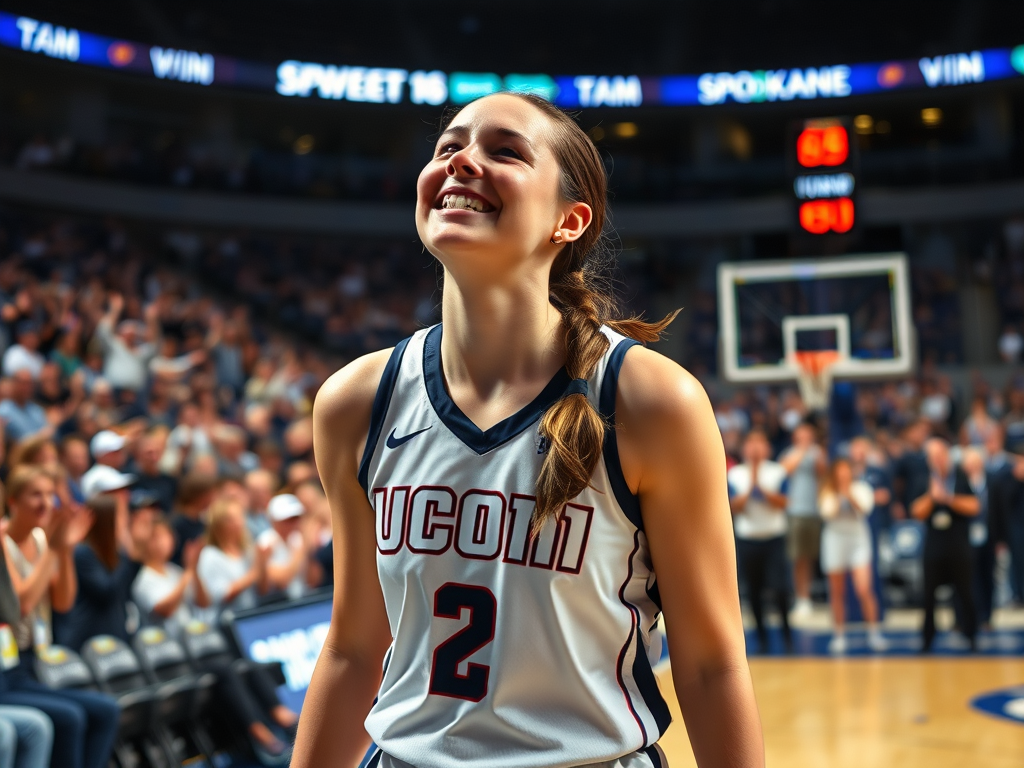

Paige Bueckers’ 40-point performance places her among the best ever at UConn

SPOKANE, Wash. — As the game clock wound down with just over three minutes left, Paige Bueckers made her way to the bench to a thunderous ovation, the Spokane arena erupting in applause as if it were her home court in Storrs, Connecticut—despite being nearly 2,700 miles away. She had dominated the fourth quarter, playing just seven minutes but outscoring Oklahoma’s entire team 19-13 in that stretch, adding nearly half of her career-high 40 points in the process. Among the many legendary players to have worn a UConn jersey, none had ever posted such a high-scoring performance in an NCAA Tournament game.
Taking a well-deserved rest, Bueckers was met with a characteristic quip from head coach Geno Auriemma, who seldom lingers on individual accolades.
“Did you check out just to hear the crowd cheer, or were you actually tired?” he asked.
She replied that she was tired, though Auriemma’s skeptical smirk suggested he wasn’t entirely convinced.
Even in the final minutes of UConn’s decisive 82-59 Sweet 16 victory, Auriemma coached with the same intensity he had all night. As the final buzzer sounded, he made his way across the court to shake hands with Oklahoma’s coach, Jennie Baranczyk. His mind, however, was already racing ahead to the Elite Eight, the most formidable hurdle in the postseason.

For Auriemma, there’s little time to dwell on shattered records or historic performances. Having witnessed countless moments of greatness, he has learned to turn the page swiftly. It’s a defining characteristic of both UConn’s dominance and its relentless pursuit of excellence.
Reflecting on Bueckers’ performance, Auriemma acknowledged, “That was as good a game as I’ve seen her play at the most critical time.” Then, with his signature wit, he added, “Did I really say that? That it was the best I’ve ever seen her play? That actually came out of my mouth?” He shook his head with a smirk. “Well, that was definitely the most I’ve seen her shoot. And let’s not forget—she was terrible on defense, so we can’t let her off the hook completely. We still have, hopefully, a few more games before she gets canonized.”
For now, the focus remains on the facts. Bueckers delivered one of the finest performances of her UConn career, precisely when the Huskies needed it most.
While the team’s warm-up shirts read “Nothing easy,” Bueckers made plenty look effortless. Her ability to maneuver off screens, sink six of eight three-pointers, and carve through Oklahoma’s defense was remarkable. Even as the Huskies struggled with shot-making in the first half—and despite being held scoreless in the second quarter—Bueckers remained composed and unshaken.
For those unfamiliar with her journey, it might seem as though performances like this were routine throughout her UConn career. But Bueckers knows better than to take any of this for granted.
Her freshman year was disrupted by the pandemic, with the NCAA Tournament played in a bubble, devoid of fans. A knee injury sidelined her for half of her sophomore season. A torn ACL forced her to miss her entire junior year.
When she committed to UConn in 2020, she was heralded as the player who would restore the program to its former glory. But during her time in Storrs, the Huskies’ remarkable 14-year Final Four streak was snapped, and for the first time since 1993, they suffered back-to-back losses. Other programs rose to prominence, and murmurs of a national title “drought” at UConn—stretching back to 2016—grew louder. Bueckers has endured it all.
So, yes, two truths coexist: She can both savor the ovation and appreciate the need for rest. She has earned both. And as a reward, she has also earned the opportunity to play more basketball. That’s what March and April demand of the game’s greatest players.
Those within the UConn program have seen this version of Bueckers before, dominating practices for extended stretches. For years, Auriemma has urged her to assert herself earlier and more often in games. Instilling that aggressive, take-charge mentality isn’t easy, especially for a player naturally inclined to share the spotlight with other elite talents.

Auriemma wants her to shoulder the responsibility, but who could blame Bueckers for occasionally deferring to her All-American teammates? After all, any of the top-10 recruits on the floor with her are just as capable of making big shots.
And yet, a coach content with Bueckers deferring isn’t the one who has led his team to 11 national championships. Auriemma is the coach who demands more—who tells Bueckers to shoot, even when she doesn’t want to take 27 shots in a game, as she did against Oklahoma.
The urgency of the moment is a powerful motivator. The reality that these could be the final 40 minutes of her college career likely lingers in the back of her mind. That looming sense of finality serves as the loudest megaphone Auriemma has ever needed.
“Little by little, I think it’s hitting her that there is no next year,” Auriemma said. “There’s no ‘I’ll get another chance.’ It’s now or never.”
And so, while she still has the privilege of wearing the No. 5 Huskies jersey, while she still has this time with her teammates, Bueckers will seize every opportunity. She will take the 27 shots. She will take control of the game. She will cherish every moment on the court.
The past five years—marked by lessons from competition, injury, and recovery—have culminated in this final stretch. Bueckers has reached a new level, both in skill and mentality. UConn, despite some roster challenges, is knocking on the door of another Final Four because of who she is—and who she is becoming.
The standing ovation was well deserved. Because Bueckers knew, from the moment she chose UConn, that the pressure would be greatest at this stage of her career, and that the spotlight would never shine brighter than it does now.
“When you’re a senior and you’ve been through what she has,” Auriemma said, “this is exactly what you came here for.”




Leave a Reply