
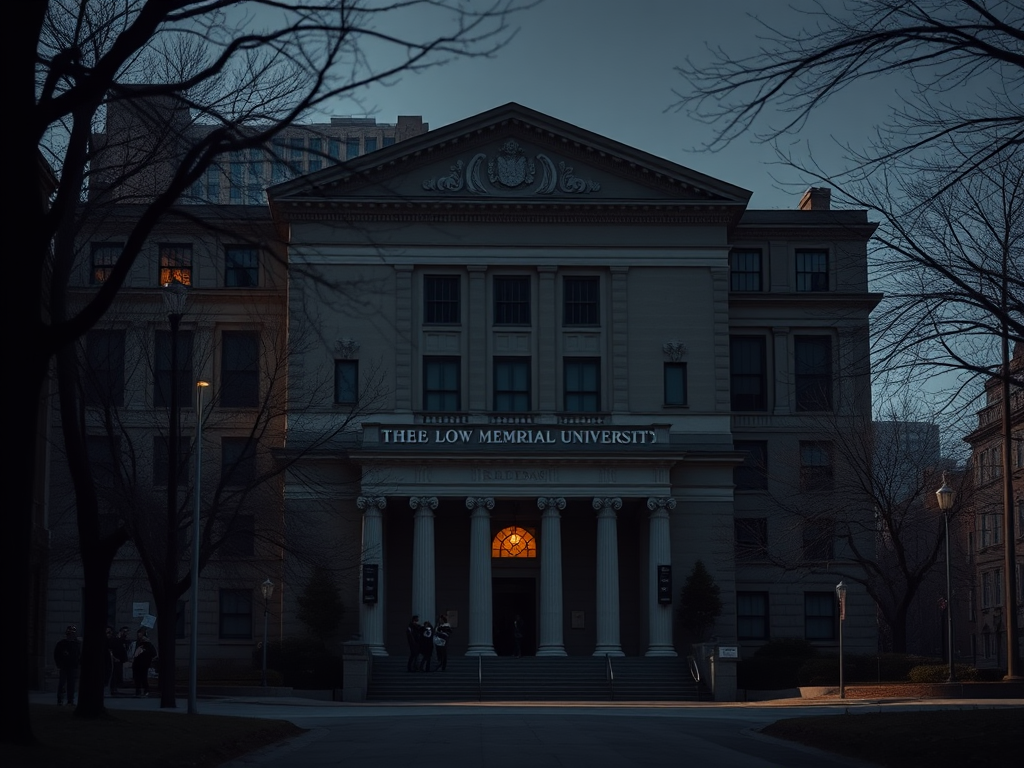

Columbia President Is Replaced as Trump Threatens University’s Funding

Columbia University faced another leadership shake-up on Friday evening as its interim president unexpectedly stepped down amid ongoing financial and political challenges. The institution has been grappling with the loss of hundreds of millions of dollars in federal funding and increasing scrutiny from the Trump administration regarding its governance.
This leadership transition occurred just a week after Columbia acquiesced to a series of demands set forth by the federal government, following the cancellation of approximately $400 million in crucial funding. The university announced that Claire Shipman, former co-chair of its board of trustees, would assume the role of acting president, replacing Dr. Katrina Armstrong. This marks Columbia’s third leadership change since August.

The university, which had already been unsettled by protests last spring and accusations that it fostered an environment of antisemitism, informed its community of the change in an email Friday night. The message expressed gratitude for Dr. Armstrong’s efforts during what it described as “a period of great uncertainty” and highlighted Ms. Shipman’s “clear understanding of the serious challenges facing our community.”
Less than a week prior, the Trump administration had signaled its approval of Dr. Armstrong’s leadership and the actions she was taking to restore federal funding. However, in a statement released on Friday, the Joint Task Force to Combat Antisemitism described her departure as “an important step toward advancing negotiations” between the government and the university.
The statement also referenced a vague but concerning development earlier in the week. This likely referred to remarks made by Dr. Armstrong during a faculty meeting the previous weekend, where she and Provost Angela Olinto reportedly downplayed the impact of Columbia’s compliance with the government’s stipulations. According to faculty members present at the meeting, some found their comments confusing. A transcript of the discussion was later leaked to both the media and the Trump administration, intensifying the controversy.
Ms. Shipman, an accomplished journalist and Columbia alumna with two degrees from the institution, is stepping into this role at a particularly turbulent time for higher education in the United States. The federal government has been tightening its grip on university funding, with multiple institutions now facing scrutiny from agencies such as the Department of Justice and the Department of Health and Human Services.

Columbia, however, has found itself at the center of these tensions. The university became a focal point for campus protests against the war in Gaza last spring, drawing criticism from one faction for allegedly permitting antisemitic behavior while others accused it of stifling academic and political discourse. The administration’s decision to withhold hundreds of millions of dollars in funding—a sum that accounts for nearly a fifth of Columbia’s annual operating budget—posed a significant financial threat. The government made it clear that reinstating these funds would be contingent on Columbia’s compliance with a set of prescribed measures.
Last week, Dr. Armstrong announced that the university had agreed to these terms. Among the changes, Columbia pledged to station 36 campus safety officers with arrest powers, a significant departure from its historically fraught relationship with law enforcement. Additionally, the institution committed to formally defining antisemitism, reassessing its admissions policies, and, most controversially, increasing oversight of its Middle Eastern, South Asian, and African Studies Department. Faculty members, particularly those concerned with academic freedom, expressed alarm at this decision.
While Columbia officials claimed that some of these measures were already under consideration before the federal mandate, the university’s compliance was met with sharp criticism both on and off campus. Other higher education leaders watched apprehensively, fearing that Columbia’s swift concession—without pursuing a legal challenge, which many believed had merit—could embolden the government to exert similar pressure on other universities.
Columbia was not alone in facing financial repercussions. Just days before the university announced its decision, the government withdrew approximately $175 million in funding from the University of Pennsylvania, citing the institution’s decision to allow a transgender woman to compete on its women’s swim team in 2022.
Dr. Armstrong’s departure was as sudden as her appointment last summer, when she stepped in following the unexpected resignation of Nemat Shafik, whose 13-month presidency had sparked international criticism. Reflecting on her tenure, David J. Greenwald, chair of the board of trustees, commended her efforts, noting that she had taken on the role during “a time of great uncertainty” and had worked tirelessly in the university’s best interest. Columbia confirmed that Dr. Armstrong would continue to serve as head of its medical center.

In a farewell email to colleagues on Friday, Dr. Armstrong described leading Columbia as “a singular honor” during such a critical period. She reaffirmed her commitment to science and medicine, stating, “My heart is with science, and my passion is with healing. That is where I can best serve this University and our community moving forward.”
The Wall Street Journal was the first to report her resignation. Just days before, Linda McMahon, the Trump administration’s education secretary, had indicated satisfaction with Dr. Armstrong’s efforts, acknowledging her responsibility to ensure campus safety and address concerns related to antisemitism. In an interview with CNN, McMahon noted that Columbia had made significant progress in a short time but stopped short of guaranteeing that federal funding would be reinstated.
Despite this, the government’s concerns over Dr. Armstrong’s commitment became apparent by Tuesday, prompting her to release a public letter reaffirming her dedication to implementing the required measures. “Any suggestion that these measures are illusory, or lack my personal support, is unequivocally false,” she wrote to the Columbia community.
Brent R. Stockwell, chair of Columbia’s biological sciences department, acknowledged the criticism but noted that many within the research community remained supportive of Dr. Armstrong, believing that securing federal funding was paramount. “She had quite a lot of support,” he said, adding that many faculty members still held onto the hope that Columbia could continue making meaningful contributions to society through its research, which necessitates federal funding.
Meanwhile, Representative Tim Walberg, a Michigan Republican and chairman of the House Committee on Education and the Workforce, emphasized that Columbia must do more to address concerns about its treatment of Jewish students and faculty. In his statement, Walberg made it clear that Ms. Shipman would be under intense scrutiny. “Ms. Shipman, while we wish you success, we will be watching closely,” he warned.
Students also expressed unease over the abrupt change in leadership. Adarsh Pachori, an engineering graduate student at Columbia, voiced his concerns about the university’s handling of these challenges. “This resignation, along with the funding withdrawal, talk of deportations, and overall government interference, is deeply frustrating,” he said while walking across campus Friday night. “It’s beginning to feel like Columbia’s administration simply caves to the demands of the U.S. government rather than standing firm on the values it claims to uphold.”




Leave a Reply