

Barcelona Becomes Ground Zero for Europe’s Housing Dilemma

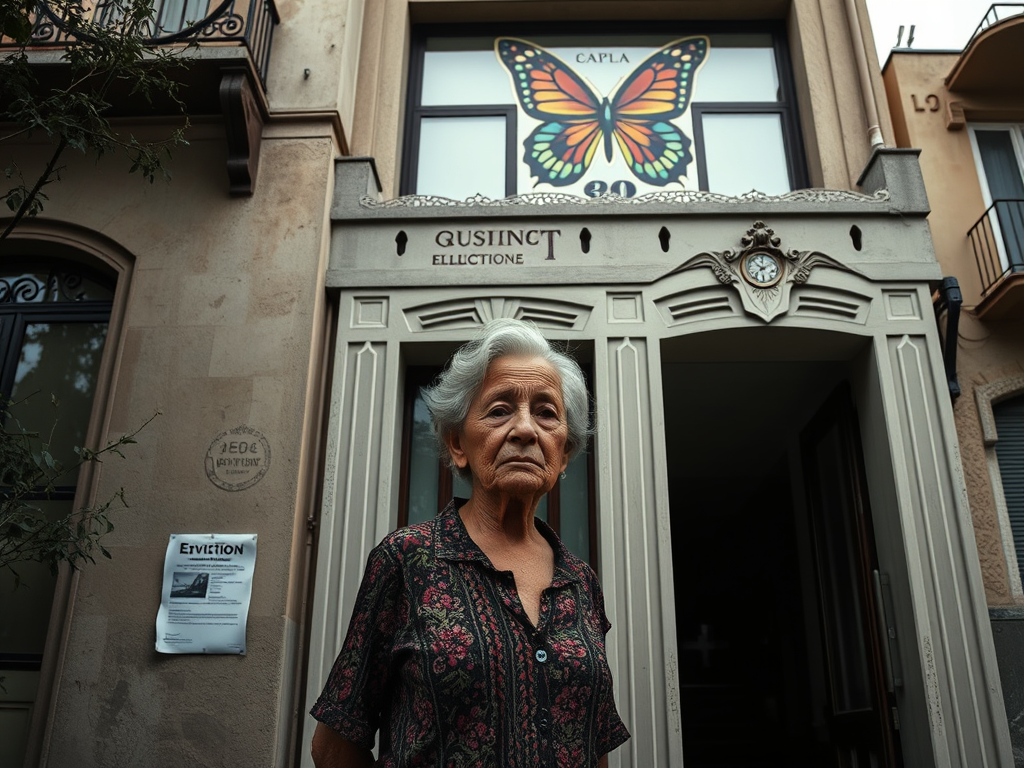
For 33 years, Marga Aguilar had never missed a single rent payment on her apartment in a striking Modernist-style building in the heart of Barcelona. The building’s owner had always treated the tenants with kindness, maintaining reasonable rental prices and fostering a sense of community among them.
However, after the owner’s recent passing, Aguilar, now 62, was hit with an unexpected and distressing reality. A Dutch investment firm swiftly acquired the property—Casa de la Papallona, named for the butterfly mosaic adorning its rooftop—with the intention of converting the apartments into highly profitable short-term rentals. Residents were abruptly served eviction notices, ordering them to vacate within a month.


“I felt my legs give way,” Aguilar recalled. Her 92-year-old father had moved in with her during the pandemic, and now they faced an uncertain future. “We have no idea where to go—we simply can’t afford to live anywhere else.”
Spain is currently grappling with an escalating housing crisis, one of the most severe in Europe. Since 2015, nearly 10% of the nation’s housing supply has been acquired by investors or transformed into tourist accommodations. The dwindling availability of homes has driven prices far beyond the reach of ordinary citizens, outpacing wage growth and making affordable housing increasingly scarce.
Nowhere is this issue more pronounced than in Barcelona, the epicenter of Spain’s housing dilemma. As summer tourism surges, the urgency to find solutions intensifies. Despite legislative efforts to curb the crisis, investors continue to exploit loopholes, leaving authorities scrambling to mitigate a problem years in the making.

“Housing should be a right, not just a commodity,” declared Salvador Illa, the president of Catalonia. “The need for action is immediate.”
Barcelona’s housing woes reflect a broader European trend: real estate has become a prime investment vehicle, with financial firms and landlords prioritizing short-term rentals over long-term, protected tenancies. Meanwhile, increasing costs and stringent regulations have hindered new construction. Additionally, much of the public housing stock—once a crucial safety net—has been sold off by governments in desperate need of funds.
This housing crisis is now a key driver of inequality across Europe. Over the past decade, rents in the EU have risen by 20%, and home prices have jumped by 50%, while incomes have failed to keep pace. By 2023, one in ten Europeans was spending at least 40% of their earnings on housing costs.
To address this growing concern, European Commission President Ursula von der Leyen recently appointed the EU’s first-ever housing commissioner, signaling a shift toward more aggressive intervention.
Recognizing the severity of the situation, Barcelona’s mayor, Jaume Collboni, has joined forces with leaders from 14 other European cities—including Amsterdam, Paris, Budapest, and Rome—to urge the EU to treat the housing crisis with the same level of urgency as the defense of Ukraine.
“Europe faces an external threat from Russian aggression,” Collboni stated in an interview from his office overlooking Plaça Sant Jaume. “But internally, we are confronting another crisis: growing inequality fueled by unaffordable housing.”

While many European cities struggle with housing shortages, Barcelona has been hit particularly hard. The city, famed for landmarks like the Sagrada Familia and La Rambla, attracts around 15 million tourists annually. In recent years, an influx of foreign workers has further strained the housing market, benefiting the local economy but exacerbating the housing crunch.
Although Spain’s Constitution enshrines the right to housing, rental prices have soared 57% since 2015, with home prices climbing 47%. Meanwhile, household incomes have increased by only 33%, according to PwC. In Barcelona alone, rents have skyrocketed by 68% over the past decade.
Collboni, a Socialist leader elected in 2023, moved swiftly to address the issue by introducing rental price caps last March. Since then, average rents have fallen by over 6%. Following a wave of mass protests demanding more affordable housing, Barcelona is set to become the first European city to revoke Airbnb licenses, requiring all short-term rental properties to be converted into long-term housing or put up for sale by 2028.
“In one decisive move, we will return 10,000 apartments to the housing market,” Collboni explained. “That means nearly 25,000 people will be able to continue living in Barcelona.”
The Catalonian government is also ramping up efforts, partnering with developers to construct 50,000 affordable housing units by 2030 and streamlining the permitting process to accelerate construction.
“When the market is this broken, intervention is necessary,” Illa emphasized.
However, housing activists argue that these measures fail to provide immediate relief. They are pressing for stronger action, urging the government to compel landlords and banks to repurpose Spain’s vast inventory of vacant homes—an estimated four million properties, including 75,000 in Barcelona—for long-term rental use.
“People are being displaced daily,” said Max Carbonell, spokesperson for the Socialist Union of Housing in Catalonia. “We have existing housing that could be used right now. Why not start there?”


In an attempt to keep residents in their homes, Barcelona’s government has also begun purchasing buildings from investors. Last year, the city spent €9 million to buy back Casa Orsola, a historic building acquired by Lioness Inversiones in 2021 for €6 million.
However, this strategy has sparked controversy. Housing advocates and tenants argue that such buybacks allow investors to profit from taxpayer money, rather than addressing the root of the problem.
Meanwhile, property owners claim that stringent regulations discourage investment and lead many landlords to leave properties vacant. “Developers, landlords, and homeowners are being villainized,” said Jesús Encinar, founder of Idealista, Spain’s largest real estate website. “That’s why we have a housing shortage.”
One legal loophole, which Collboni has labeled “a black hole,” continues to leave residents vulnerable. Under current legislation, investors can buy entire buildings and convert them into short-term rentals with leases lasting less than a year. Prime Minister Pedro Sánchez has introduced a bill to eliminate this provision, but opposition from property-rights advocates could stall its progress.
New Amsterdam Developers, the Dutch firm that acquired Casa de la Papallona, has reportedly purchased hundreds of Barcelona apartments for short-term rentals, primarily targeting business travelers who can afford premium prices. The company has declined to comment.
Elsewhere in the city, Inmobiliaria Gallardo, a developer linked to Spain’s pharmaceutical giant Almirall, exploited a temporary loophole in Catalonia’s housing laws to convert all 120 units in an 11-story building into tourist accommodations.
Maite Martín, 63, a university employee who has lived in the building for 25 years, described the rapid transformation. “One day, a few neighbors left, then more followed. Within a week, 10 apartments were empty.”


Today, a quarter of the building’s units cater to vacationers. The developer has remained silent on the matter.
“This used to be a tight-knit community of families and elderly residents,” Martín lamented. “Now, that sense of belonging is disappearing.”
She recounted an incident where she had to clean vomit off her laundry, the aftermath of a tourist party in an upstairs rental. With support from housing activists, Martín and other tenants—along with some from Casa de la Papallona—have chosen to remain in their homes as a form of protest.
In response, squatting has emerged as a grassroots movement in Spain, particularly in Barcelona, where former mayor Ada Colau rose to prominence as a housing activist. However, opposition to the movement is growing, and the Catalonian government is working to curb illegal occupations.


Amidst the turbulence, Barcelona is pushing forward with new housing developments. On a hillside overlooking the city, construction workers are erecting a five-story building on public land, part of an initiative to create energy-efficient, rent-controlled apartments.
Despite these efforts, the scale of the crisis remains daunting. “We need to find ways to move faster,” said Carles Mas, a government architect overseeing the project.
For many residents, relief cannot come soon enough.




Leave a Reply