
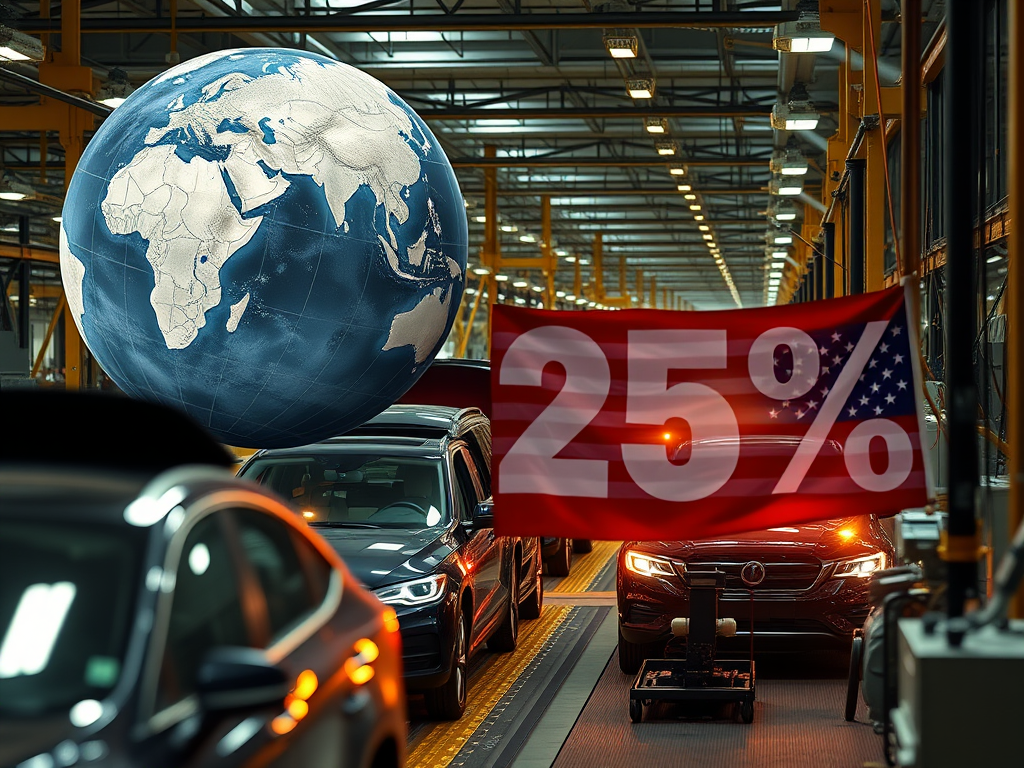

Trump Announces 25% Tariffs on Imported Cars and Car Parts

On Wednesday, President Trump announced his decision to implement a 25 percent tariff on imported cars and car parts, a policy expected to raise vehicle prices for American consumers and disrupt supply chains. This move aligns with his broader goal of strengthening U.S. manufacturing.
The tariffs, which will take effect on April 3, will apply to both fully assembled vehicles and auto parts imported for assembly at American plants. The measure will impact not only foreign manufacturers but also domestic automakers such as Ford Motor Company and General Motors, as they manufacture some vehicles in Canada and Mexico.
Currently, nearly half of all vehicles sold in the U.S. are imported, and around 60 percent of the components used in vehicles assembled domestically come from abroad. As a result, these tariffs could lead to significant price hikes at a time when inflation has already made automobiles more expensive for American buyers.
Speaking at the White House, President Trump emphasized that the tariffs would incentivize automakers and suppliers to establish manufacturing operations within the United States.
“This is great news for anyone who has production facilities in the U.S.,” he stated.
However, the automotive industry operates on a global scale, relying on trade agreements that have facilitated specialization among factories in different countries while minimizing tariffs. This is particularly true for North America, where trade policies since the 1960s have linked national auto sectors.

The largest supplier of vehicles to the U.S. is Mexico, followed by Japan, South Korea, Canada, and Germany.
Following the tariff announcement, stock markets reacted negatively, with shares of major car manufacturers declining. After-hours trading saw additional losses as the White House confirmed that the tariffs would also apply to imported car parts. General Motors stock dropped nearly 7 percent, while Ford and Stellantis each fell more than 4 percent. Tesla shares declined by 1 percent in extended trading.
While President Trump believes the tariffs will boost domestic auto production, the timeline for achieving that goal remains uncertain. While tariffs may push companies to use more American-made products and expand production, establishing new manufacturing facilities requires significant investments of time and capital.
Additionally, the increased costs associated with tariffs could have adverse economic consequences, potentially reducing profits for automakers and slowing vehicle sales.
This decision may also provoke trade conflicts with nations that export cars to the U.S., increasing the likelihood of retaliatory tariffs on American goods, including agricultural products and vehicles.
Peter Navarro, a senior trade and manufacturing advisor to the president, justified the tariffs by claiming that foreign trade practices had turned the U.S. into an assembly hub for imported parts.
“This has weakened our national security by eroding our industrial base,” Navarro asserted, criticizing countries like Germany, Japan, and South Korea for allegedly disadvantaging American automakers in international markets.

Support for the tariffs came from certain labor groups. Shawn Fain, president of the United Auto Workers union, welcomed the move, calling it a historic step toward rectifying “decades of free-trade policies that have devastated working-class communities.” He emphasized that fixing trade agreements was a critical step in ending the downward spiral in the auto industry.
However, opponents argue that the tariffs could harm both the U.S. and its trade partners.
“This will cost tens of thousands of jobs on both sides of the border and threaten North America’s leadership in the auto industry,” said Candace Laing, president of the Canadian Chamber of Commerce. “These tax increases put plants and workers at long-term risk.”
Canada’s auto manufacturing sector, which directly employs approximately 125,000 people and contributes about 10 percent of the country’s manufacturing output, could face severe consequences. With 80 to 90 percent of its automotive production being exported, primarily to the U.S., the new tariffs pose a serious threat.
Canadian Prime Minister Mark Carney denounced the tariffs as “a direct attack” on trade relations between the two nations. He warned that these long-standing economic ties were “in jeopardy” and announced plans to convene a meeting with his cabinet to determine Canada’s response.
Mexico faces similar challenges, as its automotive industry represents roughly 5 percent of its economy and employs nearly one million people. Major automakers, including General Motors, Toyota, and Stellantis, manufacture popular models such as the Chevy Silverado, Toyota Tacoma, and Jeep Compass in Mexico.
Despite the U.S.-Mexico-Canada trade agreement, the new tariffs will apply to both cars and car parts from Canada and Mexico. However, components originally produced in the U.S. but integrated into cars assembled in those countries will be exempt from tariffs.
White House officials indicated that no other exemptions would be granted, and President Trump stated that he expects the tariffs to be a permanent measure.
Given the automotive industry’s significant role in the U.S. economy, the tariffs will likely have widespread ramifications. According to the Bureau of Labor Statistics, approximately one million Americans work in auto and auto-parts manufacturing, while an additional two million are employed at dealerships. Since vehicles represent one of the most significant household purchases, the additional costs introduced by tariffs could weigh heavily on consumers.
This latest move escalates President Trump’s aggressive trade stance. Previously, he had imposed a 20 percent tariff on all Chinese imports and a 25 percent tariff on nearly all Canadian and Mexican goods before granting partial exemptions under the North American trade agreement.
More tariffs are expected next Wednesday, when Trump plans to announce “reciprocal tariffs” to counteract high trade barriers imposed by other countries on U.S. exports. He described these upcoming measures as “fair” and “gentle,” suggesting that they would be more lenient than some expect.
“People are going to be surprised,” Trump remarked.
The justification for these tariffs stems from an investigation conducted during Trump’s first term under Section 232 of the Trade Expansion Act, which concluded that automobile imports posed a national security risk. In his latest proclamation, Trump argued that these security concerns have only intensified, and previous trade negotiations had failed to produce sufficient benefits for the U.S.
The White House attempted to downplay fears that the tariffs would cause vehicle prices to skyrocket, citing Trump’s push for a new tax deduction on auto loan interest payments. However, this deduction would only apply to American-made vehicles.
Most analysts, however, foresee substantial price increases. Jonathan Smoke, chief economist at Cox Automotive, estimated that a 25 percent tariff on imports from Canada and Mexico would add about $3,000 to the cost of U.S.-assembled vehicles due to their reliance on foreign parts. Vehicles imported from those countries could see price hikes of approximately $6,000.
Smoke also projected a decline in production, with American automakers expected to manufacture 20,000 fewer cars per week, equating to a 30 percent drop in output.
“By mid-April, we anticipate disruptions across virtually all North American vehicle production,” Smoke warned. “The outcome will be reduced production, constrained supply, and rising prices.”
Automakers with significant unsold inventory, such as Ford, Hyundai, and Stellantis, might experience a short-term benefit as shortages push consumers toward existing stock. However, this effect is expected to be temporary.
Some companies are exploring production adjustments to mitigate the tariffs. Jörg Burzer, a senior executive at Mercedes-Benz, acknowledged the challenge but noted that automakers have designed factories with flexibility to shift production.
Nonetheless, completely avoiding the financial impact remains impossible. “These tariffs will undoubtedly raise costs,” Burzer admitted.
In an effort to maintain favorable relations with the Trump administration, some foreign automakers have pledged to expand U.S. production. Hyundai recently announced a $21 billion investment plan, including a new steel plant in Louisiana, while Mercedes has hinted at expanding its Alabama operations.
Despite these efforts, the long-term economic impact of the tariffs remains uncertain, with potential repercussions for both the U.S. and global auto industries.




Leave a Reply