
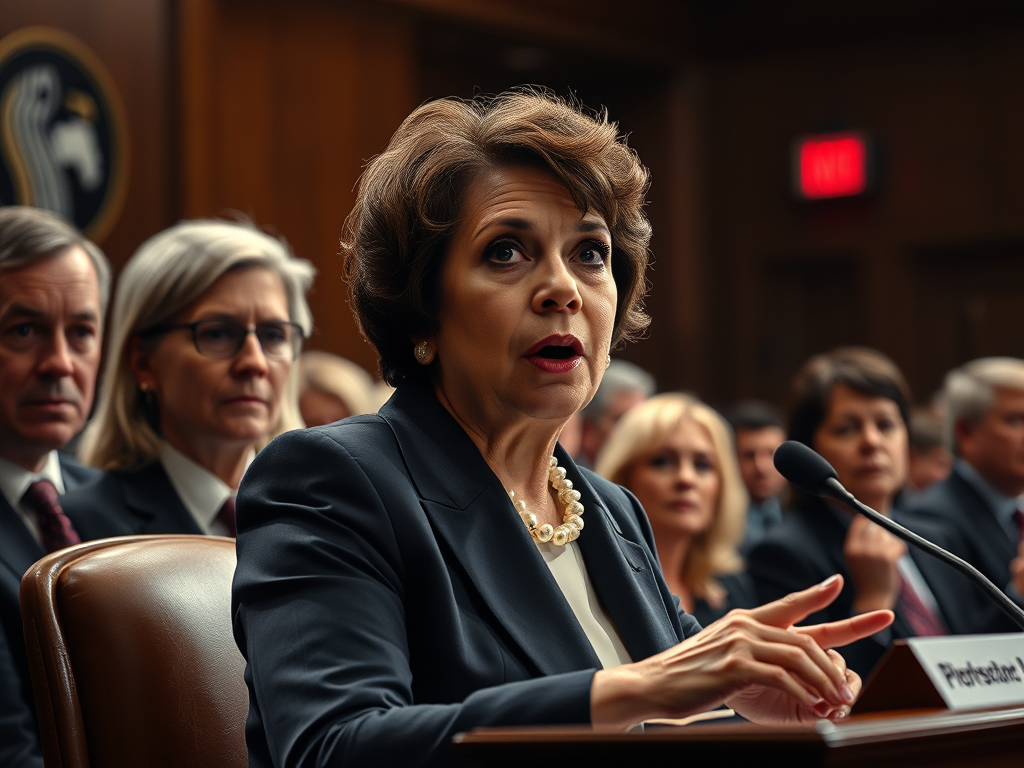

Congressional Republicans took aim at PBS and NPR on Wednesday, launching sharp criticisms against the nation’s largest public media networks in a heated hearing that underscored ongoing tensions between the Trump administration’s allies and the press.
Elmo and Elon Musk Are Cited as G.O.P. Lawmakers Grill PBS and NPR

Representative Marjorie Taylor Greene, a Republican from Georgia who led the hearing—dubbed “Anti-American Airwaves”—opened her remarks with a scathing critique of PBS and NPR. She labeled them as “radical left-wing echo chambers,” accusing them of disseminating biased news and indoctrinating children through LGBTQ-themed programming.
In response, the leaders of both PBS and NPR refuted these allegations, emphasizing that their networks serve as vital sources of accurate news and educational content for millions of Americans. While NPR’s chief executive acknowledged past social media posts critical of former President Trump before assuming her role, she expressed regret over those comments.
Democrats on the committee dismissed the hearing as a political spectacle, arguing that it was merely another attempt by Republicans to air long-standing grievances against the media. Some sought to redirect the discussion to the Trump administration, citing a recent incident in which top security officials mistakenly included The Atlantic’s editor in a group chat discussing military operations.
Representative Stephen Lynch, a Democrat from Massachusetts, ridiculed the focus of the hearing, suggesting that Republicans were more interested in targeting Big Bird than addressing serious concerns related to Trump. “If shame still existed, this hearing would be an embarrassment,” he remarked.
The hearing was part of a broader pattern of media-related confrontations by a newly established congressional subcommittee, Delivering on Government Efficiency. This event followed two months of sustained criticism of the press from the Trump administration and its supporters.

Recent actions by the administration include barring The Associated Press from certain events, selecting media outlets for the presidential press pool instead of following the traditional open approach, and attempting to dismantle the federal agency overseeing Voice of America. Additionally, the Federal Communications Commission has questioned the impartiality of major news outlets and launched an investigation into PBS and NPR.
Republican opposition to public broadcasting—and the federal funding that supports it—has persisted for decades. In 1969, Fred Rogers, host of “Mister Rogers’ Neighborhood,” famously testified before Congress to advocate against budget cuts proposed by the Nixon administration.
At Wednesday’s hearing, NPR and PBS executives defended their programming, highlighting their contributions to communities nationwide. They pointed to local journalism covering regional sports and agriculture—particularly in rural areas with few other media options—as well as beloved children’s programs such as “Clifford the Big Red Dog” and “Curious George.”
“PBS embodies American values,” said Paula Kerger, CEO of PBS.
Greene maintained an aggressive stance throughout the hearing, pressing NPR’s CEO, Katherine Maher, about her past social media activity. Before joining NPR, Maher had labeled Trump a “racist” and “sociopath” in online posts. She expressed regret over those remarks, explaining that they reflected a moment of reaction rather than a definitive characterization of the former president.
Greene also revisited claims that both NPR and PBS downplayed a story regarding Hunter Biden’s laptop during the 2020 presidential campaign. Maher, who was not leading NPR at the time, acknowledged that current editorial leadership views the handling of that story as a mistake, a sentiment she shared.

Republicans further pointed to the case of Uri Berliner, a veteran NPR business editor who argued in an essay last year that NPR had become steeped in liberal bias. The essay, published in The Free Press, fueled conservative efforts to defund NPR. Berliner later resigned but stated that while he did not support defunding NPR, he believed the network should voluntarily reduce its reliance on federal funding and openly acknowledge its progressive leanings.
The hearing oscillated between Democrats passionately defending children’s programming and Republicans issuing dire warnings about supposed public media “propaganda.” Greene even went as far as accusing public broadcasters of “grooming children” and pushing a “communist agenda.” Despite the serious accusations, there were moments of humor.
Representative Greg Casar, a Democrat from Texas, held up a sign that read, “Fire Elon, Save Elmo,” referencing Elon Musk’s role in Trump’s efforts to reduce government size. Meanwhile, Representative Robert Garcia, a California Democrat, sarcastically asked Kerger whether Elmo was a member of the Communist Party. Kerger quipped, “Well, he is a puppet. But no.”
Garcia continued in the same vein, questioning whether Bert and Ernie’s shared living arrangement was part of an “extreme homosexual agenda” and whether Cookie Monster was “silencing pro-cookie voters.”

“Cookies are a sometimes food,” Kerger replied, playing along with the humor.
Despite the levity, concerns about public media funding remained a key focus. Representative James Comer, a Republican from Kentucky, reminisced about relying on public radio for news while working on his family’s farm. However, he asserted that today’s NPR is unrecognizable compared to its past and questioned whether public media still warranted government funding, given the rise of digital news sources accessible nationwide.
The Corporation for Public Broadcasting, which oversees PBS and NPR, received $535 million in federal funds for the current fiscal year. The majority of that funding supports local public radio and TV stations, with a small portion going directly to the national organizations. Maher defended NPR’s mission, stating that it delivers “unbiased, nonpartisan, fact-based reporting” to 43 million weekly listeners. Kerger described PBS’s programming and local news coverage as integral to American communities.
A recent Pew Research Center survey revealed divided public opinion on the issue. According to the study, 43% of adults supported continued federal funding for NPR and PBS, 24% advocated for cutting funds, and 33% were unsure.
As the hearing concluded, Representative Ro Khanna, a Democrat from California, invoked Fred Rogers’ historic congressional testimony. He argued that high-quality educational programming should transcend political divisions.
“Mr. Rogers understood something that seems lost in today’s political climate,” Khanna remarked. “At a time when our country is so polarized, some things—like empathy, education, and community—are more valuable than money. And that should never be a partisan issue.”




Leave a Reply