
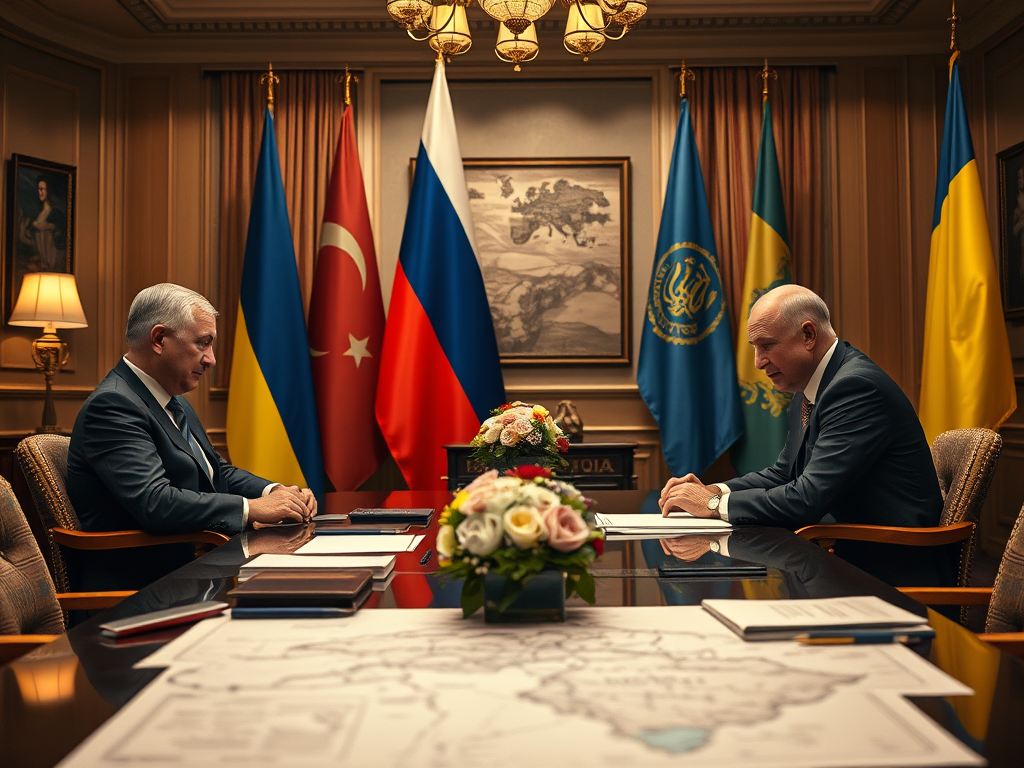

Russia and Ukraine Agree to Stop Fighting in Black Sea, White House Says

On Tuesday, the White House announced that Ukraine and Russia had reached an agreement to halt hostilities in the Black Sea and discuss the specifics of ceasing attacks on energy infrastructure. However, Ukrainian President Volodymyr Zelensky expressed skepticism, stating that it was “too early to say that it will work.” Ukraine’s defense minister, Rustem Umerov, emphasized the need for “additional technical consultations” to ensure the agreement’s implementation.
Although both nations acknowledged the agreement, which followed three days of intense negotiations in Saudi Arabia, Moscow introduced several conditions. The Kremlin specified that it would only adhere to the maritime security aspect of the deal if Western nations lifted restrictions on Russian agricultural exports—sanctions imposed following Russia’s full-scale invasion of Ukraine in 2022. The United States appeared to concede to some of Russia’s demands while securing minimal reciprocal benefits.
This agreement represents a significant step toward a ceasefire after three years of ongoing conflict, yet it falls short of a complete cessation of hostilities—an outcome the Trump administration had been advocating for. Uncertainty remains regarding the agreement’s execution and the level of commitment from both parties. Notably, a prior agreement to halt attacks on energy infrastructure resulted in mutual accusations of continued strikes.

In a statement, the White House pledged to facilitate Russia’s reintegration into the global market for agricultural and fertilizer exports, among other provisions. President Zelensky criticized this as a “weakening of positions and sanctions.” Furthermore, lifting restrictions on Russian agricultural trade would require approval from the European Union, which currently seems unlikely.
Despite these uncertainties, the White House’s willingness to accommodate Russian demands against Ukrainian objections further highlighted President Trump’s growing alignment with Russian President Vladimir Putin. Trump has long argued—without evidence—that both he and Putin were victims of political persecution during a Justice Department investigation into Russian interference in U.S. elections. Additionally, Trump has recently refrained from acknowledging Russia as the instigator of the war.
Trump administration officials have expressed interest in strengthening U.S.-Russia relations. In a summary of a recent call between Trump and Putin, officials indicated that both leaders saw potential benefits in improving ties, including “enormous economic deals and geopolitical stability when peace has been achieved.”
While the administration’s rhetoric on Russia has shifted dramatically, a U.S. intelligence report released on Tuesday still identified Russia as an “enduring potential threat to U.S. power, presence, and global interests.” The report concluded that Russia currently holds the upper hand in its invasion, providing Moscow with greater leverage to push Ukraine and its allies toward negotiations that would grant Russia the concessions it seeks.

Deep-seated mistrust remains between Russia and Ukraine. U.S. mediators held separate meetings with delegations from both sides in Riyadh, Saudi Arabia. Following these discussions, the White House issued two separate statements outlining agreements with each country regarding maritime security and energy-related attacks.
To finalize the agreement, the White House appeared to provide assurances to both sides on key concerns. In addition to Russia’s agricultural interests, the U.S. reaffirmed its support for Ukraine’s longstanding demands, including facilitating the exchange of prisoners of war, the release of civilian detainees, and the return of Ukrainian children who had been forcibly relocated.
Although these developments mark a breakthrough in U.S. efforts to negotiate a ceasefire in Ukraine, even a limited one, they do not seem to impose significant compromises on Russia. The agreement’s provisions—stopping energy strikes and securing the Black Sea—largely align with Moscow’s interests. Furthermore, Russia has signaled its intention to de-escalate on its own terms, stating that it would not honor the maritime ceasefire unless its state agricultural bank and other financial institutions involved in food trade were reconnected to the international payment system. Additionally, Russia demands the lifting of sanctions on its shipping sector, food trade, and fertilizer production.
In a separate statement on Tuesday, the Kremlin noted that Russia and the U.S. had agreed on the list of energy infrastructure sites protected under a 30-day attack moratorium. These include oil refineries, pipelines, storage facilities, nuclear plants, hydroelectric dams, and transmission infrastructure. Moscow asserted that the moratorium was in effect as of March 18, yet both sides have since accused each other of violating the agreement by continuing attacks on power grids.

Should the U.S. meet Russia’s demands, it would mark a significant shift in Western policy, easing economic pressure on Moscow and reversing efforts to isolate its financial system through sanctions. Although Putin has framed himself as open to U.S. overtures for ending the conflict, he rejected an earlier U.S.-backed proposal—accepted by Ukraine—for a comprehensive and immediate 30-day ceasefire. Putin insisted that any broader truce would require an end to Western military aid to Ukraine and a halt to Ukraine’s troop mobilization—terms that Kyiv finds entirely unacceptable, viewing them as clear evidence that Moscow seeks to prolong the war.
The viability of the partial ceasefire remains uncertain. Throughout the conflict, energy infrastructure has been a key target for both sides. Russia has persistently attacked Ukraine’s power grid, aiming to disrupt daily life and hinder Ukraine’s military operations, particularly during the winter. Conversely, Ukraine has launched repeated strikes on Russian oil facilities to weaken Moscow’s financial capacity to sustain its military campaign.
A mutual pause in attacks on energy facilities could provide strategic advantages to both sides—allowing Ukraine to repair its damaged power grid while enabling Russia to safeguard its oil infrastructure. However, Russia stands to gain more from a Black Sea ceasefire, as its naval forces have been forced into retreat due to sustained Ukrainian attacks over the past year.
Both nations rely on the Black Sea for exporting commodities. In 2022, they negotiated a deal allowing Ukraine to transport grain through the sea, but Russia later withdrew from the agreement, citing Western-imposed trade restrictions. Moscow subsequently threatened all commercial vessels heading to and from Ukraine, seeking to disrupt Kyiv’s exports. In retaliation, Ukraine launched a counteroffensive, driving Russian warships out of the western Black Sea, targeting naval infrastructure in Crimea, and securing a new trade corridor that restored grain exports to near pre-war levels.
Under the new agreement, Ukraine’s defense minister, Mr. Umerov, asserted that any movement of Russian military vessels beyond the eastern Black Sea would violate the spirit of the deal, granting Ukraine the right to act in self-defense. The White House’s statements indicated that both nations had committed to eliminating the use of force in the Black Sea. However, it remains unclear whether the agreement includes restrictions on attacks against port infrastructure. Ukrainian officials indicated that such provisions were discussed, and they have shown interest in resuming commercial activity in key port cities like Mykolaiv and Kherson, which remain impacted by ongoing hostilities.
Andrii Klymenko, head of the Black Sea Institute of Strategic Studies, expressed doubt over the enforceability of any maritime agreement. He argued that the objectives of Ukraine and Russia remain fundamentally opposed—Kyiv aims to prevent Russian strikes on its ports, while Moscow seeks to revive the 2022 grain deal, which granted Russia some control over commercial shipping in the Black Sea.
With these conflicting interests and ongoing military tensions, the sustainability of the tentative agreements remains uncertain.




Leave a Reply