

Sudan’s Military Sweeps Across Capital, Hoping to Turn the War

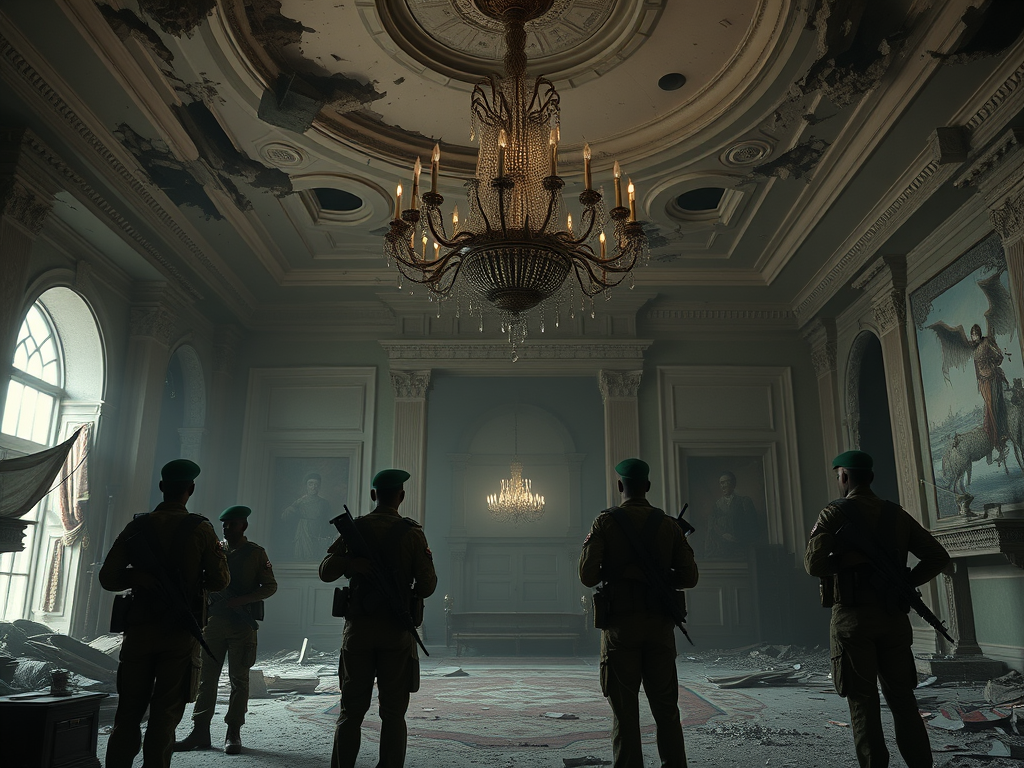
Inside the war-torn presidential palace at the heart of Sudan’s devastated capital, soldiers gathered beneath a grand chandelier on Sunday afternoon. With rifles and rocket launchers slung over their shoulders, they stood at attention, listening to their orders.
Moments later, they marched out—down a once-prestigious red carpet that had welcomed foreign dignitaries—into the abandoned city center. Their mission: to eliminate the last strongholds of resistance from the paramilitary fighters they had been battling for two years.

Since seizing the presidential palace on Friday in a brutal confrontation that claimed hundreds of lives, Sudan’s military has taken control of much of central Khartoum. This dramatic shift in power marks a pivotal moment in the country’s devastating civil war, one that could alter its trajectory.
By Sunday, the army had also secured the Central Bank, the national intelligence headquarters, and the towering Corinthia Hotel overlooking the Nile.


Journalists from The New York Times were the first Western reporters to cross the Nile into central Khartoum and visit the palace since the conflict erupted in April 2023. What we witnessed made it evident how significantly recent events had altered the war’s course—but offered little hope for a swift resolution.
“We will never surrender our country to mercenaries,” declared Mohamed Ibrahim, a special forces officer, referring to the Rapid Support Forces (R.S.F.), the paramilitary group that was once an ally of Sudan’s army but has now become its fiercest rival.
As our vehicle sped through a deserted street along the Nile—an area under R.S.F. control just days earlier—the sheer scale of the city’s destruction was stark.

Explosions had stripped trees bare. A mosque stood riddled with bullet holes. Ministry buildings and office towers—once symbols of Sudan’s oil and gold wealth—had been reduced to charred shells.
The military headquarters, where high-ranking generals had been trapped for the first 18 months of the war, had been obliterated.
Khartoum University, once a vibrant center for political discourse, had been ransacked.
The once-iconic site where tens of thousands of Sudanese citizens gathered in 2019 to oust dictator Omar Hassan al-Bashir was eerily silent. All that remained of those hopeful days were faded murals riddled with bullet holes.
Some of those same pro-democracy protesters have now taken up arms. On Sunday, they stood assembled amid the ruins of the presidential palace.
The Chinese-built palace, once a shared seat of power for Sudan’s warring military leaders, had been reduced to a crumbling shell. Dust and debris covered ministerial offices and grand state rooms. Ceilings had collapsed. Gaping holes in the walls exposed views of the Nile.
Next door, on the grounds of an older palace constructed a century ago by British colonists, soldiers rested beneath the scorched remains of a bombed-out archway.

What began as a power struggle between rival generals quickly engulfed the nation, bringing catastrophic suffering. The conflict has displaced 12 million people, killed tens of thousands, and triggered what the United Nations describes as the worst famine in decades.
Foreign powers—including the United Arab Emirates and Russia—have fueled the war by supplying arms to both sides. Many fear the conflict could spill into neighboring fragile states like South Sudan or Chad.
Efforts by the U.S. to mediate peace last year failed. Whether President Trump will take an interest remains uncertain, though some believe Sudan’s vast mineral wealth could attract his attention.
The severity of Friday’s battle was evident on the palace steps, where piles of bloodstained rubble bore witness to the carnage. As government forces closed in, R.S.F. leader Lt. Gen. Mohamed Hamdan released a video urging his fighters to hold their ground.
By the time the final assault began, at least 500 paramilitary troops remained inside, according to military officers.
Those who attempted to escape ran into deadly ambushes. A video taken half a mile from the palace, verified by The New York Times, showed dozens of bodies lying in the streets, their vehicles burned or riddled with bullets.
“This is the season for hunting mice,” the officer filming the scene remarked, dating the footage to Saturday.
On Tuti Island, at the confluence of the Blue and White Nile Rivers, R.S.F. fighters attempted to flee by boat. It remains unclear how many managed to escape.

A Sudanese military spokesperson stated that “hundreds” of paramilitary fighters had been killed, though soldiers privately admitted that their own ranks had suffered significant casualties due to R.S.F. drone strikes and combat.
Alan Boswell, director of the Horn of Africa project at the International Crisis Group, believes Sudan’s military will soon gain full control of Khartoum, forcing the R.S.F. to retreat to its stronghold in Darfur.
“It’s quite a fall from where they were in the war’s first 18 months, when they controlled most of the capital,” Boswell noted.
Despite the shift in power, few expect the war to end anytime soon. Both sides receive substantial foreign backing, with an estimated 36 million small arms now in circulation—an alarming figure for a country with a prewar population of 48 million, according to Sudan’s deputy leader, Malik Agar.
International peace efforts have collapsed, and Sudan’s military chief, Gen. Abdel Fattah al-Burhan, recently declared his preference for continued warfare over negotiations.
A fresh bloodstain marked the palace steps where an R.S.F. drone strike had killed four Sudanese state television employees and two military officers on Friday morning. As we stood there on Sunday, another drone hovered overhead, prompting soldiers to move quickly between buildings, urging us to do the same.
Col. Algoney Ali Eseil, a commander leading a unit of former pro-democracy protesters turned fighters, claimed that the R.S.F. drones were being operated from bases in Darfur and Chad by the United Arab Emirates, the R.S.F.’s main foreign sponsor. He provided no direct evidence, but previous reports by The Times indicated that the Emirates had deployed Chinese-made Wing Loong 2 drones from an airstrip in Chad, well within striking distance of Khartoum.
Sudan’s military, too, has relied heavily on foreign-supplied drones. Last year, it acquired Iranian-made drones that helped shift the battle in Khartoum, along with eight Turkish-manufactured Bayraktar TB2 drones—highly valued in African conflicts, according to U.S. officials. Documents confirming the acquisition were first reported by The Washington Post.

With central Khartoum now under army control, the battle has shifted toward the international airport, located just a mile and a half from the palace. Satellite imagery shows its runways scarred by shellfire and strewn with the wreckage of passenger planes destroyed when the fighting began in 2023.
As the transition from R.S.F. to military rule unfolds, human rights groups warn that civilians accused of aiding the rebels may face violent reprisals. In January, Sudanese forces were accused of brutal attacks against suspected R.S.F. sympathizers after reclaiming the city of Wad Madani. Volunteers from the Emergency Response Rooms—a network operating hundreds of soup kitchens in Khartoum—fear they may also be targeted.
Should the military solidify its hold on Khartoum, the war’s focus will likely shift to Darfur, where R.S.F. forces are enforcing a brutal siege on the famine-stricken city of El Fasher—the last major urban center in the region still outside their control.
On Friday, R.S.F. fighters captured Al Malha, a town 130 miles north of El Fasher. Reports indicate they are now preventing residents from fleeing, with growing accounts of arrests and killings.
As Sudan’s military consolidates its grip on the capital, the next chapter of this brutal war is already unfolding elsewhere.




Leave a Reply