
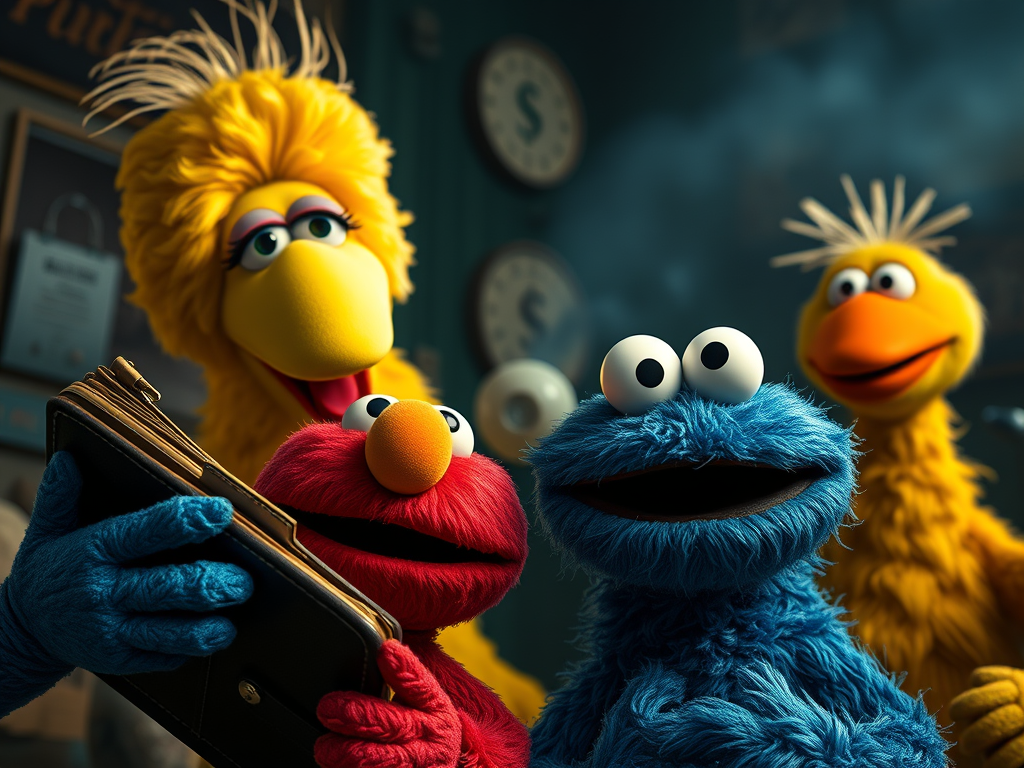

How ‘Sesame Street’ Is Adapting to Market Pressures

Sesame Workshop, the nonprofit organization behind beloved characters like Elmo, Big Bird, and Cookie Monster, is facing what executives describe as a “perfect storm” of challenges.
One major setback is the loss of its lucrative contract with HBO, which had been paying between $30 million and $35 million annually for the past decade to secure the rights to “Sesame Street.” With Hollywood tightening its budgets, no comparable deal is on the horizon.
Compounding the situation, funding cuts under the Trump administration have significantly impacted the nonprofit. Reductions in the budget of the United States Agency for International Development unexpectedly stripped Sesame Workshop of key grants. Additionally, broader attacks on public media could lead to further financial strain.
Meanwhile, “Sesame Street” is struggling to maintain its relevance in an increasingly competitive children’s entertainment market. The show ranks well behind popular programs like “Bluey” and “Cocomelon” in streaming viewership, while YouTube continues to capture a growing share of young audiences’ attention.
Faced with these mounting pressures, Sesame Workshop has found itself at a crossroads, prompting what executives describe as a necessary “reset.”
In response, the organization recently implemented significant cost-cutting measures, laying off nearly 100 employees—about 20% of its workforce. Internal documents obtained by The New York Times reveal that without these reductions, the nonprofit would be facing a nearly $40 million deficit next year. Even after the cuts, it was forced to withdraw $6 million from its investment fund—the first such move in over a decade—to cover financial shortfalls.
The turbulence surrounding “Sesame Street” is just one example of the broader transformation underway in the television industry due to the rise of streaming. Many long-established TV franchises and traditional broadcast genres are encountering similar difficulties. Recognizing the need for adaptation, Sesame Workshop has announced a reimagined format for “Sesame Street” starting next year.

Sherrie Westin, a 27-year veteran of the organization who stepped into the role of chief executive last year, acknowledged the economic challenges but expressed confidence in the nonprofit’s ability to sustain its mission.
“This is not a rejection of ‘Sesame Street,’ and the show is not disappearing,” Westin assured. “However, we have a responsibility to evolve alongside the changing world if we want to continue fulfilling our purpose.”
Since its debut in 1969, “Sesame Street” has been one of television’s longest-running programs. The organization, originally called the Children’s Television Workshop, has faced financial difficulties before. Just a decade ago, the collapse of DVD sales—a crucial revenue source—forced the nonprofit to seek alternative funding.
At that time, HBO, which had recently launched its standalone streaming service, stepped in with a lifeline, paying $30 million to $35 million annually for both new and archival episodes, according to sources familiar with the agreement. The partnership allowed “Sesame Street” to expand its episode count, with PBS continuing to air the show months after its HBO release. Though controversial, the deal proved financially beneficial, helping Sesame Workshop generate $271 million in revenue and over $20 million in profit as recently as 2022.


However, the expiration of the HBO agreement coincided with a major shift in the streaming industry. As Wall Street grew skeptical of subscriber growth at the expense of profitability, media companies significantly curtailed spending. The Peak TV era ended, leading to a steep decline in new productions and a widespread contraction across the industry.
Last year, HBO’s streaming service, Max, announced it would not renew the Sesame Workshop deal, explaining that children’s programming was no longer a core part of its strategy. Instead, Max agreed to a smaller two-year deal worth $6 million annually to stream non-exclusive library content, according to internal reports.
In April, Sesame Workshop executives began discussions with major streaming platforms in hopes of securing a new distribution deal, initially expecting an agreement within a few months. However, the realities of the post-Peak TV landscape led to multiple delays. Nearly a year later, negotiations are still ongoing with major players such as Netflix, YouTube, and Amazon Prime Video, as well as alternative platforms like Tubi, Roku, and PBS.
Even before searching for a new streaming partner, Sesame Workshop had acknowledged the need for adaptation in response to the rapidly shifting and highly competitive market.
Production on the show’s 56th season begins next month, bringing significant format changes. The traditional magazine-style structure will be replaced with three distinct segments: two 11-minute narrative episodes bookending a shorter animated feature. Additionally, the revamped series will emphasize humor, music, and animation to better engage young viewers.
Internal research by Sesame Workshop revealed that while parents continue to trust and value “Sesame Street,” children tend to gravitate toward shows like “Bluey” that deliver bigger laughs and encourage imaginative play after watching. Last year, children engaged more with franchises such as “PAW Patrol,” “Mickey Mouse Clubhouse,” “Peppa Pig,” “Baby Shark,” “Cocomelon,” and “Blippi” than with “Sesame Street.”

Further complicating matters, YouTube has become a dominant force in children’s entertainment, offering an overwhelming volume of content. Some of it is high-quality, such as the Ms. Rachel channel—recently licensed by Netflix with strong results—while much of it is not.
Despite these challenges, “Sesame Street” continues to receive praise from pediatricians and children’s media experts for its commitment to education.
“The media landscape is shifting so dramatically that even well-executed educational content like ‘Sesame Street’ may struggle against programming designed for instant gratification,” noted Dr. Michael Rich, director of the Digital Wellness Lab at Boston Children’s Hospital.
While the nonprofit grapples with financial uncertainty, the timing of the recent layoffs did not go unnoticed by staff. Many employees had been working for months to unionize Sesame Workshop’s administrative workforce, which includes education specialists, fundraisers, and legal professionals. On March 4, workers formally announced their intention to unionize with a rally outside the organization’s Midtown Manhattan headquarters.
Immediately after the demonstration, employees gathered for a staff meeting—where they learned about the layoffs.
“It was an emotional rollercoaster,” said Phoebe Gilpin, a senior director of formal learning at Sesame Workshop who was among those let go. “We went from celebrating our collective efforts to being blindsided by job cuts.”

According to David Hamer-Hodges, an organizer with the Office and Professional Employees International Union, six of the seven workers who spoke at the rally were soon informed they had been laid off.
Sesame Workshop’s spokesperson stated that the layoffs had been planned well in advance and were unrelated to the unionization efforts.
Despite the job cuts, Hamer-Hodges confirmed that the union drive would continue. However, Sesame Workshop leadership has indicated that it will not voluntarily recognize the union.
Looking ahead, CEO Sherrie Westin emphasized the nonprofit’s commitment to securing new sources of funding, including increased philanthropic support. While the revenue from any future distribution deal may not match the HBO arrangement, Westin remains optimistic that the show could become more widely accessible—either through expanded streaming platforms or a return to free broadcasting.
“I have no doubt that we will weather this challenge, and ‘Sesame Street’ will reach more children than ever before,” Westin affirmed. “Now, more than ever, the world needs ‘Sesame Street.’”
Gilpin, however, expressed concern about the broader transformation of the children’s media industry.
“‘Sesame Street’ has been a cornerstone of children’s media for generations,” she said. “But with the industry shifting so drastically, many of us are left wondering—if we are dedicated to children’s educational content, where do we go from here?”




Leave a Reply