
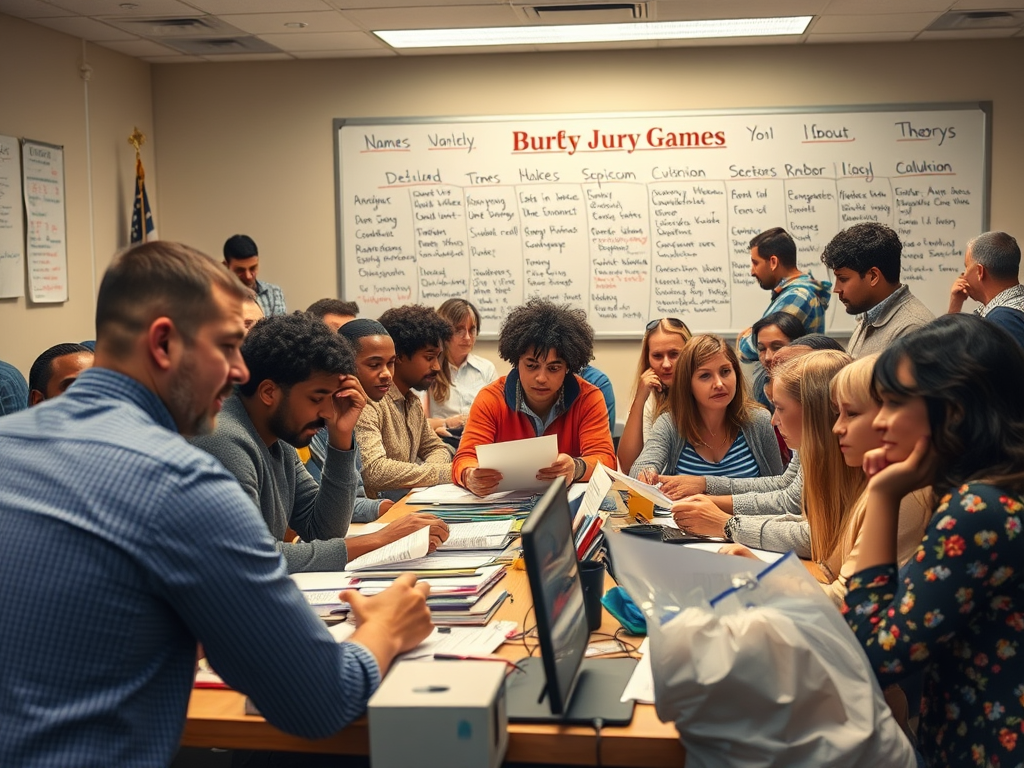

In a compact, brightly lit conference room nestled in a corner of a London office building, a dozen individuals are deeply engrossed in examining computers, printed documents, and large Ziploc bags filled with evidence. The whiteboard behind them is a chaotic yet organized web of names, notes, and theories.

This group—this jury—is deliberating on whether a man is guilty of arson and murder. In just over an hour, they will determine whether he walks free or faces decades behind bars.
However, this is no ordinary jury with real legal authority. Instead, these participants—groups of friends, couples on dates—have each paid £46.50 (approximately $60) for an evening of sifting through evidence, analyzing video testimonies, and reaching a verdict together.

This is “Jury Games,” one of several immersive theater productions that transform jury service—historically viewed as a burdensome civic duty—into an engaging form of entertainment.
Similar experiences are emerging in cities worldwide, including “The Jury Experience” in Brooklyn, Toronto, Dublin, Madrid, and other locations across North America and Europe, as well as “Murder Trial Tonight,” a touring production in the UK.


For those who dread receiving a jury summons in the mail or have crafted elaborate excuses—ranging from childcare obligations to an extreme fear of heights—this concept might seem bizarre.
Even some participants of “Jury Games” acknowledge that spending their time and money on such an experience is an unconventional choice.
“I imagine this is a lot more engaging than real jury duty,” said Alex Franco, a London resident originally from Australia. She expressed her enthusiasm for serving on a real jury someday but admitted, “If I actually get summoned, I’ll probably think, ‘This sucks.’”
Eric J. Parker, a Boston-based attorney and consultant for the legal drama series Accused, was initially baffled by the idea of jury-themed entertainment.

“What happened to a classic American date night?” he joked. “What’s next? You and your partner getting audited just for the experience?”
On the other hand, London-based lawyer and television legal consultant Jeanette Ashmole sees the appeal. These experiences allow participants to unravel the complexities of a case without the weight of real-life consequences.
“If you love true crime documentaries, this is like stepping into one,” she said. “Who wouldn’t want that?”
Joe Ball, one of the creators of “Jury Games,” attributes its success to the enduring cultural fascination with jury duty. The production, which originally began on Zoom during the pandemic, has resonated with audiences, bolstered by courtroom dramas like Juror #2, directed by Clint Eastwood, and the 2023 hit series Jury Duty, a hybrid reality sitcom featuring an unsuspecting participant on a fabricated jury.
Ball cites the 1957 classic 12 Angry Men as a key inspiration. “People who attend ‘Jury Games’ get to be one of the 12 angry men,” he said.
The familiarity of jury duty in pop culture also makes it easy for participants to immerse themselves in the experience.
“Everyone knows what a jury does,” added Tom Black, another co-founder of the show.
Despite its premise, “Jury Games” diverges from actual courtroom proceedings.
The atmosphere is much lighter than a real trial, where a person’s freedom is at stake. Nervous laughter ripples through the room as the group learns about the case—a man accused of setting an office building ablaze after hours, while someone inside, identified as a cleaner (or was he really?), perished in the fire.
As the night unfolds, the story expands into a larger conspiracy involving a government cover-up and a romantic subplot. Unlike real jurors, participants can question the defendant—portrayed by actor Jack Flammiger—via video link. Drinks from the downstairs bar and cellphone use are also permitted.

At just over an hour, the experience is far shorter than most real trials, which can drag on for weeks or months. Here, entertainment takes precedence over absolute realism.
“These aren’t real trials,” Ashmole said. “But at the end of the day, if they were truly authentic, no one would buy tickets.”
Many participants arrive as strangers, and initial hesitation is common. However, enthusiasm builds quickly, turning the event into an engaging social experience.
“I worry when a group is too quiet,” admitted Brendan O’Rourke, an actor who plays the role of court coordinator, ensuring the jury stays on track. “But by the end, everyone is hooked.”
At the conclusion of each session, after reaching a verdict, the participants learn the actual outcome of the case. On a recent Thursday evening in London, 12 individuals stepped out into the crisp winter air, satisfied that they had made the right call.
It was the kind of satisfying resolution that real jurors can only wish for.




Leave a Reply