
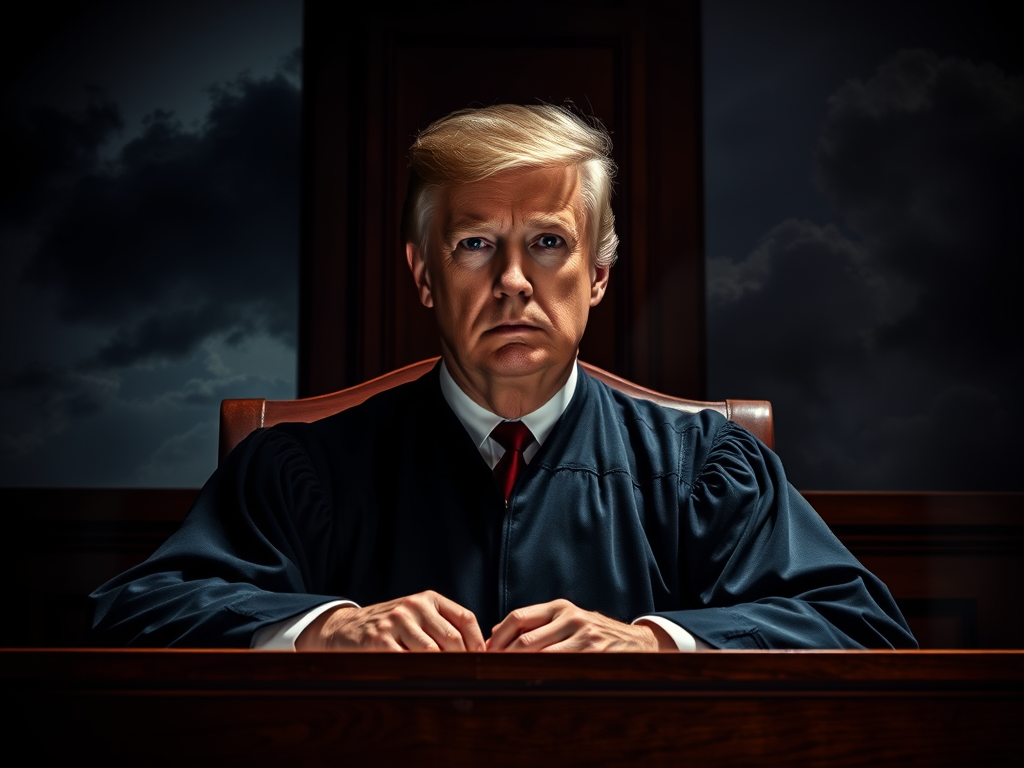

Judges Fear for Their Safety Amid a Wave of Threats

On Tuesday, former President Trump called for the impeachment of a federal judge who ruled against his administration’s deportation flights, sparking an immediate wave of social media backlash. This included taunts and even threats, with some users sharing images depicting judges being led away in handcuffs.
The call came at a particularly tense moment. Just nine days earlier, police in Charleston, S.C., were dispatched to the home of Supreme Court Justice Amy Coney Barrett’s sister following a threat that a pipe bomb had been placed in her mailbox. The threat claimed that the device would detonate upon the next opening of the mailbox.
Though the bomb turned out to be a hoax, judges report that threats and intimidation targeting them and their families have become all too real. With the judiciary currently handling critical cases concerning Trump administration policies, concerns are growing that the risk of violence against judges is escalating.
“This feels like a game of Russian roulette with our lives,” said Judge Esther Salas of the U.S. District Court for the District of New Jersey, whose son was tragically shot and killed in 2020 by an anti-feminist extremist.
“This is not an exaggeration,” she emphasized. “I am pleading with our leaders to understand that lives are at risk.”
While these threats have not always escalated to physical violence, they appear to be increasing. Trump, his advisers, and his supporters have been openly questioning the legitimacy of the U.S. legal system on an almost daily basis. There is no evidence that these hostilities have influenced judicial rulings, but they could shape public perception of the courts’ decisions.
Intimidation tactics have varied widely—from bomb threats and swatting incidents to more subtle yet unsettling acts, such as anonymous pizza deliveries to judges’ homes. While seemingly harmless, these pranks send a chilling message.
“They know where you live, where your family lives,” said a judge overseeing litigation against the Trump administration, who requested anonymity due to security concerns after receiving an unexpected pizza delivery.
On the same day police responded to Justice Barrett’s sister’s home, the U.S. Marshals Service in New York issued an alert: federal judges were being targeted with anonymous Domino’s pizza deliveries. Officials confirmed that Justice Barrett’s family members were among the recipients.
“This new form of harassment has been observed in multiple districts across the country,” the bulletin stated.

Judges appointed by both Republican and Democratic presidents have been targeted, but a pattern has emerged—many of the threats are directed at those presiding over lawsuits against the Trump administration.
“We believe these incidents are connected to high-profile cases that have attracted widespread media attention and public scrutiny,” the Marshals Service noted regarding the pizza deliveries.
Judge John C. Coughenour of the U.S. District Court for the Western District of Washington, who blocked the Trump administration’s efforts to eliminate birthright citizenship for children of noncitizens, revealed that he was the target of a swatting attack. Law enforcement officers were falsely tipped off about an armed intruder at his residence. Shortly after, a hoax bomb threat was reported to the FBI concerning his mailbox.
Similarly, when Judge John J. McConnell Jr. of Rhode Island halted an attempt by the Trump administration to withhold $3 trillion in federal funding from states, his courthouse received an influx of messages, some of which were flagged for review by the Marshals Service.
Threats against judges are not new. In June 2022, an armed man, Nicholas John Roske, was arrested near Justice Brett M. Kavanaugh’s home after traveling from California with the intent to kill him. His trial is set for June.
However, members of the federal judiciary warn that these dangers are intensifying, both online and in real life.
Earlier this month, two Republican-appointed appellate judges, Jeffrey S. Sutton and Richard J. Sullivan, voiced concerns about judicial safety following a Judicial Conference meeting, the federal judiciary’s policy-making body.

“Criticism is expected—it comes with the job,” said Judge Sutton, chief judge of the Sixth Circuit. “But when criticism escalates into threats, it becomes an attack on judicial independence.”
Trump’s social media post on Tuesday went beyond merely calling for the impeachment of District Judge James Boasberg. He labeled the judge, who had temporarily blocked the administration’s deportation of Venezuelan immigrants, a “Radical Left Lunatic, a troublemaker, and an agitator.”
This provoked an unusual public rebuke from Chief Justice John G. Roberts Jr., who responded, “Impeachment is not an appropriate response to disagreement with a judicial decision.”
By that time, however, Trump’s supporters had already acted on his rhetoric. On social media, pseudonymous accounts branded judges as “traitors” and “lawless.” Some referred to Judge Boasberg as a “terrorist-loving judge,” while another suggested he should be detained at Guantanamo Bay for 20 years.
Far-right activist Laura Loomer, a close Trump ally, directed her 1.5 million online followers’ attention toward Judge Boasberg’s daughter. “His family is a national security threat,” she wrote.
This echoed a previous instance where billionaire Elon Musk, an advisor to Trump and owner of the social media platform X, amplified a post by Loomer that purportedly revealed personal details from the LinkedIn profile of Judge McConnell’s daughter.
Despite growing concerns, some judges remain skeptical about whether threats have actually increased. Judge James C. Ho, a conservative appellate judge appointed by Trump, argued that the alarm over judicial threats might be politically motivated.
“Judges have faced hateful attacks for years,” he said, pointing to threats against conservative judges such as Matthew Kacsmaryk in Texas and Aileen Cannon in Florida. “Defending judicial independence only when it aligns with your preferred outcomes is not protecting the judiciary—it’s politicizing it.”
Data from the U.S. Marshals Service, which provides security for judges, indicates that the number of investigated threats against federal judges, prosecutors, and court personnel has declined over the past two years, dropping from 1,362 in 2022 to 822 in 2024. However, the Marshals Service has not disclosed statistics for 2025.
Despite this, Chief Justice Roberts, in his year-end report on the judiciary, issued a grave warning about a “significant increase” in threats. He cited internal data showing that hostile communications directed at judges had more than tripled over the past decade.
“The judges I speak to are more concerned than they were four, eight, or twelve years ago,” said Gabe Roth of Fix the Court, a judicial transparency advocacy group.

Legal experts caution that targeting individual judges over their rulings poses a severe risk—not just to the judges themselves but to the integrity of the judicial system.
“You don’t need a mob storming the courthouse,” said Jeremy Fogel, a retired federal judge and judicial ethics expert at UC Berkeley. “All it takes is one person acting on these threats.”
Beyond the immediate danger, threats to impeach judges over their decisions suggest that it is acceptable to ignore court rulings and bypass the legal appeals process.
“The judiciary has no power over the sword or the purse,” said Judge Marjorie Rendell of the Third Circuit Court of Appeals. “We rely on respect. And once that respect erodes—who knows what happens next?”
Judge Coughenour, who had previously faced threats during the trials of the Montana Freemen militia in 1999 and an Al Qaeda terrorist in 2001, said he had learned to brush off personal threats.
“I’ve been doing this for so long that these things don’t faze me,” he remarked.
However, he admitted that calls from Congress to impeach him over his rulings were unprecedented.
“I’ve never seen anything like this before,” he said.
A Supreme Court spokeswoman declined to comment on security matters. Justice Barrett did not respond to requests for comment. Law enforcement officials in Louisiana confirmed they had received reports concerning the home addresses of Justice Barrett’s family members and had referred the incidents to federal authorities.




Leave a Reply