
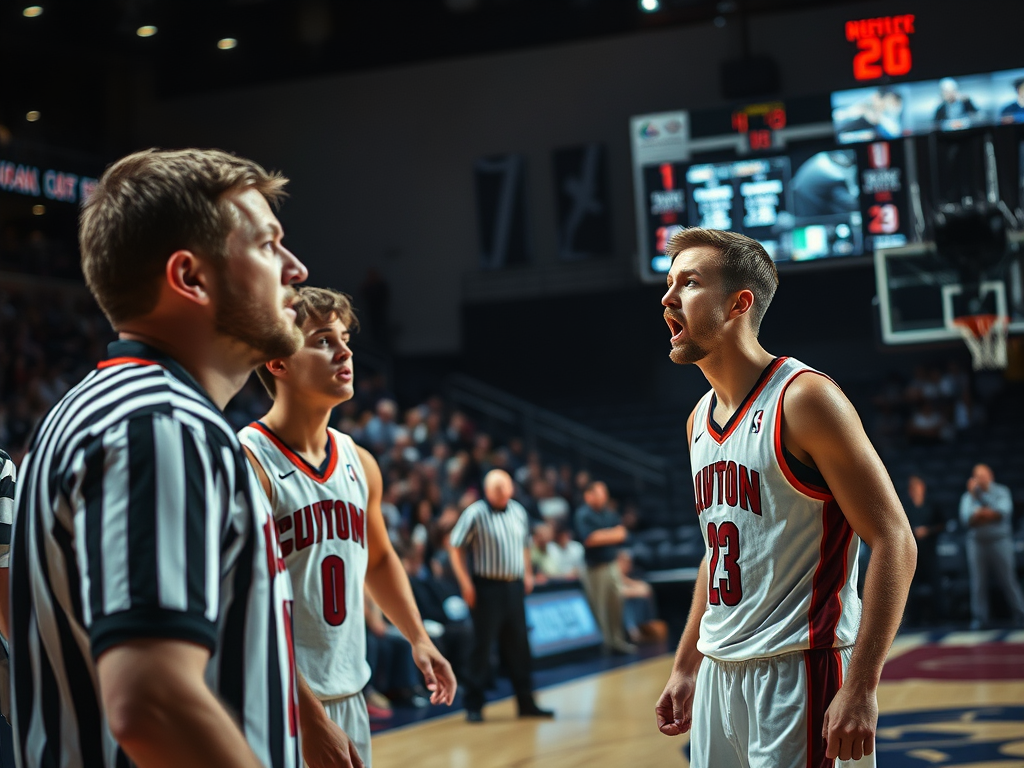

College basketball will fix its replay review woes — if the coaches don’t screw it up

It was fitting that the final moments of men’s college basketball before the NCAA Tournament bracket appeared on Sunday were spent watching Michigan’s victory over Wisconsin in the Big Ten tournament final—a game that ended in an unnecessarily drawn-out, grinding, and frustrating manner.
Out-of-bounds call—review. Another out-of-bounds call—review. Yet another out-of-bounds call—review. One of these was so blatantly obvious that a review wasn’t needed, yet in today’s college basketball, everything gets scrutinized. That’s not necessarily by choice—it’s the directive officials are given. But the result is a game experience that suffers needlessly. The last 77 seconds of Michigan vs. Wisconsin took a staggering 15 minutes to conclude.
This has become a recurring theme in college basketball—one that dominates discussions far too often. The NCAA Tournament is supposed to be a celebration, from the bracket reveal to the final net-cutting moment. But if you’re like me, you’ve probably also thought about how prolonged TV timeouts (30 seconds), extended halftimes (five minutes), and endless reviews contribute to games that already feel like they drag on forever.
“If you’re constantly prioritizing officiating accuracy through instant replay, you risk seriously undermining the very essence of the game,” said Garth Glissman, SEC associate commissioner.
Fortunately, there’s hope for change next season. A proposed challenge system, modeled after the NBA’s, is on the table—assuming NCAA rule makers recognize that this solution, put forth by Glissman and the SEC, is the best option. The biggest hurdle? Coaches who fear too many calls might end up being incorrect.

That fear, however, is shortsighted. Mistakes in officiating are inevitable, just like errors in every other aspect of basketball. The game thrived long before instant replay was introduced, and now, it’s being suffocated by it. Save challenges for blatant misses in critical moments—both teams play under the same conditions.
Fans, much like in the NBA, will reap the benefits of this change. And that should be a priority.
Sounds simple, right? But that doesn’t guarantee coaches will embrace it. A high-major head coach once told me that accuracy is the only thing that matters—game flow be damned. Glissman acknowledges that resistance is expected.
“The coaches, broadly speaking, don’t have concerns about the issue you’re raising,” said Karl Hicks, chair of the NCAA Men’s Basketball Rules Committee. “Their primary concern is getting the calls right.”
This committee, composed of administrators and coaches, will convene in May in Indianapolis to discuss rule modifications for the upcoming season. The NCAA changes its rules every other year, allowing time for thorough testing. Any proposed changes will go to the Playing Rules Oversight Panel for final approval. If reason prevails, officials next season won’t be pressured to review every trivial call, nor will they feel compelled to rush to the monitor in the final minutes of every game.
This issue was on full display during Vanderbilt vs. Texas A&M on February 26, when the last two minutes of game time stretched into 36 minutes of real time. The Big Ten wasn’t the only conference experiencing this slowdown.
“People don’t always acknowledge that Texas A&M was fouling repeatedly late in that game,” said Mike Eades, the SEC’s coordinator of men’s basketball officials. “They kept fouling, again and again. But yes, referees want to make the right calls, and they’re following the rules as written. Some officials have a different feel for the game, but in general, they’re reviewing for the right reasons.”
Eades has a point—basketball games often slow down in the final minutes due to strategic fouls and excessive timeouts. But those elements have always been part of the sport. They don’t explain why, according to a study by Ken Pomeroy, the average game length has increased by nearly six minutes over the past five years, reaching 2 hours and 4 minutes in 2025.
Another widely discussed idea to speed up the game is shifting from two halves to four quarters, as seen in most levels of basketball worldwide. This would reset the foul count each quarter (five fouls for the bonus) instead of the current seven fouls per half, which sometimes results in 15 minutes of free throws to close out a game.
The simplest and most effective solution, however, is implementing a challenge system—immediately. The NIT, owned by the NCAA, is already experimenting with this. Under its system, officials can no longer review out-of-bounds calls in the last two minutes unless a coach challenges. If the challenge fails, the team loses a timeout. If out of timeouts, a technical foul is assessed.
Glissman calls this system “well-intentioned” but prefers a set number of challenges for the entire game. His expertise in this area is extensive—before joining the SEC, he was vice president of basketball operations for the NBA and played a key role in drafting the challenge rule that became permanent in 2020.
In the years before that, Glissman said, the NBA looked much like college basketball does now—with constant complaints from both sidelines demanding reviews. The NBA’s solution—allowing one challenge per game, with a second awarded if the first is successful—has proven effective. However, Glissman proposes that the college version should exclude foul calls from being challenged.
“Some NBA coaches, focused purely on competition, argued that every call must be correct,” Glissman said. “But that argument ignores history—basketball flourished long before instant replay existed. The current replay system wasn’t handed down by some higher power; it was created by people in recent years, and like any man-made system, it should evolve.”
Perfection in officiating is unattainable—just as it is for players and coaches. Hopefully, as college basketball takes center stage for the next three weeks, those in charge will recognize that sometimes, the best decision is to step back. The last thing this sport needs is for its games to be dragged out even longer.




Leave a Reply