
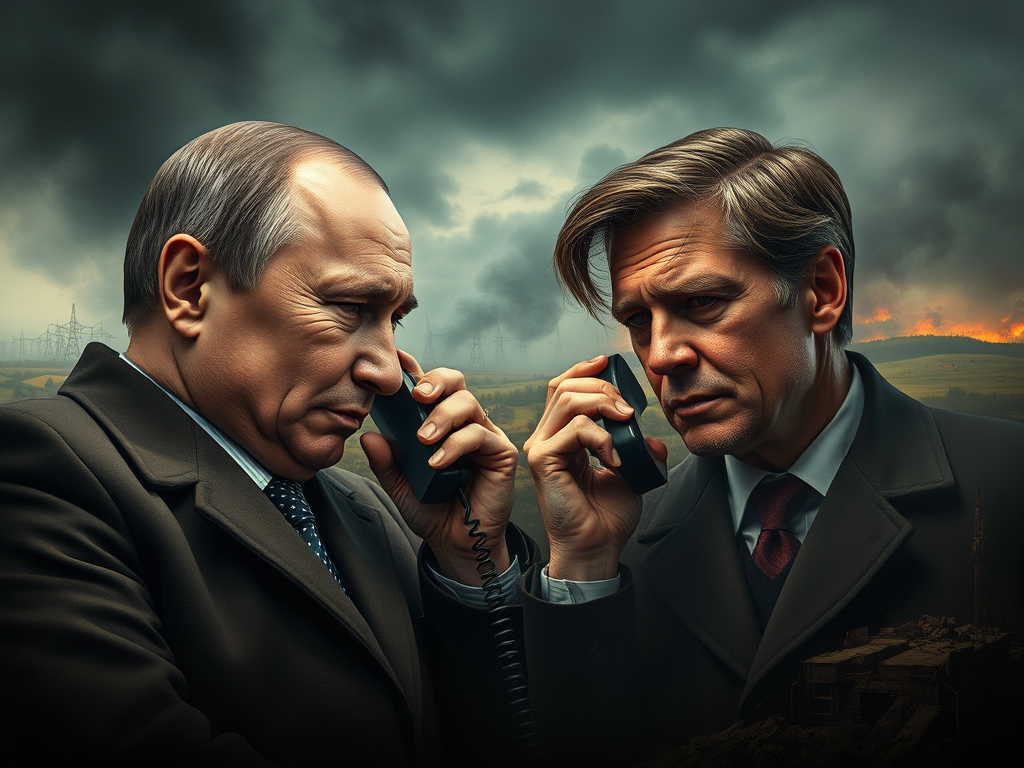

Putin Agrees to Limits on Energy Targets but Not Full Ukraine Cease-Fire

Russian President Vladimir V. Putin agreed on Tuesday, for the first time, to a partial cease-fire that would halt strikes on energy infrastructure—provided Ukraine does the same—the Kremlin announced in a statement.
However, during a two-and-a-half-hour phone conversation with President Trump, Putin declined to commit to a broader 30-day cessation of hostilities, which had been proposed by both U.S. and Ukrainian officials. As a result, attacks on Ukrainian civilians, cities, and ports will persist as both sides continue to battle for territorial gains and leverage in negotiations.
If both nations adhere to the pause in strikes on energy facilities, it would mark the first mutually agreed halt to attacks in the three-year conflict—an outcome the White House framed as an initial step toward a larger peace agreement. Yet, privately, some administration officials expressed skepticism, believing Putin’s move was a strategic delay tactic, allowing him to appear engaged in diplomacy while continuing to press his military advantage.
A cease-fire targeting energy infrastructure would not only aid Ukraine—whose power grid has suffered repeated Russian attacks—but would also bring relief to Moscow. Ukraine has carried out deep strikes on Russian oil and gas facilities, threatening a vital source of revenue for the Kremlin.
Ukrainian President Volodymyr Zelensky stated that he was awaiting a call from Trump to discuss the details of his conversation with Putin. He indicated his openness to an agreement to halt strikes on energy infrastructure, provided Russia also complies.
“Through U.S. mediation, Russia and Ukraine can reach an understanding not to target energy facilities,” Zelensky told Ukraine’s public broadcaster, Suspilne, on Tuesday night. “We are willing to support this. But if Russia continues attacking our energy sector, we will not stand by idly. We will respond.”
Later, Zelensky asserted that Putin had effectively dismissed the proposal for a full cease-fire and accused Russia of continuing its assaults, including a drone attack on a hospital in the northeastern city of Sumy—an allegation that could not be independently verified.

The diverging accounts of the call between the U.S. and Russia underscored the ongoing divide. According to the Kremlin, Putin emphasized that a lasting peace would require an end to all foreign military and intelligence support for Kyiv.
In essence, Putin was demanding the complete cessation of the military aid that the U.S. and its allies have supplied to Ukraine for the past three years. While both Trump and Vice President JD Vance have been critical of the billions spent on the war, the White House omitted any mention of this in its carefully worded summary of the discussion. Meanwhile, European nations have pledged even greater assistance to Ukraine.
Additionally, the White House did not comment on any discussions regarding the fate of the territories Russia has seized, including approximately 20% of Ukraine’s land—starting with the illegal annexation of Crimea in 2014.
The call’s outcome fell short of Trump’s expectations, despite his recent optimistic statements that peace was within reach. Even as Trump projected confidence—going so far as to post an exclamation-filled message on social media—no date was set for a meeting between the two leaders, nor was a formal statement issued outlining shared principles to end the war.
Still, there were some gestures of goodwill. The Kremlin stated that Russia would release 23 gravely wounded Ukrainian soldiers and would proceed with a prisoner exchange later this month, with each side swapping 175 captives.
The negotiations followed a recent, highly publicized rift between Trump and Zelensky, which worked to Putin’s advantage. Earlier this month, the Trump administration had briefly halted military and intelligence aid to Ukraine after a tense Oval Office confrontation between the two leaders. The suspension was lifted after U.S. and Ukrainian officials met in Saudi Arabia and agreed on a proposed 30-day cease-fire, which the Trump administration then presented to Moscow.

Eager to maintain the Kremlin’s improving ties with Washington, Putin acknowledged that the proposal was “correct” and supported it in principle. However, he then laid out conditions that were widely recognized as unacceptable to Kyiv.
During Tuesday’s call, Putin reiterated these concerns, according to the Kremlin. He stressed the need for “effective control” to implement a cease-fire along the extensive front line and insisted that Ukraine must suspend its mobilization of troops and halt military rearmament—terms that Kyiv has categorically rejected.
On Sunday night, Trump suggested to reporters that the conversation would largely focus on territorial concessions to Russia and control over nuclear power plants—indicating he intended to discuss the fate of the Zaporizhzhia nuclear facility, Europe’s largest, which remains under Russian occupation.
However, neither the White House nor the Kremlin referenced discussions on territorial divisions or the power plant in their official summaries of the call.
While Washington and Moscow had agreed last month to restore normal diplomatic operations after years of tit-for-tat expulsions and closures, and mid-level officials from both sides had met to discuss the issue in February, this topic also went unmentioned in their respective statements.
The White House, in its statement and a separate Truth Social post by Trump, announced that Putin had agreed to cease strikes on “energy and infrastructure.” However, the Kremlin’s statement was more narrowly phrased, referring only to “energy infrastructure.” It remained unclear how the cease-fire, if implemented, would be enforced.
According to the Kremlin, the two leaders also discussed broader normalization of U.S.-Russia relations and explored potential economic cooperation, particularly in the energy sector. In an unexpected addition, Putin proposed a series of hockey tournaments between American and Russian professional players—an idea Trump agreed to, the Kremlin reported.
By steering clear of details—particularly regarding potential land concessions that Trump and Putin might pressure Zelensky to accept—the Trump administration appeared to be maintaining maximum flexibility in negotiations. At the same time, this omission may have been intended to avoid another open dispute with Zelensky.
Senior Ukrainian officials have drawn three firm red lines for negotiations: Kyiv will never recognize Russian sovereignty over occupied territories, agree to neutral status, or accept reductions to its military. Additionally, Ukraine has insisted on securing security guarantees as part of any settlement. France and Britain have proposed sending troops as peacekeepers or a deterrent force, but Moscow has outright rejected the idea. Military experts have also questioned whether such a force would be viable without U.S. backing.
Speaking to reporters on Saturday, Zelensky reaffirmed that Ukraine would never recognize Russian control over occupied land “under any circumstances.” He acknowledged that Russia would insist on demands that Kyiv cannot accept. Last November, however, he admitted that not all lost territory could be reclaimed militarily and suggested that some areas might remain under de facto Russian control after a settlement.
The White House, in its statement, emphasized discussions beyond Ukraine, stating that Trump and Putin had explored “potential cooperation” in the Middle East and stressed the importance of preventing the proliferation of strategic weapons. The sole remaining nuclear arms limitation treaty between the U.S. and Russia is set to expire next February, and negotiations for a replacement have yet to begin. In his first term, Trump had refused to enter a new arms control deal without China’s participation—an idea Beijing has consistently rejected while expanding its nuclear arsenal.
For Trump, securing a cease-fire in Ukraine represents the first step in a broader effort to normalize relations with Russia—a strategy at odds with most NATO allies, who continue to push for sanctions, containment of Moscow, and sustained support for Ukraine.
Ukrainian officials, however, remain wary, accusing Putin of using negotiations as a stalling tactic to maintain leverage while continuing attacks on Ukrainian cities.
According to the White House, Trump and Putin agreed to initiate “technical negotiations” aimed at securing a broader cease-fire in the Black Sea—where Russian naval operations have been severely hindered—as well as talks on a full cease-fire and a permanent peace settlement. The discussions, the statement added, would “begin immediately in the Middle East.”




Leave a Reply