
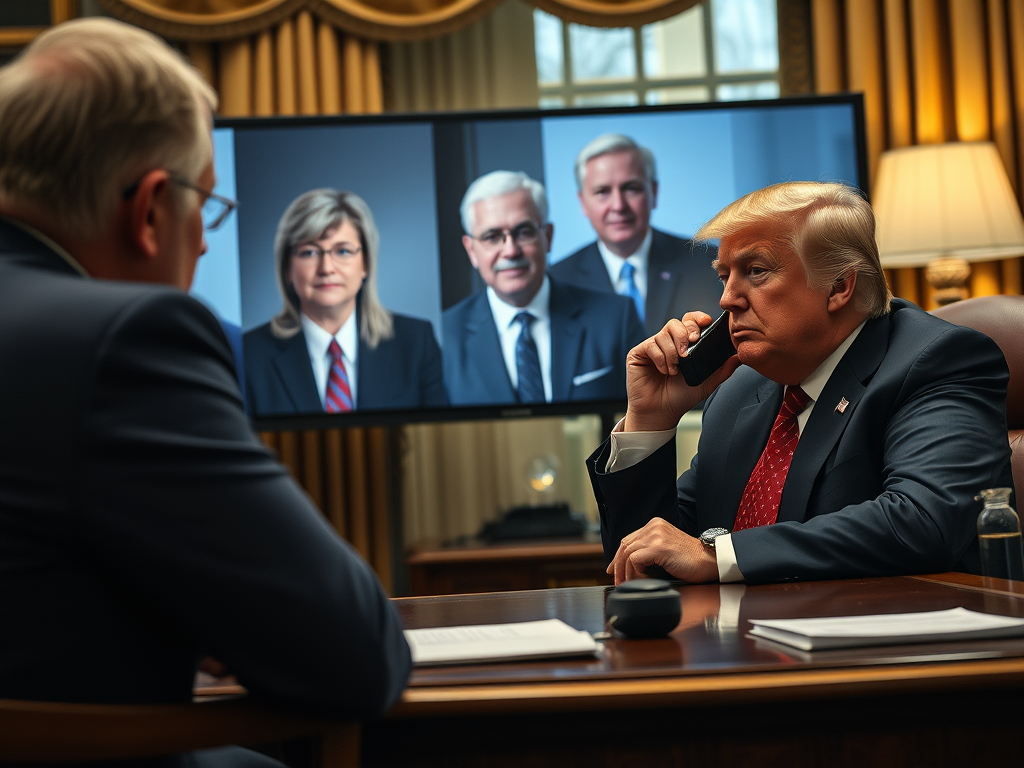

Trump’s Unwelcome News to Auto Chiefs: Buckle Up for What’s to Come

During a phone call from the Oval Office, President Trump delivered unwelcome news to three of the most influential figures in the American auto industry: Mary Barra of General Motors, John Elkann of Stellantis, and Jim Farley of Ford.
“Everyone needs to brace themselves,” Trump stated during the early March call. “Tariffs are taking effect on April 2. It’s time to get on board.”
Like leaders in other sectors, the auto executives had been pushing back against Trump’s 25 percent tariffs on cars imported from Canada and Mexico, arguing they would wreak havoc on supply chains and severely disrupt the industry. Their efforts had secured a temporary concession—a one-month delay, pushing implementation to April 2.
But now, it was clear to the heads of the Big Three automakers that there was no room for further negotiation. They had obtained as much leeway as they were going to get.
For corporate America—including some of Trump’s key donors—the reality of his second term was sinking in: He genuinely believed what he had been saying for decades. In his view, foreign nations had been exploiting the United States, and tariffs were the ultimate solution. When Trump declared that “tariff” was the most beautiful word in the dictionary, he meant it.
To him, tariffs were not just a bargaining tool; they were a means to “make America rich again.” They also served two of his favorite presidential powers: unilateral authority to impose or lift them at will and the ability to force powerful figures to plead for exemptions.

This account is based on conversations with over a dozen Trump administration officials and individuals familiar with White House discussions on tariffs. They requested anonymity to speak candidly about private deliberations.
Within corporate circles—where consultants are hired at great expense to decode Trump’s intentions—many had reassured themselves that he viewed tariffs primarily as leverage. It wasn’t that Trump loved tariffs, they reasoned, but that he valued the negotiating power they provided.
For years, the prevailing belief was that the stock market would act as Trump’s primary restraint, ensuring that any sharp declines would curb his tariff ambitions. During his first term, tariffs were applied more selectively.
But Trump 47 has shown no such hesitation. Despite a declining stock market—where the Dow Jones Industrial Average has dropped over 600 points since the tariffs took effect, and the S&P 500 has slipped into correction territory—he remains undeterred.
In his first term, Trump had been more cautious about the economic fallout from a narrower set of tariffs, which affected over $300 billion in goods. Now, in less than two months, he has imposed tariffs on nearly $1 trillion worth of imports.
While recent polls suggest growing discontent with Trump’s handling of the economy, his advisers insist that dissatisfaction stems more from lingering inflation than from tariffs.
One Trump adviser, speaking anonymously, said Biden’s presidency convinced Trump that the stock market is not an infallible measure of economic health or voter sentiment. “If it were, Biden—who presided over a booming market—would still be president,” the adviser explained.
Trump’s advisers also believe that foreign leaders are closely watching whether he follows through on his tariff threats, scanning for signs of weakness. They say he views backing down as a blow to his strongman persona.

At times, Trump has granted limited exemptions—such as waiving tariffs for certain Canadian and Mexican products that align with his North American trade deal. However, he has repeatedly signaled that even broader tariffs are coming.
Business leaders are now scrambling to reassess the assumptions that guided their expectations after Election Day.
Bill Reinsch, a senior adviser at the Center for Strategic and International Studies and a former Commerce Department official, noted that Trump had been explicit about his intentions during the campaign. “He was clear,” Reinsch said. “I just don’t think people took him seriously.”
It’s understandable why they miscalculated.
Ahead of the 2024 election, Trump’s new economic advisers sent reassuring signals to Wall Street, suggesting his second-term trade policy would mirror his first. In September, Howard Lutnick—now the commerce secretary—described tariffs as a “bargaining chip” leading to freer markets. Scott Bessent, Trump’s new treasury secretary, wrote to clients last year that tariffs would remain a tool of negotiation but would rarely be implemented.
While Trump could still scale back some tariffs, his closest advisers have seen no indication of a change in course. He has repeatedly declared that even more extensive tariffs will take effect on April 2. His aides have conveyed the same message to foreign officials and business leaders, reinforcing that he is unwavering in his stance. Two individuals with direct knowledge of private discussions confirmed that Trump’s comments in Oval Office meetings align with his public rhetoric.
Trump personally drafts or dictates his Truth Social posts, escalating tariff threats as China, Canada, and the European Union retaliate. Even some former aides who disagree with his hardline approach concede that he raises legitimate concerns about unfair trade practices by China and Europe.

According to his aides, Trump believes his pressure tactics have already yielded results, citing Mexico’s efforts to curb illegal immigration and fentanyl trafficking into the U.S. Despite Mexico’s cooperation, Trump still imposed a 25 percent tariff before pausing its application on select items.
One key difference between Trump’s first and second terms is his confidence in his instincts. He has surrounded himself with advisers who reinforce his views, leaving little room for internal dissent.
During his first presidency, Trump faced significant opposition to tariffs from officials who warned of rising costs for consumers and businesses. His team included figures he derisively called “globalists,” such as former Treasury Secretary Steven Mnuchin and economic adviser Gary Cohn, who actively worked to block tariffs—sometimes even removing paperwork from Trump’s desk. Others, like Larry Kudlow, were more diplomatic but still skeptical of protectionism.
Peter Navarro, Trump’s hardline trade adviser, used to have heated arguments with these so-called globalists in the Oval Office. Now, in his second term, such debates have shifted from whether tariffs should be used at all to how they should be implemented.

Bessent, formerly a hedge fund executive, and Lutnick, once CEO of Wall Street firm Cantor Fitzgerald, had both voiced support for tariffs before securing their roles in the administration. Whether they hold private reservations, no one is sitting across from Trump at the Resolute Desk making a forceful case against his economic agenda. Discussions within his team now revolve around messaging, timing, and exemptions—not whether tariffs should be used.
Similarly, there is little pushback from Capitol Hill. Republican lawmakers either support protectionism or hesitate to challenge Trump publicly. The Wall Street Journal editorial board remains one of the few right-leaning institutions openly critical of his trade policies.
Lutnick, who also oversees the U.S. trade office, fields numerous calls from frustrated business leaders, alongside White House Chief of Staff Susie Wiles and Agriculture Secretary Brooke Rollins.
On the evening of March 13, Lutnick, Bessent, National Economic Council Director Kevin Hassett, and others met at the Naval Observatory with Vice President JD Vance. The discussion centered on creating a unified economic message amid concerns from allies about inconsistent rhetoric, according to four individuals briefed on the meeting.
White House officials declined to comment.
However, in a statement provided by the administration, Navarro described Trump’s approach to tariffs…




Leave a Reply