

Ryan Gomes lost a friend to cardiac arrest. How the NBA vet responded is still saving lives

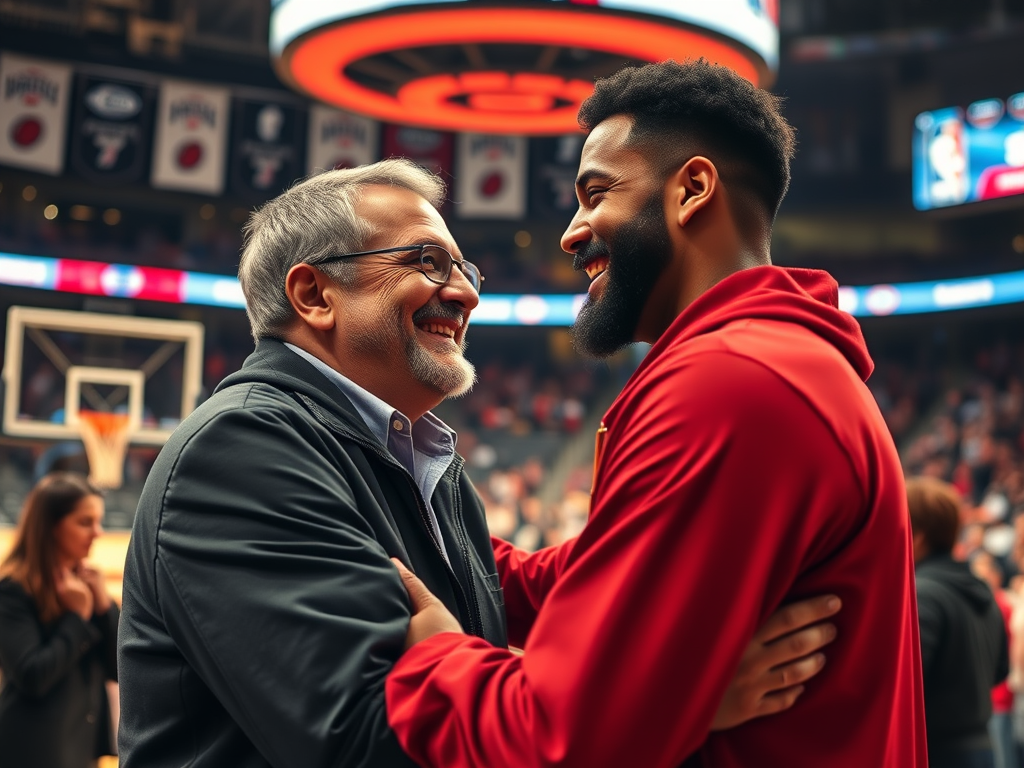
PORTLAND, Ore. — When the Portland Trail Blazers visited Utah on February 24, a meaningful reunion took place after the game. Danny Berger, a 34-year-old former Utah State basketball player, had the chance to reconnect with Ryan Gomes, a former NBA player who now serves as an assistant coach for the Blazers.
Their paths had first crossed years ago in Connecticut at a charity golf event organized by Gomes. However, this meeting carried a much deeper significance. Accompanying Berger were his wife, Taylor, and their two young children—2 ½-year-old Logan and 3-month-old Avery.
Had it not been for Gomes, Berger might not have been standing there that day. There would have been no reunion, no marriage, no family. In all likelihood, Berger would have lost his life on a basketball court in 2012.
“The older I get, the more I realize just how much I owe to him,” Berger said. “I have a wife, kids, and a second chance at life. Words alone aren’t enough to express my gratitude.”
Back on December 4, 2012, Berger—standing 6-foot-7—was wrapping up a Utah State practice session ahead of their matchup against BYU.
“It was the very end of practice, and we were running through BYU’s plays,” he recalled. “I got scored on, and that’s the last thing I remember.”
Without warning, Berger went into sudden cardiac arrest.
Just three months earlier, Utah State had been one of 12 Division I schools to respond to an email from Gomes, who had offered to donate an automated external defibrillator (AED). Gomes, an eight-year NBA veteran, had become an advocate for AEDs after a personal tragedy in 2006. That year, Stanley Myers, an 18-year-old athlete who had played on the same AAU team as Gomes, collapsed while jogging at Morgan State University due to sudden cardiac arrest.
At the time of Myers’ death, Gomes was in his second season with the Boston Celtics and was just beginning to establish his charitable foundation. Determined to take action, he committed to donating an AED to every NBA city. By 2012, having played for the Minnesota Timberwolves and LA Clippers, he extended his efforts to colleges, reaching out to Division I programs to see if they needed an AED. Utah State was one of the schools that responded.
When Berger collapsed, his teammates rushed to retrieve the AED that had only been installed three months prior.

Many people played a role in saving Berger that day—the teammates who sprinted to grab the device, the Utah State athletic trainers who administered it, and the emergency medical responders who airlifted him to Salt Lake City. But Berger insists that without Gomes’ donation, he wouldn’t be alive today.
Gomes refers to Berger as “a save” and knows of at least three people whose lives have been spared thanks to the AEDs he has donated. He still vividly remembers the moment he received the call confirming that Berger had survived.
“You know these devices save lives, but when you get that call—when someone tells you, ‘He’s going to be okay’—it really hits differently,” Gomes said. “It’s still an incredibly emotional experience for me.”
During their postgame conversation in Utah, Berger expressed his gratitude, telling Gomes how often he thinks about him.
“Hearing him say that made me step back and reflect,” said Gomes, now 42. “It was overwhelming to realize that I had helped someone continue living. That kind of moment stays with you.”
Gomes still remembers the shock of returning to his hometown of Waterbury, Connecticut, in 2006 after an encouraging rookie season with the Celtics—he had played 61 games, averaging 7.6 points and 4.9 rebounds—only to be devastated by the news of Myers’ passing.
“I’ll never forget the heartbreak and how crushed our community was,” he said. “No one expected something like that to happen to a young, healthy athlete. He was just out for a run.”

The tragedy filled Gomes with a mix of emotions—fear, as he had often pushed himself to exhaustion during workouts, and frustration that there had been no life-saving equipment available for Myers. More than anything, though, he felt an obligation to make a difference.
“It really struck me,” Gomes said. “My NBA career was taking off, and I realized I had the platform to do something meaningful. I wanted to raise awareness and take action.”
Determined, he began researching sudden cardiac arrest and the critical role of AEDs. Initially, his goal was simple: donate one AED in Myers’ honor. Unsure of where to start, he reached out to Rachel Moyer, a leading advocate for AED accessibility.
Moyer had lost her son, Greg, in 2000 when he collapsed in the locker room at halftime of his first varsity basketball game. Paramedics took 42 minutes to arrive, and when they did, they didn’t have an AED. Another ambulance arrived 10 minutes later with the device—but it was too late.
“That night, I truly felt that if Greg had to leave us, he left us with a mission—to get AEDs everywhere,” Moyer said.
When she met Gomes in 2006, they began working together, sharing a vision: Gomes wanted an AED in every NBA city, while Moyer aimed to place them in schools, police vehicles, and restaurants.
She had never put a headstone on her son’s grave.
“We made a promise—we wouldn’t place a headstone until there was an AED in every school in this country,” said Moyer, who now works with the American Heart Association.
Since then, Gomes has made it his mission. With Moyer’s guidance and support, he has donated 110 AEDs over the past two decades through his foundation, Hoops for Heart Health.
Following his NBA career, which concluded with Oklahoma City in 2014, Gomes played overseas for two years before transitioning into coaching. He led Overtime Elite for two seasons and was an assistant coach for the Long Island Nets in the G League. Now in his second year as a player development coach with Portland, he remains committed to his cause.
Often, Gomes covers the full cost of an AED—approximately $2,000—though some organizations contribute what they can. Recently, he donated a device to Philly Got Game, a nonprofit that hosts basketball leagues for high school and college players. In the coming weeks, he plans to donate another in New York City before the Knicks game on March 30, as well as two more in Portland.
From YMCAs to Boys & Girls Clubs, from schools to restaurants, his donations span across communities.
“I always say AEDs are like car insurance—you hope you never need it, but you’ll be thankful it’s there,” Gomes said.
For Berger, moments of reflection come often.
“There are random times throughout the week when it just hits me—how lucky I am,” he said. “The survival rate for out-of-hospital cardiac arrest is about 8 percent, and I made it. It could have easily gone the other way, so I never stop feeling grateful.”
After taking a year off, Berger returned to the court, finishing his collegiate career at BYU-Hawaii before playing professionally in Germany for two years. Throughout his journey, he remained in contact with the doctor who implanted his defibrillator the day of his collapse. Though he had majored in business administration, the experience led him toward the medical field. When the same doctor informed him of a job opening at a medical device company in Salt Lake City, Berger knew it was the right path.
Today, he works as the territory manager for the company’s cardiac rhythm division.
“After what happened, I knew I wanted to work in this space—it changed my life,” Berger said. “What once felt like a tragedy became a blessing. I found a career I never even knew existed.”
That’s why the meeting after the Blazers-Jazz game on February 24 wasn’t just a routine conversation—it was a heartfelt thank-you.
“People ask me, ‘What do you even say to him?’” Berger shared. “I tell them, I try to thank him, but he’s not looking for that. He’s doing it for the bigger picture. But I remind him—because sometimes, when you’re working in a foundation, it can feel like your efforts aren’t making a difference. I’m living proof that they do.”
For Gomes, praise isn’t the goal. His focus remains on the next place in need.
“When you have the chance to change lives, you have to act,” he said. “For me, it’s always about helping the next person.”




Leave a Reply