
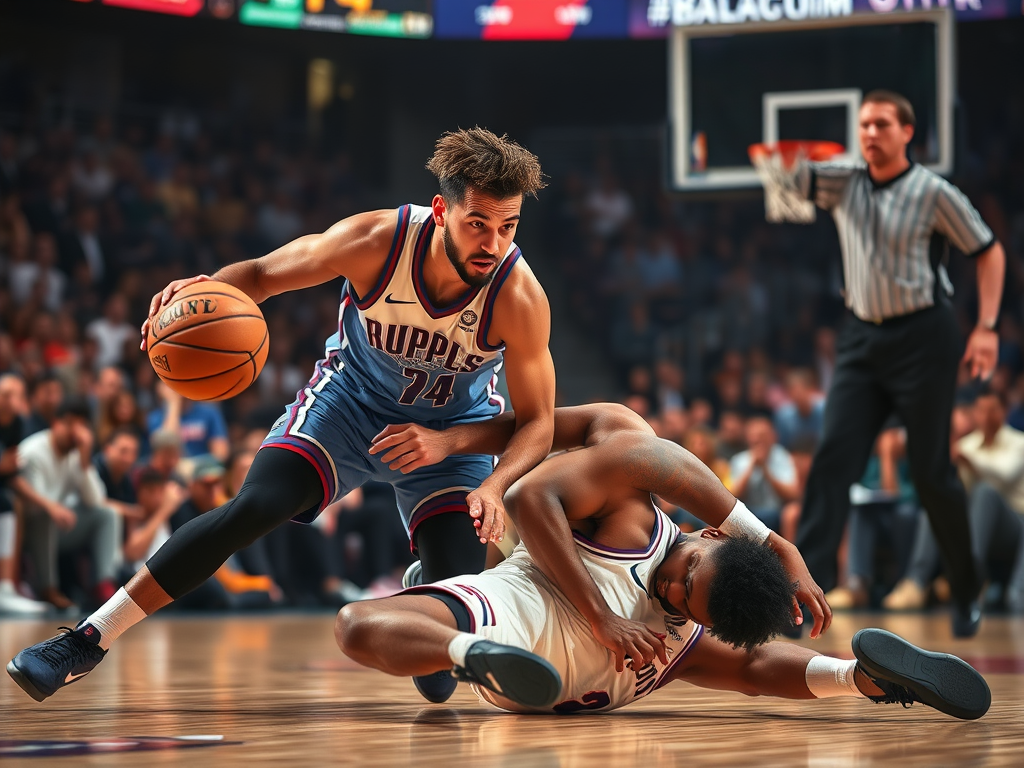

What happened to NBA flopping violations? Why calls are down and what the league wants

A recurring scene played out repeatedly during last spring’s electrifying Western Conference semifinal between the Dallas Mavericks and the Oklahoma City Thunder.
The pattern was predictable: Luka Dončić would drive into contact with Luguentz Dort, Dort would hit the floor, and Dončić would immediately turn to the officials, demanding a technical foul for flopping. Sometimes, he’d clasp his hands together in the official signal for a technical. Other times, he’d mimic the motion for a flopping violation, pressing his palm flat to the floor and lifting it repeatedly. On one occasion, he and Kyrie Irving even managed to synchronize their appeals (see the second clip below).
Regardless of the specific gesture, Dončić’s message was clear—he believed Dort deserved a flopping technical.
Interestingly, Dort was never penalized for flopping during that series, despite being among the few players actually whistled for it earlier in the season. (To be fair, Dončić wasn’t entirely innocent of embellishing contact either.)
However, the fact that Dort avoided a flopping call, even in moments where fans might argue he was guilty, doesn’t mean the officials got it wrong.
With another playoff season approaching—potentially featuring another showdown between these two players—it’s worth revisiting the NBA’s flopping rules. Specifically, we should examine why in-game flopping calls and postgame fines have nearly disappeared this season.
To start, the definition of “flopping” from an officiating standpoint is slightly different from the casual way fans use the term to describe exaggerated foul-drawing tactics.

Simply falling after minor contact—whether by Dort, Marcus Smart, or another defender—doesn’t automatically warrant a technical foul. The NBA is not interested in making hyper-detailed distinctions; instead, the goal is to eliminate the most blatant examples of deception.
To that end, before the 2023-24 season, the NBA implemented two ways to penalize flopping: an in-game, non-unsportsmanlike technical foul and a $2,000 fine for missed violations caught after the fact. (This fine replaced the previous postgame flopping penalty.)
Initially, the league enforced these rules strictly. In the first week of the 2023-24 season, officials issued eight flopping fines, with 22 handed out by midseason. However, enforcement tapered off significantly after February 1, with only four fines recorded in the second half of the season. (Surprisingly, the only player fined more than once last season wasn’t Dort, Dončić, Smart, or Dillon Brooks—it was Collin Sexton.)
By the 2024-25 season, flopping fines had become nearly nonexistent. Only five had been issued all year, and only the most blatant infractions warranted action from Joe Dumars’ office. (These fines, by the way, are made in collaboration with the league’s officiating department.)
Technical fouls for flopping followed a similar, albeit less drastic, trend. They surged during the first two weeks of 2023-24 before leveling off for the remainder of the season. Dort received three such calls, though two were later rescinded, while Smart and Brooks were each penalized twice. Even San Antonio’s Blake Wesley was hit with a flopping tech in Game 81.
From the outset, the NBA intended for flopping calls to be rare, not a tool to punish every instance of minimal contact. The league’s overarching objective was to curb the most egregious displays of theatrics.
To achieve this, the NBA established a clear standard for what constitutes a technical-worthy flop. The criteria are summed up in the acronym “STEM”—Secondary, Theatrical, and Exaggerated Movements.
Monty McCutchen, the NBA’s senior vice president overseeing referee development and training, explained:
“STEM means there’s initial contact, followed by a reaction, a pause, and then another exaggerated reaction—the ‘secondary’ aspect. Then, there’s the ‘theatrical’ and ‘exaggerated’ components. Key indicators include: multiple rollovers, an excessive distance covered compared to the actual contact, or a reaction that’s disproportionate to the force applied. If those elements are present, the movement should be penalized as a flopping violation.”
Zach Collins provides a perfect example of this in action.
A couple of factors have contributed to the decline in enforcement. First, the NBA prefers to err on the side of caution when calling flopping violations. Incorrectly penalizing a player for a non-existent flop is seen as a greater officiating mistake than failing to call an actual flop.
Second, enforcing flopping rules requires referees to track a player’s actions even after the ball has moved elsewhere—something that isn’t always the highest priority in real-time game management.
As a result, by the spring of 2024, flopping technicals were already scarce, and by the 2024-25 season, they had become virtually extinct. But there’s another factor at play: the players themselves.
As we see every October, NBA players are incredibly quick to adjust to rule changes and points of emphasis.
Atlanta Hawks coach Quin Snyder put it this way:
“It depends on whether you think the referees stopped calling flopping or the players stopped doing it. NBA players are incredibly smart and adapt quickly. If they sense that officials are calling games a certain way on a given night, they adjust accordingly. I think it’s good that the league has focused on minimizing flopping.”
To ensure clarity, the NBA has released two instructional videos since the start of 2024—one in January and another in late February—highlighting how flopping is officiated.

For those short on time, the final clip in the second video is particularly relevant. Just because a player meets the common definition of “flopping” doesn’t necessarily mean they should be penalized. Falling to the floor isn’t an issue—unless it turns into a dramatic performance.
Take, for example, a play involving the Philadelphia 76ers’ Paul George. He absorbed light contact from the Denver Nuggets’ Christian Braun and fell, trying to sell a charge. The referee wasn’t convinced, but George wasn’t called for a flopping tech either—because his movements didn’t meet the STEM criteria.
The flip side of having so few flopping calls is that when they do happen, they spark even more frustration among players and coaches.
Oklahoma City Thunder coach Mark Daigneault described it bluntly:
“It’s a ceremonial rule. When Dort got a flop against Boston in the third quarter of a 1-point game, and then another against Dallas 12 days later, we checked the numbers. At that time, only 10 flops had been called all season … so you’d have to watch nearly a hundred games to see one.”
Those two calls on Dort within a short span illustrated both sides of the issue. The first, against Boston on January 5, likely shouldn’t have been called based on the league’s stated standard.
The second, on January 17, while not as exaggerated as Collins’ earlier example, did seem to meet the STEM criteria. Eight months later, the Mavericks finally got the whistle they had been demanding.
Daigneault summed up the frustration well:
“What I want is consistency. If the NBA says this is the rule and it’s going to be enforced, then enforce it so we know what to expect. It’s difficult for us to adapt when a rule is introduced but then fades away.
“I don’t care what the rule is, but if you put it in place and say this is a flop, then call it on everyone.”

This brings us back to the bigger question: Are referees still watching for flopping as closely as they were in October 2023? And has the reduction in enforcement allowed more egregious flops to creep back into the game?
From the league’s perspective, the answer is no.
“We’ve drastically reduced both technicals and fines,” McCutchen said. “There’s no internal directive to back off. If referees miss a call, we review it and show them what should have been caught.
“One of our key markers is whether flopping is making a comeback due to fewer calls. Right now, we’re very happy with where things stand.”
Still, from an outside perspective, this whole situation feels somewhat unsatisfying. We’ve all witnessed obvious flops that don’t quite fit the STEM criteria, yet they remain unpunished. But we…




Leave a Reply