

They Had an Answer to Their City’s Decline. Then Came the Immigration Crackdown.

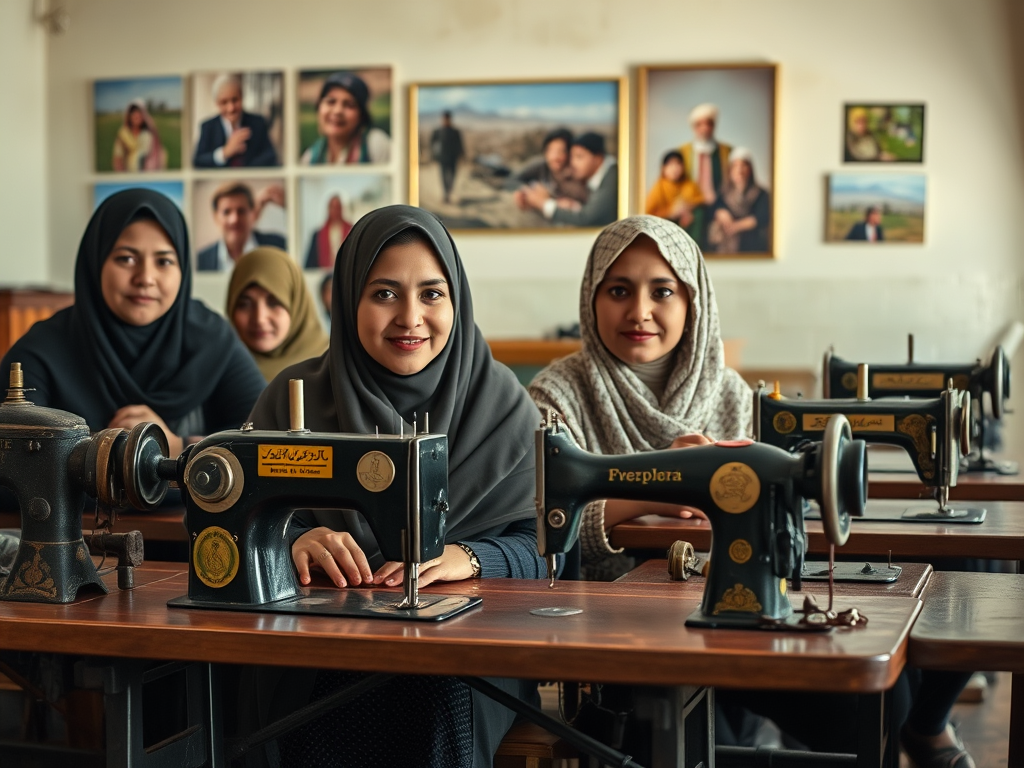
The walls are adorned with photographs of Afghanistan, the homeland from which most of the students have recently arrived. Before the lessons begin, a few women wearing sneakers and headscarves step into a separate room for prayer, while their young children play in a well-equipped room nearby. When they return, they take their places at old sewing machines, learning how to establish small businesses from home as they adjust to life in a new country.
For 20-year-old Halima Osmani, the Afghan Community Center—founded just two years ago—has been a crucial support system since she arrived from Afghanistan last summer with her parents and seven siblings. She now operates her own tailoring business, selling garments to local women via Instagram, all while working towards her G.E.D. Looking ahead, she hopes to become a physician assistant, believing St. Louis is a promising place to pursue her dreams.
“We originally planned to settle in Virginia, but we ended up here and grew to like it,” Ms. Osmani said through a translator, as she is still learning English. “The first thing we noticed was how uncrowded it was.”
That lack of congestion is both a challenge and an opportunity for St. Louis, a city that has experienced a steady population decline for decades. In response, local politicians, business leaders, religious groups, and philanthropists have embraced immigration as a strategy to reverse this trend. Their efforts extend beyond refugees like Ms. Osmani; they are also working to attract individuals from Central and South America, international students, and highly skilled professionals on employment visas.

Early signs suggest the approach is working. In 2023, the region saw an influx of 30,000 foreign-born residents, marking a 23.2% increase in the immigrant population, according to census data. (In contrast, the New York City area added 88,000 immigrants, representing only a 1.5% increase.) This growth nearly compensated for the departure of 34,000 native-born residents.
“We have no choice but to grow, and immigration is how we’re going to do it,” said Dustin Allison, interim chief executive of Greater St. Louis Inc., the city’s leading business organization. “I see this in purely pragmatic terms—we need people, we need talent, and that’s essential for attracting and keeping businesses here.”
The labor shortage is widespread, affecting industries from law enforcement and education to manufacturing. “We’re seeing workforce gaps across the board,” said Brad Christ, a Republican state representative from a suburban district southwest of the city. “I strongly support legal immigration—when done effectively, it’s a great solution, and I think St. Louis has executed it well.”
This strategy has proven successful in other struggling metro areas like Detroit and Philadelphia, which implemented similar initiatives around the same time. With birth rates in decline, immigration is projected to be the primary driver of U.S. population growth in the coming years. Cities with aging populations are now competing for a share of this influx.

“Given that these places are losing domestic migrants, they’re becoming increasingly reliant on immigration to sustain population growth,” said William Frey, a demographer at the Brookings Institution who has studied the recent rise in immigration. Domestic migrants, he explained, are those who relocate within the country—or, in many cases, leave it.
However, this strategy faces headwinds under the Trump administration, which has reduced refugee resettlement funding, rescinded temporary legal protections for certain immigrant groups, and proposed tighter restrictions on employment-based visas. Missouri’s Republican governor, Mike Kehoe, has reinforced this stance, instructing state law enforcement to crack down on undocumented immigrants and collect immigration data on individuals charged with crimes.
For St. Louis officials—all of whom are Democrats—state and federal opposition to immigration policies presents a significant obstacle to making their city more welcoming to new residents. Even so, leaders from the surrounding county, which encircles but does not include St. Louis, share the same pro-immigration perspective.
“We want people who can come here, work, and contribute their skills,” said St. Louis County Executive Sam Page, also a Democrat. “But the president’s policies are sending the wrong message.”

A City in Decline
By the early 2010s, St. Louis was already experiencing a severe population decline.
Once a booming hub for the automotive and brewing industries through World War II, the city had lost over half its population since the 1950s. In 2010, the population stood at 319,000; today, it has shrunk to 282,000. Residents—both Black and white—left in search of better schools, safer neighborhoods, and greater job prospects, while the construction of new highways carved through urban districts, accelerating the exodus. Even the surrounding county, which once absorbed much of the city’s population loss, has stagnated in recent years, hovering around 987,000 residents.
Population decline can be self-perpetuating. As the tax base shrinks, schools close, and city staff face layoffs. Vacant neighborhoods become hotspots for crime, discouraging new arrivals. Employers, unable to find sufficient workers, relocate their headquarters elsewhere.

A 2012 study by city officials pinpointed the core issue: St. Louis wasn’t losing jobs at a higher rate than other cities, nor was its population aging faster than average.
“Our problem was that we weren’t attracting enough immigrants,” said David Kemper, executive chairman of Commerce Bank and a board member of Greater St. Louis. “We were simply off the radar.”
There was, however, one bright spot: the influx of Bosnian refugees in the 1990s, who eventually formed a thriving community of around 70,000 people. They revitalized the Bevo Mill neighborhood in South St. Louis, launching businesses and renovating homes before expanding to nearby areas.
Recognizing the potential of immigration, Mr. Kemper and other business leaders set out to make St. Louis more appealing to international newcomers. They launched Mosaic, an initiative that helps companies recruit foreign talent and fosters a welcoming environment for those who choose to settle in the city.
Lusnail Haberberger represents the kind of immigrant success story that local leaders hope to replicate. Originally from Venezuela, she moved to Texas for college and later to St. Louis in 2015 with her husband, whose family is from the area. A few years later, she founded a utility engineering firm, which has since grown to employ over 100 people—many of them hired through visa programs, as she finds it difficult to convince American candidates from other cities to relocate to St. Louis.

“My ability to grow quickly and build a strong team has been fueled by immigration,” said Ms. Haberberger, who proudly displays the flags of the 23 countries her employees represent in the office lobby.
The city’s immigrant community began expanding further in the mid-2000s, with around 800 Syrian refugees settling in the area. However, the Trump administration’s restrictive policies led to a steep decline in refugee admissions, weakening the local resettlement infrastructure.
When U.S. forces withdrew from Afghanistan in 2021, St. Louis attorney Jerry Schlichter saw an opportunity—not just to provide immediate aid but to position the city as the primary destination for Afghan immigrants in the United States.
“Secondary migration was the key then, and it remains the key today,” Mr. Schlichter explained.
Through the International Institute, St. Louis’s main refugee organization, he funded the Afghan Support Program, which offers housing assistance, startup grants for small businesses, a community center, a newsletter, and a full-time coordinator who travels across the country promoting St. Louis as a welcoming home for Afghan families.
The city’s biggest advantage is affordability. Housing costs are significantly lower than in coastal cities—the median home price is $214,000, compared to the national median of $418,000. Large sections of the city remain underpopulated, and the unemployment rate, at 3.2%, is well below the national average.


Over the past few years, the International Institute has resettled 750 Afghans, with another 750 arriving independently. Many have found stability, and some have even purchased homes. While many start off in industries like construction or manufacturing due to credential transfer issues, others launch businesses immediately.
Mohammed Raza Hassani, for instance, was a mechanic in Afghanistan and knew he wanted to open an auto repair shop upon arriving in 2021. With a $15,000 startup grant from Mr. Schlichter’s program, he upgraded his tools. Today, his business is thriving—so much so that he’s looking to expand and has already hired several refugee employees.
“Small city, cheap city,” he said, smiling from his workshop office.
Encouraged by this success, Mr. Schlichter recently expanded his efforts, hiring former Hispanic Chamber of Commerce leader Karlos Ramirez to attract Latino migrants to St. Louis as well.




Leave a Reply