
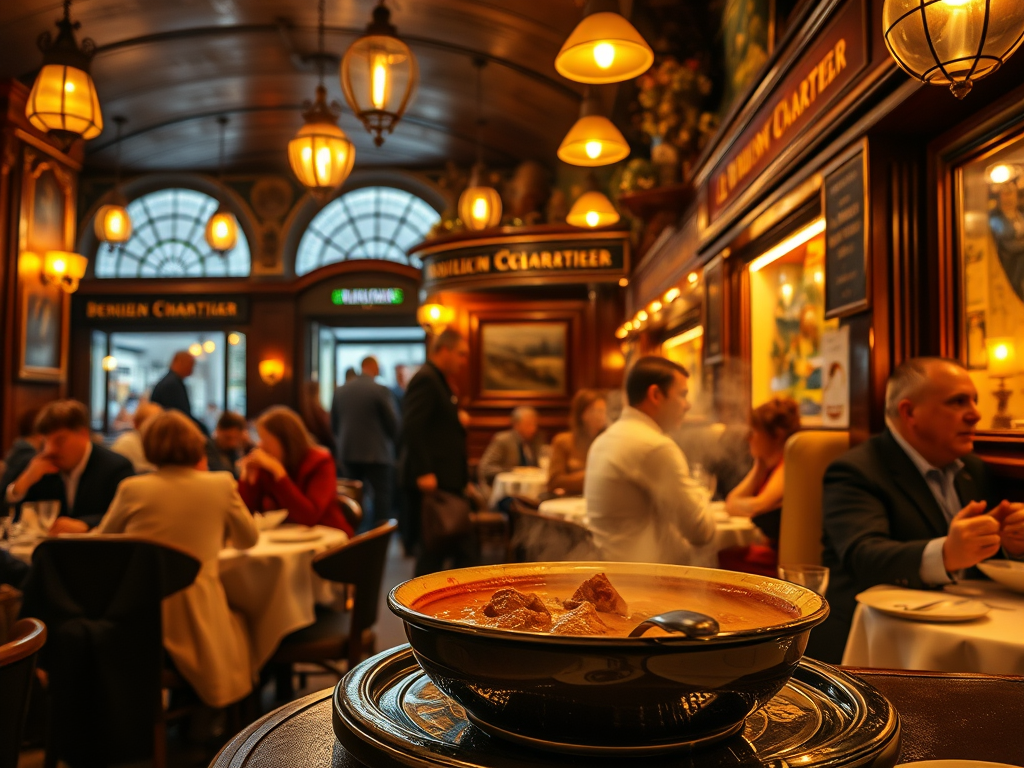

High Prices Hit a French Classic: Beef Bourguignon

At Le Bouillon Chartier in Paris, crafting the perfect beef Bourguignon requires a simple yet essential combination of ingredients: beef, carrots, wine, butter, and “coquillettes”—a small macaroni-like pasta. The dish must simmer for no less than three hours. And above all, it must remain affordable, with a price tag that does not exceed 10 euros per serving.
Since 1896, this Belle Époque eatery has been a go-to spot for Parisians seeking budget-friendly French cuisine. It’s a lively, bustling canteen serving hearty meals that sustain patrons through the day, offering those on modest incomes a filling dish for less than an hour’s wage.
Yet, few moments in Bouillon Chartier’s long history have presented such challenges in keeping costs under control as today.
According to Christophe Joulie, the restaurant’s owner, the cost of ingredients, electricity, and wages for the energetic team of servers and cooks has surged by 30 to 45 percent over the past five years. In order to maintain the steady price of the restaurant’s signature dish—still priced at around $10.80—he has absorbed up to a 20 percent reduction in profit margins for his family-run business.

“The cost of everything that went up has essentially stayed high,” Mr. Joulie remarked one weekday at the eatery’s Ninth Arrondissement location, one of three Bouillon Chartier establishments in Paris. By 11:30 a.m., a line nearly two blocks long had already formed, waiting for the doors to open for lunch service. “But our mission is to always provide a good meal at a fair price.”
Mr. Joulie’s struggle mirrors the broader impact of persistent inflation across Europe. Inflation in the eurozone rose to 2.4 percent in February after a temporary decline last year. While the European Central Bank recently cut interest rates for the sixth consecutive time, uncertainty looms with rising military expenditures and potential tariffs.
Although inflation has eased from a record 10 percent following the pandemic and the war in Ukraine, essential costs—including energy, meat, dairy, glassware, and even table linens—remain stubbornly high.
Businesses across Europe, particularly energy-intensive industries like manufacturing and hospitality, are feeling the strain. In households across France, grocery bills have only slightly decreased, leaving many struggling to make ends meet.
At Bouillon Chartier, these economic pressures are deeply embedded in its signature beef Bourguignon. The overall cost of preparing the dish has nearly doubled since the pandemic, Mr. Joulie noted.

Beef prices from his long-standing suppliers have tripled, driven by rising feed and fertilizer expenses, energy costs for slaughterhouses, and increased fuel prices for farm equipment and transportation.
While the cost of some ingredients has declined from peak levels, they remain elevated, according to Insee, France’s national statistics agency.
Electricity costs for the restaurant have skyrocketed, soaring from €500,000 three years ago to €1.5 million annually. Despite negotiating a lower rate last year, the financial strain persists. Meanwhile, wages—accounting for roughly 40 percent of the cost of a beef Bourguignon—have risen 15 to 20 percent as workers demand higher pay to keep up with inflation.
“Every morning, I check in with my purchasing director to see what we can afford to buy,” Mr. Joulie explained. “It feels like playing the stock market.”


Le Bouillon Chartier began as a humble canteen, made famous in Paris over a century ago by the Chartier brothers, who served nourishing broths and affordable meals to working-class laborers. Over time, white-collar professionals and tourists—especially those drawn in by the restaurant’s appearance in Netflix’s Emily in Paris—joined the crowd.
Amid rising living costs, bouillons like Chartier have become a haven for those seeking a quality meal without breaking the bank. The priciest item on the menu, steak frites, costs just €13.50—significantly cheaper than at most bistros and restaurants. In recent years, nearly a dozen similar low-cost bouillons have sprung up across Paris, drawing crowds eager for a budget-friendly dining experience.
However, Bouillon Chartier hasn’t always thrived. Until the mid-2000s, it dominated the city’s affordable dining scene, but shifting food trends saw many Parisians gravitate toward fast food, Mr. Joulie recalled. By the time his father—who started as a waiter in French bistros in the 1970s—stepped in to save it from bankruptcy, the restaurant was struggling. Together, father and son took over, incorporating it into their family business, Groupe Joulie, which now operates 12 classic Parisian bistros.
They restored the Ninth Arrondissement location—now a historic monument—preserving its Art Nouveau chandeliers, wood-paneled walls, and red-checked tablecloths. The vast mirrors lining its patinaed walls even served as inspiration for New York City’s famous French brasserie, Balthazar.


To keep prices low, Mr. Joulie relies on volume. He purchases 1.5 tons of beef weekly for beef Bourguignon alone across his three bouillons, serving over 4,000 customers daily. The average diner spends just €20 per meal.
When costs spike too dramatically, certain dishes temporarily disappear from the menu. The popular duck confit, for instance, was removed when it became impossible to keep its price at €12.50. In early January, soaring beef prices forced Bouillon Chartier to take its signature beef Bourguignon off the menu for a week. Nevertheless, the dish’s price has remained unchanged at €10 for four years.
More often than not, Mr. Joulie absorbs these rising costs himself, rather than passing them on to customers. “We can do this because we’re a family-run business, not beholden to investors or stockholders,” he said.
“So far, it’s worked,” he added, glancing across the grand dining hall filled with patrons seated elbow to elbow. A vast fresco, painted in 1929 by artist Germont as payment for an overdue bill, adorned the walls. Around 20 waiters in black vests and white aprons moved swiftly, jotting down orders on paper table coverings before dashing off to the kitchen. Glasses clinked, and cutlery scraped against white plates bearing the Chartier emblem.


Despite the lively atmosphere, Mr. Joulie acknowledged that inflation’s effects were felt by everyone in the room. After an initial post-pandemic boom, restaurant traffic across France began to slow by late 2023 as persistently high energy and food costs squeezed household budgets. Even at Bouillon Chartier, customers were ordering less.
Ali Belcacem and his friend, longtime regulars, had just finished a €3.20 chocolate mousse following plates of beef Bourguignon and andouillette—a tripe sausage—washed down with house red wine. “We don’t eat out as often as we used to,” Mr. Belcacem admitted. Retired and living on a fixed income, he had felt the financial strain over the past year and a half, as electricity, food, clothing, and gas prices remained high.
“When they say inflation has eased, that’s not our reality,” he said. “Some things in our grocery basket are still 40 percent more expensive.”
A meal at Chartier was a rare treat—a way to enjoy a satisfying meal without overspending.
Watching Mr. Belcacem pay his bill, Mr. Joulie sighed. “High prices are hitting everyone hard,” he said. “Now more than ever, keeping things affordable is crucial.”




Leave a Reply