

Banker Mark Carney Wins Race to Lead Liberal Party, and Canada

Amid a critical moment in Canada’s relationship with the United States, the Liberal Party of Canada on Sunday selected an unelected financial expert to succeed Justin Trudeau as both party leader and the nation’s prime minister, positioning him to take on President Trump.
Mark Carney, 59, who guided the Bank of Canada through the 2008 global financial crisis and later led the Bank of England through Brexit, secured victory in the leadership race against his friend and former finance minister, Chrystia Freeland. Despite never having held elected office, Carney won a resounding 85.9% of the votes cast by Liberal Party members, with over 150,000 people participating, according to party officials.
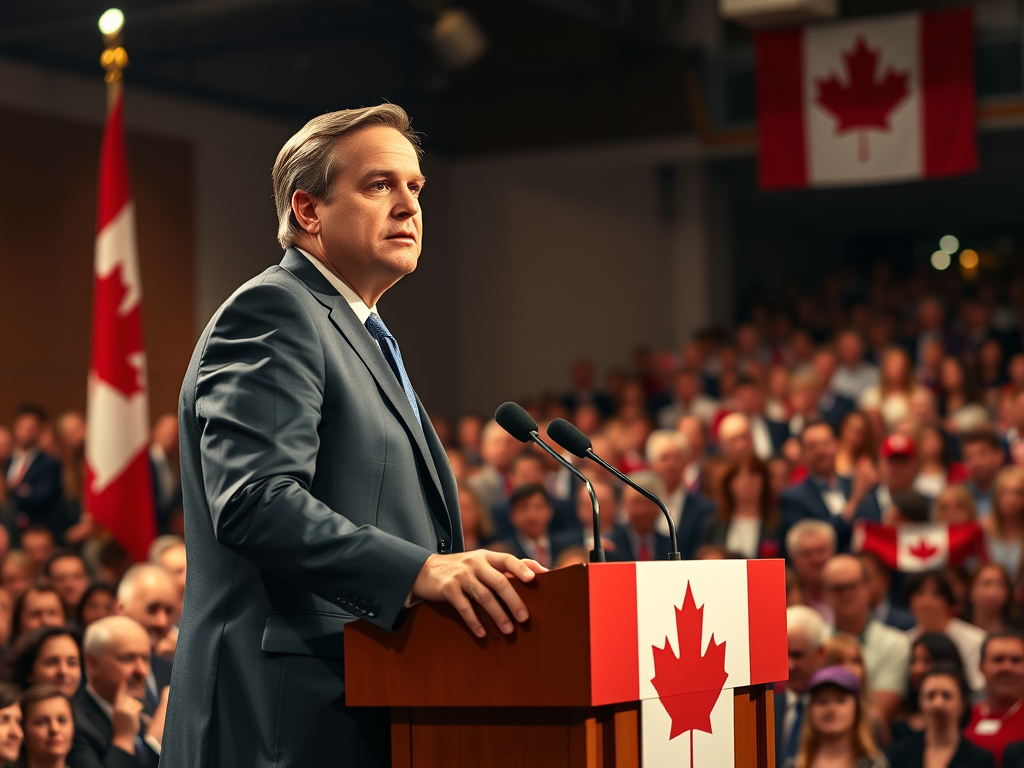
“Canada is not America. And it will never, in any way, shape, or form, become part of America,” Carney declared in his acceptance speech on Sunday night, addressing Trump’s persistent rhetoric about making Canada the 51st state. Speaking to an energized crowd of party loyalists, he added, “We didn’t seek out this fight, but Canadians never back down when challenged.”
Carney reinforced his stance with a pointed analogy: “Americans should have no doubts—whether in trade or hockey, Canada will come out on top.”

He is expected to be sworn in as prime minister early this week, officially marking the end of Trudeau’s leadership. His immediate priority will be addressing the economic and sovereignty threats posed by Trump.
However, given that Carney does not currently hold a parliamentary seat, a federal election is likely to be called soon after he assumes office. He will face off against Conservative Party leader Pierre Poilievre in what is shaping up to be a pivotal election for Canada, a key NATO and G7 member and the world’s second-largest country by land area.
Trump has exerted considerable influence over Canadian politics, frequently threatening tariffs on Canadian goods that could severely impact the economy and making provocative remarks about annexation.

Speaking to a supportive crowd at the Liberal Party convention before his successor was announced, Trudeau captured the prevailing sentiment among Liberals and many Canadians:
“This is a defining moment for our nation. Democracy is not guaranteed. Freedom is not guaranteed,” he warned. “Even Canada’s existence is not guaranteed.”
Carney has expressed firm support for Canada’s retaliatory tariffs, vowing, “My government will maintain these tariffs until the U.S. shows us the respect we deserve.”
Public opinion research suggests that Canadians are prioritizing a leader who can stand up to Trump, influencing both Carney’s selection and the upcoming election. While the Conservative Party had maintained a strong lead over the Liberals—exceeding 20 points in polls—the gap has narrowed following Trudeau’s resignation and Trump’s escalations against Canada.
Recent polls indicate that if Carney leads the Liberals into the election, he would be the preferred choice over Poilievre. Voters also favor Carney over Poilievre when it comes to negotiating with Trump. Poilievre’s popularity has suffered, with some perceiving him as ideologically aligned with Trump.
On Sunday night, Carney wasted no time pivoting to campaign mode, launching a sharp critique of Poilievre. He portrayed the Conservative leader as inexperienced outside of politics and too admiring of Trump to effectively stand up to him.
“Donald Trump thinks he can weaken us by dividing and conquering,” Carney said. “Pierre Poilievre’s plan will leave us divided and vulnerable. Because someone who worships Donald Trump will kneel before him, not challenge him.”

Carney’s extensive experience in navigating economic crises may be giving him an edge over Poilievre, who, at 45, has spent his career solely in politics and lacks comparable global leadership experience.
The Liberal Party establishment rallied behind Carney over Freeland, a former key ally of Trudeau, whose resignation in December set off a chain of events leading to Trudeau’s departure.
The Conservative Party, recognizing Carney as a formidable opponent, has already launched negative ads targeting his wealth and financial investments.
A major challenge for Carney will be distancing himself from Trudeau, whom he previously advised and shared a friendly rapport with. After nearly a decade of Trudeau’s leadership, many Canadians are eager for change. The Conservatives have sought to highlight the ideological and personal ties between the two men.
Beyond the Trump factor, Canada faces pressing domestic challenges, many of which have been blamed on Trudeau, particularly the affordability crisis. Soaring housing costs and rising living expenses have left many Canadians struggling.
Larger systemic questions about Canada’s governance are also looming. One key issue is how to leverage the country’s vast natural resources—oil, gas, coal, and essential minerals such as potash and uranium—while balancing environmental concerns.

Carney, who has become a global advocate for green investment since his time in central banking, will need to determine how to manage Canada’s natural wealth in line with his climate commitments.
Immigration is another divisive topic. While Canada has traditionally welcomed both economic migrants and refugees, the post-pandemic surge in temporary migration has sparked backlash, with many blaming newcomers for exacerbating the country’s housing and healthcare crises.
In his acceptance speech, Carney sought to reaffirm his Liberal values, emphasizing that, despite his financial success, he remains committed to the party’s progressive principles.
“I understand that markets don’t have values—people do,” he said. “When properly regulated, markets create good jobs and strong growth. But they are indifferent to human suffering and blind to society’s greatest needs.”




Leave a Reply