

‘People Are Going Silent’: Fearing Retribution, Trump Critics Muzzle Themselves

Federal employees who have been dismissed and now fear losing their homes prefer to remain anonymous. University presidents, worried about losing substantial federal funding, are choosing to stay quiet. Corporate executives, alarmed by tariffs that could harm their businesses, have opted for silence.
Even longtime Republican hardliners in Congress, shocked by President Trump’s revisionist claim that Ukraine is responsible for Russia’s invasion and his explosive Oval Office encounter with President Volodymyr Zelensky, have either held their tongues, cautiously criticized without naming Trump, or completely reversed their stance.

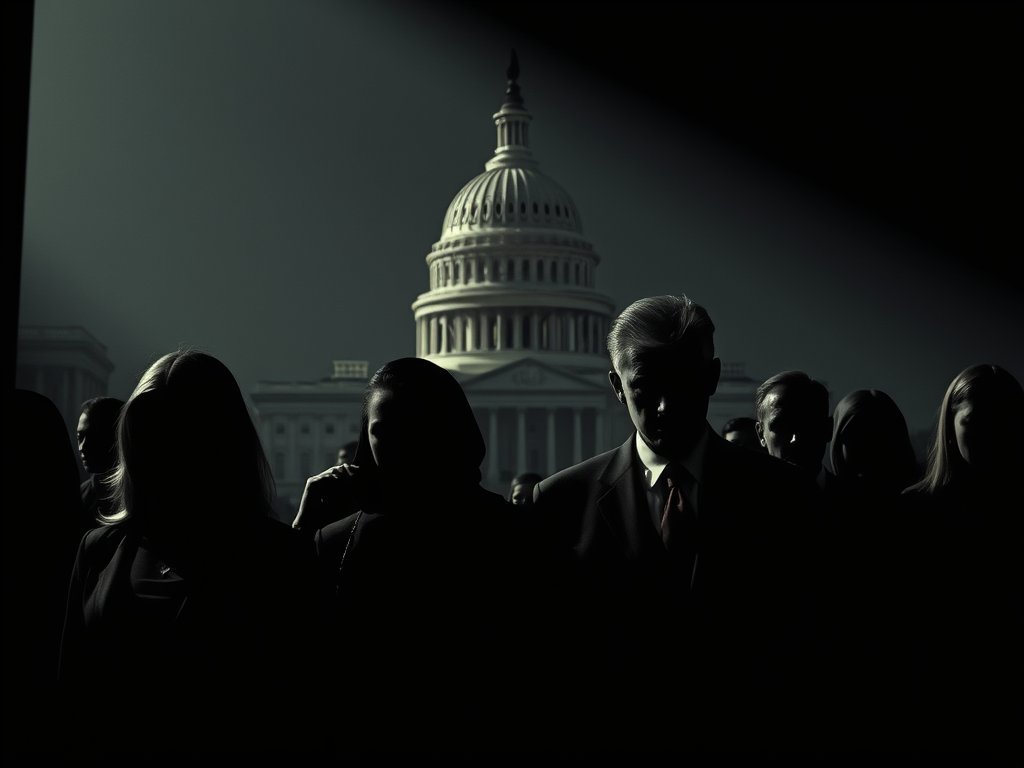
Now, more than six weeks into Trump’s second term, a chilling effect is sweeping across Washington and beyond.
Individuals from both political parties who would typically engage in public debate on major issues are now hesitant, fearing online attacks from Trump and Elon Musk, potential damage to their businesses, and threats to their families’ safety. Politicians are particularly wary, afraid of being cast out by a party reshaped in Trump’s image or facing primary challengers bankrolled by Musk—now Trump’s most influential ally and the world’s richest man.

“When key societal figures—university presidents, media organizations, CEOs, mayors, governors—begin altering their behavior to avoid government backlash, it signals that we have crossed into a form of authoritarianism,” said Steven Levitsky, a Harvard government professor and co-author of How Democracies Die.
Trump campaigned in 2024 on a promise of retribution and has wasted no time making threats from the White House. He rescinded security details for prominent critics like retired Joint Chiefs of Staff chairman Gen. Mark A. Milley, who has received death threats from Iran. He also announced plans to strip security clearances from lawyers at a major firm representing special counsel Jack Smith, who investigated him.
A former Trump critic from his first term recently refused not only to comment on the record but also to be mentioned at all in a news article, explaining that each time his name is publicly linked to Trump, he receives more threats from the far right.
On Capitol Hill, Republican Senator Thom Tillis of North Carolina was initially undecided about supporting Pete Hegseth, Trump’s nominee for defense secretary—until the president threatened him with a primary challenge. Tillis soon changed his position. (His office later claimed he was simply conducting due diligence.)
Meanwhile, Senator Roger Wicker of Mississippi met with Zelensky at the Hay-Adams Hotel, telling him he and his colleagues were there “as a show of support.” But after Trump’s confrontation with Zelensky later that day, Wicker deleted a social media post featuring their handshake.
More than half a dozen Republican national security hawks in the Senate—typically outspoken—either declined to comment or ignored inquiries regarding Trump’s statements on Ukraine and the broader Republican silence on the issue.
Most elected Republicans fully support Trump and his agenda, while some Democrats are shifting toward his stance on issues like immigration, reflecting broader public opinion. However, Democratic lawmakers were divided over whether it was wise for Rep. Al Green of Texas to stage a protest during Trump’s address to Congress on Tuesday night.
Still, the lack of strong opposition from Trump’s targets, whether individuals or institutions, is notable—if, in some cases, understandable.
University presidents remain largely silent to shield their institutions, according to Ted Mitchell, president of the American Council on Education. “Don’t wrestle with a pig,” he said. “You’ll just get dirty, and the pig will enjoy it.”
Business leaders, who rarely criticize presidents from either party, largely support Trump’s tax cuts and deregulatory policies, though they are less enthusiastic about his tariffs. One executive admitted that periodic workforce reductions can be beneficial for an organization’s health but described Musk’s approach to downsizing the federal workforce as “completely unhinged.” He would only say so anonymously, fearing backlash.

Intellectual Freedom Under Pressure
Not everyone is staying silent. Consider Michael Roth, president of Wesleyan University.
“This is the greatest assault on intellectual freedom since the McCarthy era,” Roth said. “And like that time, future generations will judge whether people defended their values or cowered in fear of the federal government.”
Roth has publicly condemned aspects of Trump’s rhetoric as authoritarian and voiced support for diversity, equity, and inclusion initiatives. In a Washington Post interview last month, he criticized Trump, Vice President JD Vance, and Florida Governor Ron DeSantis for leveraging their Ivy League credentials to advance their careers while simultaneously portraying themselves as champions of the anti-“woke” movement against elite universities.
Some have called Roth brave for speaking out, but he insists otherwise. “When people tell me, ‘Oh, you’re courageous,’ it terrifies me,” he admitted. “I’m just a neurotic Jewish kid from Long Island—I’m scared of everything.”

Still, he feels compelled to speak. “It’s outrageous that the federal government is trying to suppress free expression,” he said.
California Democratic Representative Eric Swalwell, a frequent Trump critic, believes Republican lawmakers remain silent not just to protect their careers but out of fear for their families’ safety.
“I used to think their reluctance was about losing their jobs,” he said. “But in reality, it’s about personal security. They tell me their wives warn them: ‘Don’t make us targets for harassment at church, the grocery store, or the country club.’”
Swalwell himself receives constant threats. He has spent hundreds of thousands of dollars from his campaign and congressional office budgets on security for his family. His young daughter recently included a security guard in a drawing of their family for a kindergarten project.
Senator Todd Young of Indiana is one Republican who has experienced public intimidation from Musk for not falling in line. After Young challenged Tulsi Gabbard—Trump’s nominee for Director of National Intelligence—during a Senate confirmation hearing last month, Musk called him a “deep state puppet” on social media.

Shortly after, Musk deleted the post and suddenly referred to Young as “a great ally in restoring power to the people.” Young eventually voted to confirm Gabbard but later insisted in an interview that he had not discussed the matter with Musk. “Nobody should be afraid to express their beliefs,” he said. “Understood?”
Delaware Democratic Senator Chris Coons, who maintains close ties with Senate Republicans, said lawmakers who have long worked in foreign policy circles are alarmed by the rapid, forceful, and disorganized cuts under Trump and Musk’s leadership.
Why don’t they push back? Coons believes Musk has posed “a credible electoral threat” by pledging to fund primary challengers against dissenting Republicans.
Yet, he pointed out, senators only face re-election every six years. “Some of them are just hoping the chaos will burn itself out,” Coons said.
‘A Legitimate Reason for Concern’
Marc Elias, a top Democratic lawyer who led legal efforts to counter Trump’s allies in their attempts to overturn the 2020 election, is sharply critical of Republicans who say they submit to Trump out of fear.

“I understand what it means to be a target of his attacks and the mob he mobilizes,” Elias said. “It’s completely reasonable to be afraid. But for a sitting senator to say they’re so scared that they’ll betray their oath of office? That’s cowardice. Why are you even in public service?”
Some Republicans dismiss the alarm over authoritarianism as overblown.
Former Representative Peter Meijer of Michigan—one of the ten House Republicans who voted to impeach Trump over his role in the January 6 Capitol riot—said he’s losing patience with the rhetoric. “All this hand-wringing—come on,” he scoffed.
Mark Cuban, the billionaire entrepreneur who backed Kamala Harris in 2024, recently spoke at the Principles First summit, an anti-Trump conservative gathering. He argued that many Republicans view left-wing identity politics and “wokeness” as the true silencing force in American society.
Now that Trump has won, Cuban said, “There’s no point in calling him names. That might work during an election, or in firing up a rally crowd, but it’s not my style.”




Leave a Reply