
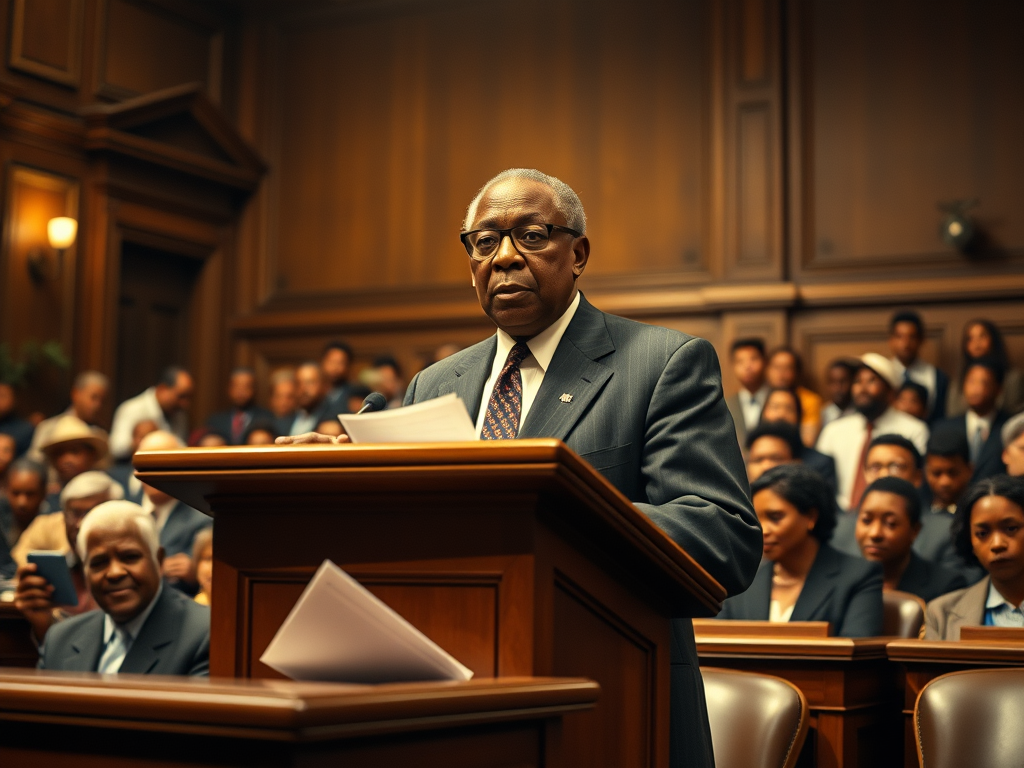

L. Clifford Davis, Who Fought to Desegregate Texas Schools, Dies at 100

L. Clifford Davis, a civil rights attorney who played a pivotal role in desegregating Texas high schools—often facing violent mobs, political resistance, and threats to his life—passed away on February 15 in Fort Worth at the age of 100.
His daughter, Karen Davis, confirmed his death, stating that he had been in a nursing facility.
Despite the U.S. Supreme Court’s landmark 1954 ruling in Brown v. Board of Education of Topeka—a case in which Mr. Davis contributed alongside Thurgood Marshall—many Southern states and cities initially defied the mandate to integrate schools.
Enforcing that ruling fell to lawyers like Mr. Davis. He began his work in Mansfield, Texas, where the town’s only high school was exclusively for white students, forcing Black students to travel 20 miles to Fort Worth for their education.
Representing five students, Mr. Davis filed a lawsuit against the Mansfield school district in 1955. The following year, a federal appeals court ruled in their favor.
However, when Black students arrived at the school in September 1956, they were confronted by an enraged white crowd—some wielding nooses—while burning crosses stood as ominous warnings.
Mr. Davis sought assistance from U.S. Attorney General Herbert Brownell Jr., but his plea was denied. He then turned to Texas Governor Allan Shivers, writing:
“These Negro students are exercising a constitutional right. I call upon you as Governor to cause to be dispatched additional law enforcement officers to Mansfield to assure that law and order will be maintained.”

Governor Shivers sent Texas Rangers to maintain order but made it clear he would not enforce integration.
Amid growing hostility, a friend urged Mr. Davis to carry a handgun for protection against white vigilantes. He accepted the firearm but never used it, despite receiving death threats, which he dismissed without much concern.
As tensions escalated, Mr. Davis ultimately decided that the risk to the students’ safety was too high and halted his efforts to integrate Mansfield High School at that time.
Yet he did not abandon the fight. In 1959, he filed a class-action lawsuit against the Fort Worth school district, which was still segregated. This time, he won, and the district agreed to implement an integration plan.
Reflecting on his career, Mr. Davis saw his legal work as a calling.
“The philosophy that was instilled in us in those days was that lawyers were social engineers,” he said in a 2014 oral history interview for the University of North Texas. “It was our job to try to use the principles of law to help bring about equality and opportunity for all people, not just Black people.”
Born on October 12, 1924, in Wilton, Arkansas, L. Clifford Davis (the “L.” did not stand for a name) grew up in a deeply segregated society. His parents, Augustus and Dora (Duckett) Davis, were sharecroppers.

Since Wilton’s Black schools only went up to the eighth grade, his parents rented a home in Little Rock, where he and five of his six siblings lived while pursuing their high school and college education.
He earned a degree in business administration from Philander Smith College (now Philander Smith University), a historically Black institution, in 1945.
Determined to study law, Mr. Davis faced barriers in Arkansas, where no law schools admitted Black students at the time. He moved to Washington, D.C., to attend Howard University but found the cost of living prohibitive. In 1947, he attempted to integrate the University of Arkansas School of Law by applying for admission.
The university offered him a place—but only under restrictive conditions: he would be segregated from white students and required to pay his tuition upfront.
Unwilling to accept such terms, Mr. Davis remained at Howard, where he graduated in 1949. However, his efforts contributed to a breakthrough: in 1948, Silas Hunt became the first Black student admitted to Arkansas’s law school under similar circumstances.
Mr. Davis initially practiced law in Pine Bluff, Arkansas, before relocating to Fort Worth, Texas, in 1952. There, he became the city’s first Black attorney to open a private practice.

A dedicated advocate for civil rights, he worked with the NAACP and played a role in the early stages of Brown v. Board of Education alongside Thurgood Marshall, who later became a U.S. Supreme Court justice.
In 1983, Mr. Davis was appointed a criminal district court judge, winning election to the position the following year. Though he lost re-election in 1988, he continued serving as a visiting judge until retiring in 2004.
He is survived by his daughters, Karen and Avis Davis. His wife, Ethel (Weaver) Davis, passed away in 2015.
Though Mr. Davis never sought public recognition, his contributions were eventually acknowledged. In 2012, the Fort Worth Black Bar Association, which he co-founded in 1977, renamed itself the L. Clifford Davis Legal Association in his honor.
Five years later, in 2017, the University of Arkansas School of Law awarded him an honorary degree.
“It never crossed my mind that this would happen,” he told The Arkansas Democrat-Gazette. “I applied 71 years ago to earn a degree. Now they’re going to give me one.”




Leave a Reply