
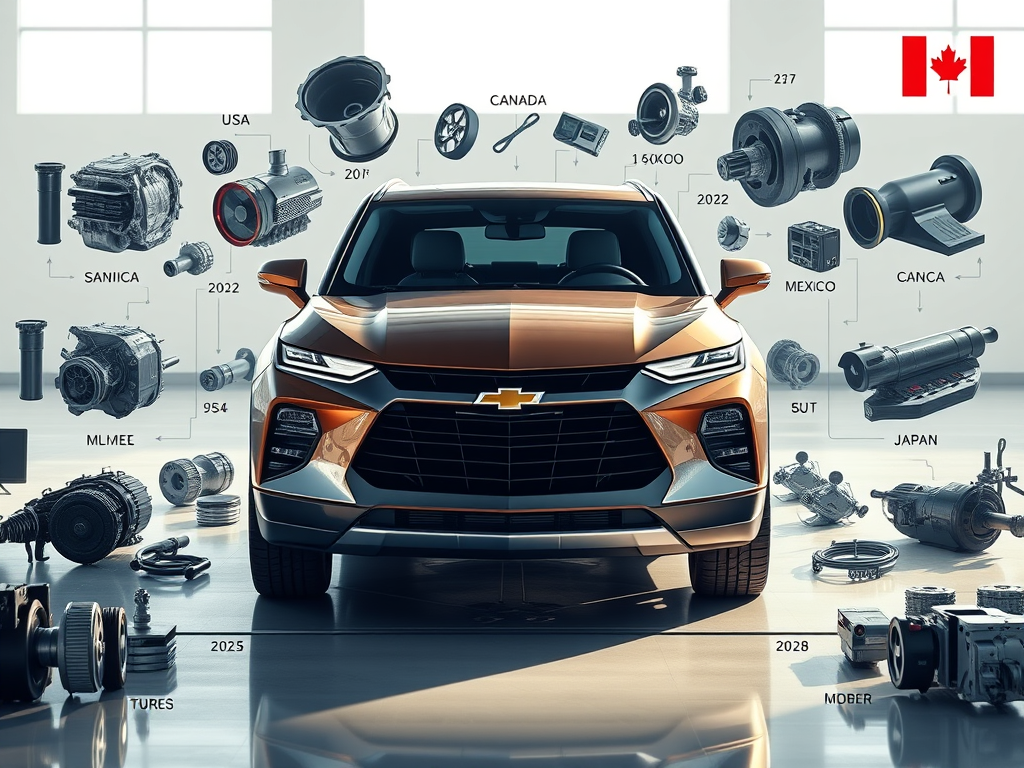
President Trump’s decision to impose a 25 percent tariff on imports from Canada and Mexico is expected to significantly impact both automakers and car buyers. This is due to the vast number of vehicles and components that cross into the United States daily as part of the automotive supply chain.
The Problem With Car Tariffs: What’s an Import?

Since the establishment of the North American free trade zone in 1994, car manufacturers have developed integrated supply networks spanning national borders. By concentrating the production of key components—such as engines and transmissions—in large plants that serve multiple vehicle assembly facilities across North America, companies have achieved economies of scale. This approach extends to other essential parts, including seats, instrument panels, electronics, and axles.
“This system leverages each country’s strengths, benefiting both businesses and consumers,” said Sam Fiorani, vice president at AutoForecast Solutions, a research firm. “If all components had to be manufactured domestically, vehicle costs would rise significantly.”
A car is categorized as an import when its final assembly occurs outside the United States. However, given the complexity of modern supply chains, determining whether a vehicle is truly “American-made” has become increasingly difficult.
For instance, General Motors assembles the 2024 Chevrolet Blazer—one of its popular SUVs—in Mexico, using engines and transmissions manufactured in the U.S. Nissan, on the other hand, produces its Altima sedan in Tennessee and Mississippi, but its turbocharged variant features a two-liter engine from Japan and a transmission sourced from Canada. Similarly, Toyota’s RAV4, a best-selling SUV in the U.S., is mostly assembled in Canada. These Canadian-made models incorporate American-built engines and transmissions, which are shipped north for assembly before the completed vehicles return to the U.S. market.

The Trump administration has yet to clarify how the tariffs would apply to vehicle components that are exported and later reimported as part of finished cars. Despite being classified as an import from Canada, about 70 percent of the RAV4’s components—by value—originate in the United States, according to the National Highway Traffic Safety Administration.
Conversely, the Nissan Rogue SUV is assembled in Tennessee, qualifying it as a domestically produced vehicle. However, only about 25 percent of its components are sourced from the U.S., with its engine coming from Japan and its transmission from Mexico, based on data from the traffic safety agency.
The proposed tariffs have raised concerns within the auto industry. “To be completely honest, a 25 percent tariff on trade with Mexico and Canada would cause unprecedented damage to the U.S. automotive sector,” said Ford CEO Jim Farley during an investor conference in February.
Stellantis Chairman John Elkann also commented on the matter, acknowledging former President Trump’s intent to strengthen American manufacturing while emphasizing the importance of maintaining tariff-free trade with Canada and Mexico. Stellantis, the parent company of brands like Chrysler and Jeep, is among the manufacturers advocating for an open trade policy in North America.
Over the past two decades, the proportion of imported vehicles sold in the U.S. has remained relatively stable, except for declines during the 2008–09 financial crisis and the COVID-19 pandemic. Mexico is the largest source of vehicle imports, followed closely by Japan, South Korea, and Canada. Meanwhile, U.S. automobile production has fluctuated over the years. While domestic output exceeded 12 million vehicles in 1999, it dropped significantly during the recession. Although the industry rebounded as fuel prices stabilized and consumer confidence recovered, production levels have never returned to their early 2000s peak.
For many buyers, a car’s country of origin is not a decisive factor. Frank Krieber, a retired tech executive from Charlotte, N.C., recently purchased a Chevrolet Tahoe, assuming it was an American-made vehicle. While the SUV is assembled in Arlington, Texas, government data reveals that only about a third of its parts come from the U.S., with a similar proportion sourced from Mexico.
“I don’t mind that some parts are from Mexico,” Krieber said. “Even if the whole car had been built there instead of Texas, I still would have bought it.”




Leave a Reply