
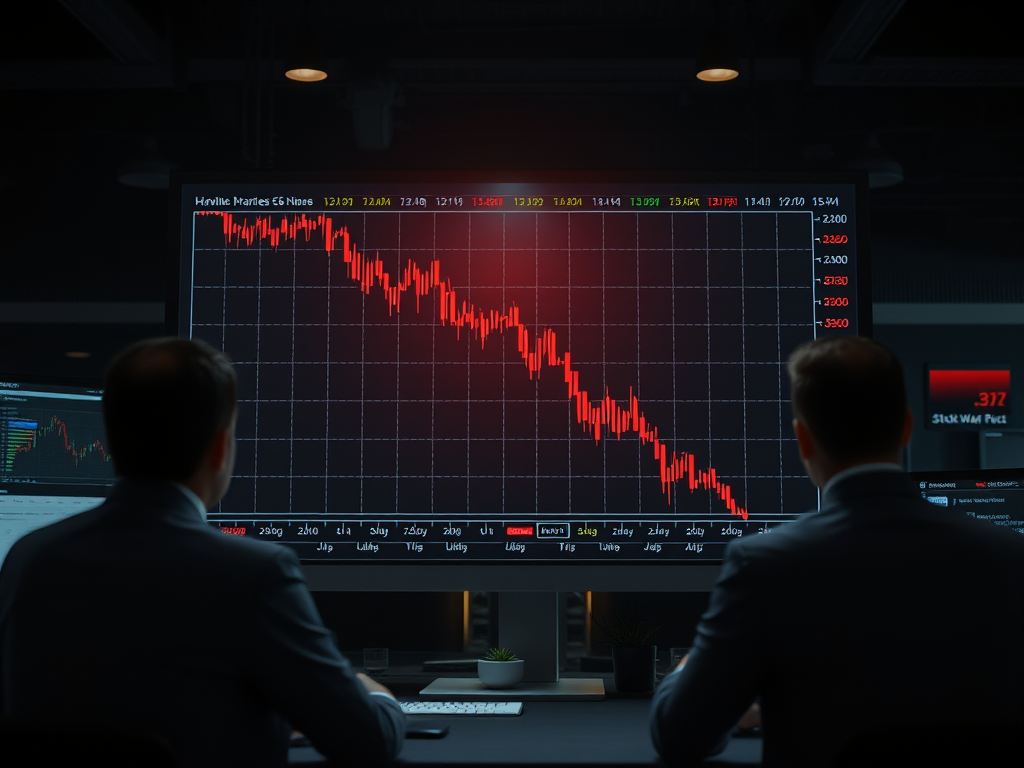

Stocks plunged on Tuesday as President Trump’s sweeping tariffs on Canada, Mexico, and China rippled through global markets, heightening investor concerns about economic stability.
Trade War Sends a Shiver Through Global Markets

The S&P 500 initially dropped by as much as 2 percent before paring losses in the afternoon, ultimately closing 1.2 percent lower. Meanwhile, the tech-focused Nasdaq Composite briefly entered correction territory—a decline of at least 10 percent from its recent peak—before rebounding slightly as investors took advantage of lower prices.
The sell-off was widespread, with approximately 80 percent of S&P 500 stocks ending the day lower, even after an afternoon recovery led by major tech companies such as Nvidia and Alphabet. Due to their large market capitalizations, these companies had a notable influence on the index’s movement. Among the 11 sectors, technology was the only one to close in positive territory, though by a slim margin.
Wall Street’s recent sharp declines have erased the gains made since Trump’s election victory in November, as initial optimism about deregulation and business-friendly policies has given way to anxiety over the economic damage posed by the newly imposed tariffs.
Investors sought refuge in government bonds, initially driving the yield on the 10-year Treasury note to its lowest level since October before it rebounded later in the day. Yields and bond prices move in opposite directions. Concerns over the economy’s resilience in the face of prolonged tariffs were also evident in shifting expectations about Federal Reserve interest rate cuts.

In the short term, tariffs are expected to drive inflation higher, prompting the Fed to maintain elevated interest rates. However, over the long run, economists warn that the tariffs will slow economic growth and increase the risk of a downturn, which could lead the Fed to cut rates more aggressively.
Market expectations now suggest that the Fed may lower rates up to three times this year, starting as early as June—a stark contrast to forecasts from earlier in the year, which only anticipated a single rate cut. This shift reflects growing concerns that the central bank may need to act swiftly later in the year to support a weakening economy.
“A trade war may have short-term inflationary effects,” noted Ian Lyngen, an interest rate strategist at BMO Capital Markets, “but it also poses significant risks to global economic growth.”
The Nasdaq Composite has declined 9.4 percent from its December high, with much of the downturn occurring over the past two weeks. The S&P 500 has lost 6 percent from its mid-February peak. The deepening losses in major indexes have psychological significance for traders, signaling that the market downturn may not be a temporary dip but rather a more sustained decline affecting corporate valuations.
The Russell 2000 index, which tracks smaller companies more closely tied to the U.S. economy, has already fallen into correction territory and is approaching a bear market—defined as a drop of 20 percent or more from its recent high. Notably, the index had reached a record high as recently as November following a strong recovery under the previous administration.
Several major corporations suffered significant declines. Ford shares fell around 3 percent, General Motors slid 4.6 percent, and Tesla dropped 3.7 percent. Financial and industrial stocks—often seen as barometers of economic health—were among the hardest hit.
The airline sector also took a substantial hit, as concerns over a potential trade war’s impact on economic growth and travel demand weighed on investors. United Airlines lost 5.8 percent, while Delta dropped 6.4 percent.
“There are multiple factors at play,” said Tom Fitzgerald, an airline industry analyst at TD Cowen. “It’s a sector where investors often sell first and ask questions later.”
European markets had already faced pressure earlier in the day as investors grappled with the prospect of escalating global trade tensions after Canada and China swiftly imposed retaliatory tariffs.
The Euro Stoxx 50, which tracks the largest companies in the eurozone, slid 2.5 percent—its worst single-day decline since July 2023. Germany’s DAX index tumbled 3.5 percent, erasing gains from the previous session when it had hit a record high on optimism surrounding increased European military spending. It was the index’s worst day in nearly three years.
German automakers and their suppliers were particularly hard-hit due to their reliance on assembly plants in Mexico to produce vehicles for the U.S. market. Volkswagen declined around 3 percent, while BMW sank more than 5 percent.
The U.S. dollar index, which tracks the currency’s performance against a basket of major currencies, weakened by 1 percent. Meanwhile, both the Canadian dollar and the Mexican peso remained relatively stable against the American currency.
Oil prices also declined after the OPEC oil cartel and some of its allies announced on Monday that they would ramp up production. Brent crude, the global benchmark, slipped 0.8 percent to settle at $71.04 per barrel.




Leave a Reply