
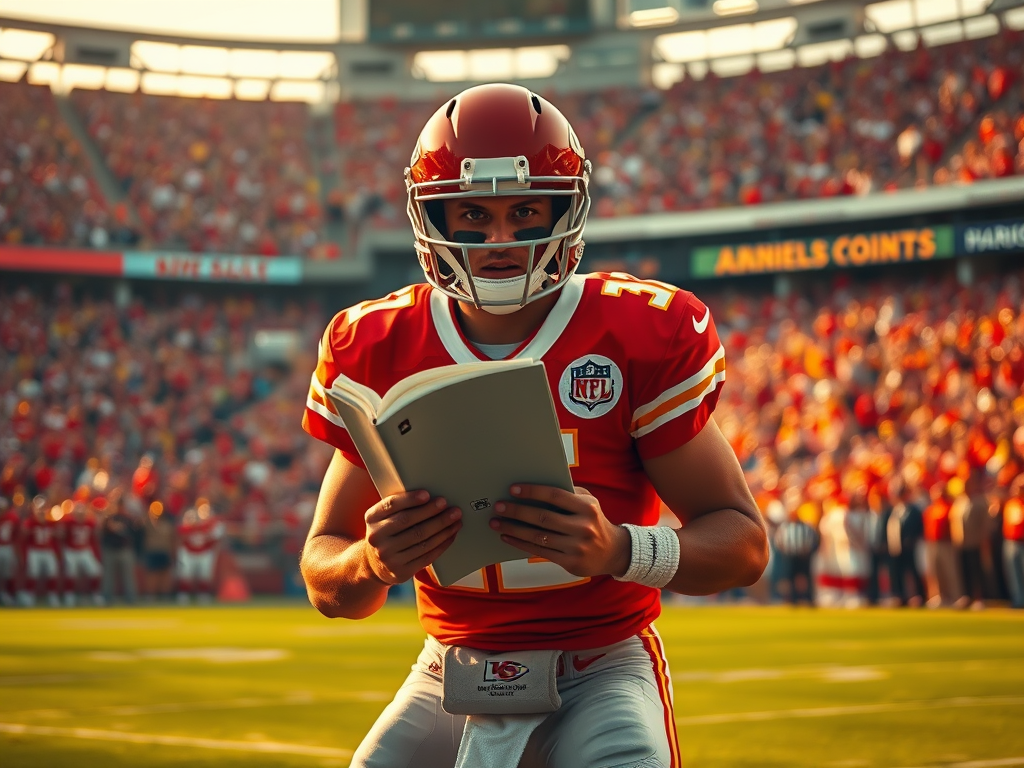

Why do NFL quarterbacks say Blue 42? The answer is almost as old as football itself

When Tyler Bray joined the Kansas City Chiefs in 2013, he faced a tough learning curve. As an undrafted free agent, he had to absorb a complex playbook, familiarize himself with the language of a new offensive system, and adjust to the rapid pace of the professional game.
One unexpected challenge was finding the right “cadence”—the color-number sequence quarterbacks shout before the snap, like “Blue 42” or “Red 80.” At the University of Tennessee, Bray played in a no-huddle offense where snaps were triggered by physical cues such as a clap or a leg kick, so using a verbal cadence felt unfamiliar. Initially, he didn’t think it would be a big deal.
But when he tried calling out “White 80” in practice, Chiefs head coach Andy Reid quickly shut it down.
“You hold your ‘white’ too long,” Reid told him. “Pick a different color.”
Bray switched to “Green,” but it didn’t feel quite right either. Eventually, he settled on “Blue 80″—a call that stuck with him for the rest of his career.
In today’s NFL, where microphones capture nearly every sound on the field, a quarterback’s cadence is one of the most recognizable elements of the game. Patrick Mahomes often growls “Blue 80” (or occasionally “White 80”). Tom Brady preferred “Green 18.” Brett Favre and Aaron Rodgers both used “Blue 58,” though Rodgers sometimes called “Green 19” instead. The tradition has even made its way into pop culture—Jim Carrey famously shouted “Blue 42” in Ace Ventura: Pet Detective.

Sometimes, these calls have strategic meaning. Other times, they’re just a rhythmic way to initiate the play.
“This is something quarterbacks never want to give up,” former NFL quarterback Matt Hasselbeck explains. “Because keeping it a mystery is important.”
But despite its widespread use, most quarterbacks have no idea where or how the color-number cadence originated.
“I have no clue who started it,” admitted Seahawks quarterback Geno Smith.
Giants QB Drew Lock laughed and added, “I hope you didn’t expect me to know that.”
Vikings quarterback Sam Darnold shrugged, saying, “It’s just always been that way.”
However, there is a logical explanation behind the evolution of these cadences—one that traces back to the early days of football.
In 1890, a crowd of 3,000 gathered at Sportsman’s Park in St. Louis to watch the University of Missouri play Washington University of St. Louis. It was Mizzou’s first-ever football game, marked by the crisp autumn air, the clatter of cowbells, the blare of tin horns, and spectators arriving in farm carts and carriages.
During the opening series, Washington’s quarterback began calling out a sequence of numbers—“31, 49, 87, 12”—to relay plays to his team. Mizzou’s players froze, confused. They turned to the referee, halting the game. The officials gathered to confer: Was this even allowed?
It turned out that yes, it was legal—but at the time, it was such a novel concept that Missouri’s players hadn’t encountered it before.
The origins of verbal signals can be traced back further, to a pivotal meeting in 1882 at the home of Yale football strategist Walter Camp. At the time, football was an unruly, chaotic sport, more akin to rugby, with scrums determining possession. That year, Camp introduced the “five-yard rule,” requiring teams to gain five yards in three downs to maintain possession. This innovation led to structured plays and the first recorded play calls.
Camp devised a set of verbal signals, each corresponding to a specific play. One of the earliest, “Play up sharp, Charlie,” instructed Yale quarterback Henry Twombly to pitch the ball to an end for a sideline run.
By 1889, numerical signals had become standard, thanks in part to Camp’s former player Amos Alonzo Stagg. While Stagg claimed that Yale first adopted numerical calls, historian Alexander Weyand argued that the Pennsylvania Military College had actually pioneered the system in 1887, using cadets’ serial numbers to designate ball carriers. Either way, by the 1890s, quarterbacks were regularly using numbers to initiate plays.
As defenses caught on, play-calling became more intricate. Coaches assigned numbers to positions and gaps in the offensive line, creating coded signals for running plays. The introduction of the huddle led to the development of “automatics”—early audibles that allowed quarterbacks to adjust plays at the line. At one point, quarterbacks even used arithmetic-based calls, such as “add three” or “subtract seven” to modify pre-huddle assignments.
“Football was turning into an advanced course in mental math,” Stagg later remarked.
Then came a young coach with a law degree and a revolutionary idea.
Terry Brennan, a former All-American halfback at Notre Dame, was an unlikely innovator. Majoring in philosophy before earning a law degree at DePaul, he became Notre Dame’s head coach at just 25 years old, despite having only coached at the high school level.
In the 1950s, Brennan attended a coaching clinic led by Oklahoma’s Bud Wilkinson, whose Split T offense relied heavily on numerical signals. While Brennan respected Wilkinson’s success, he believed there was a better way.
“You can teach any system to perfection,” he once said, “but I don’t believe in following it blindly.”
Brennan worried that overcomplicated calls led to mental errors. His solution was the “live color” system. In Notre Dame’s huddle, each play was preceded by a designated color. If the quarterback said “Red 28,” the team knew “Red” was the live color. If he called another color at the line of scrimmage, it was a dummy call. But if he shouted “Red 17,” his teammates understood the play had changed.

The system caught on rapidly. While Brennan may not have been the sole inventor, he was one of its key pioneers. Soon, teams across college and professional football adopted color-number cadences. When Paul Brown coached the Cincinnati Bengals, they always used “Brown” as their live color. Bill Parcells favored “Black” for the New York Giants.
Before long, the color-number cadence became an NFL staple.
By the late 1990s, when Matt Hasselbeck became Brett Favre’s backup in Green Bay, the coaching staff assigned him a specific cadence: he had to mimic Favre exactly.
It wasn’t just about saying “Green 58″—Favre’s preferred call because it had a natural flow—it was about replicating his rhythm and delivery. Consistency was key.
One day, Packers quarterbacks coach Mike McCarthy pulled Hasselbeck aside.
“He told me, ‘You need to go home and practice in front of a mirror,’” Hasselbeck recalled. “So I did.”
Today, cadences serve various purposes—timing pre-snap motion, throwing off defenses with dummy calls, or making subtle adjustments. But more often than not, they’re less about meaning and more about rhythm.
Take Cowboys quarterback Dak Prescott, who replaced traditional calls with a simpler, but still melodic, “Here we go!” Or Joshua Dobbs, who warmed up for emergency action in 2023 by rehearsing his cadence on the sideline with his offensive line.
The most important factor remains consistency.
“You want to give your offensive line the best possible jump against the defense,” Bray explains. “If your cadence stays the same every time, your O-line learns to anticipate the snap.”
As modern offenses rely more on motion, rhythm has become everything. The exact words may not matter, but the cadence must align perfectly with the pre-snap movement.
That’s why former NFL coach Rich Scangarello once gave a quarterback recordings of every play, ensuring he learned the precise timing. It’s why Drew Lock, like Hasselbeck, once practiced in front of a mirror. And it’s why Hasselbeck—long after his playing days—can still recite “Green 58” as if he’s about to take the snap.




Leave a Reply