
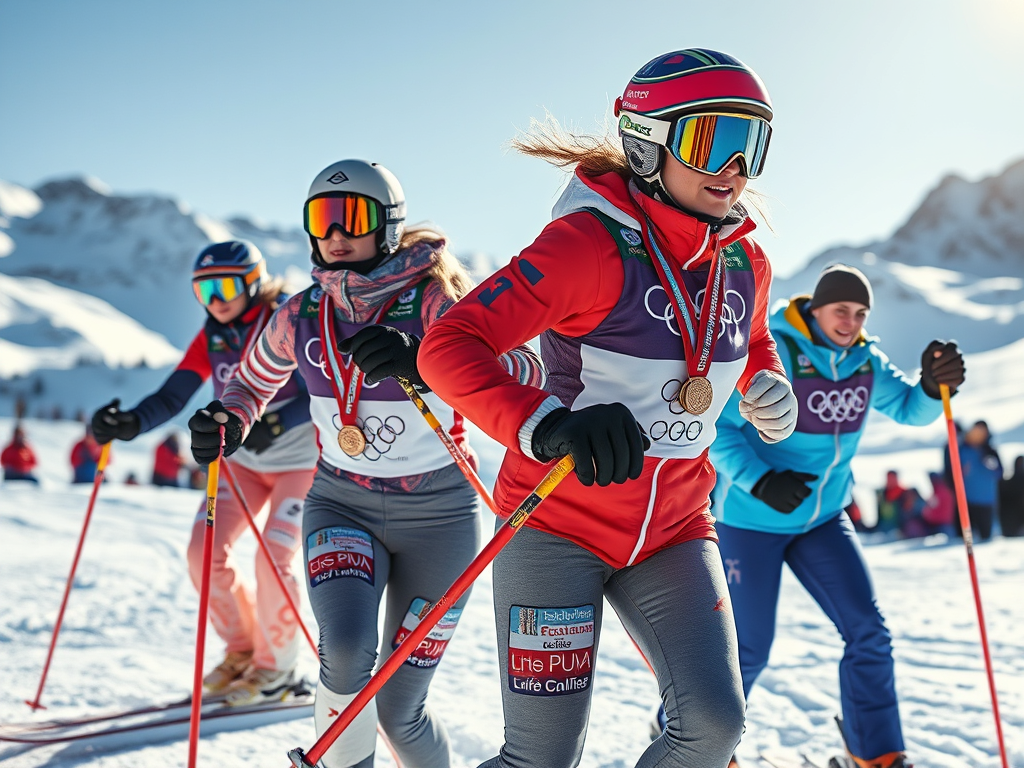

In skiing, where ‘champions pull up champions,’ U.S. women ahead of the men

It’s hard to ignore the growing disparity in performance between American men and women in Alpine and Nordic skiing.
At the recently concluded Alpine World Championships in Saalbach, Austria, the U.S. women secured four medals—two of them gold. Meanwhile, their male counterparts left empty-handed.
Now, as the Cross-Country Skiing World Championships unfold in Trondheim, Norway, expectations are high for the women’s team, led by Olympic and world champion Jessie Diggins. The men, however, haven’t reached the podium at an Olympics or world championship since Bill Koch’s bronze medal in the 30-kilometer race back in 1982.
Although the U.S. Nordic skiers function as a unified team, the men are well aware of this historical gap—and they’re eager to change the narrative.

“It’s not exactly a rivalry, but as a men’s team, we aim to match the women’s success,” said Ben Ogden, widely considered the American man with the best shot at a world championship medal, during a recent press conference from Norway. “So either they slow down, or we step up.”
His teammate and close friend, Gus Schumacher, immediately interjected: “We have to step up.”
This trend extends beyond skiing.
At the 2024 Summer Olympics in Paris, American women claimed 67 of the nation’s 126 medals, continuing a streak of outshining the men for the fourth consecutive Summer Games.
In the Winter Olympics, the shift has been just as evident. In 2006, the U.S. men won 16 medals, double that of the women’s eight. But by 2014, the tally was even at 13 each. The women pulled ahead in Pyeongchang in 2018, and by Beijing 2022, they had secured 13 medals compared to the men’s eight—all despite Mikaela Shiffrin, arguably the greatest skier of all time, enduring a rare medal-less performance. The U.S. also earned four medals in mixed-gender events.
This pattern in sports may reflect a broader societal shift. Women now make up 58% of U.S. college students, a gap that has widened in recent years. Not only are they enrolling in greater numbers, but they’re also achieving more.
A 2023 Pew Research Center report highlighted that 47% of women aged 25-34 have earned an undergraduate degree, compared to just 37% of men. Since 1995, the percentage of women attaining degrees has jumped by 22 points, while the increase for men has been just 12 points.
But back to skiing—soon to take center stage in the American sports conversation as the 2026 Winter Olympics in Italy approach.
Leading the charge in assembling the strongest U.S. ski team possible is Anouk Patty, a former collegiate skiing champion and business executive who now serves as the Chief of Sport Performance for U.S. Ski and Snowboard.
Patty has thought deeply about the gender disparity in skiing and has a few key insights on the matter—along with a strategy for closing the gap.
One major factor, she notes, is the long-term impact of Title IX. The 1972 civil rights law required equal access to education programs, including sports, for women, which triggered a cultural shift. Over time, it became the norm for parents to encourage their daughters to play sports, just as they did their sons.
This shift led to a wave of female sports icons—Serena Williams in tennis, Angela Ruggiero in hockey, Julie Foudy in soccer—who, in turn, inspired the next generation.
“Now, those little girls have grown into elite athletes,” Patty explained. “And many other countries are just starting to catch up because, for years, the U.S. was one of the few nations where large numbers of girls played organized sports.”

In Alpine skiing, Patty sees a strong tradition of mentorship among female athletes. Picabo Street paved the way for Lindsey Vonn, who now mentors rising star Lauren Macuga. Macuga, a breakout performer this season in speed events, is one of three sisters competing for Team USA in Italy next year—her sister Alli in moguls, and Sam in ski jumping.
Vonn, despite coming out of retirement at 40 after knee surgery, has remained a guiding force for younger athletes. She regularly meets with up-and-coming skiers in Park City, Utah, offering advice and encouragement. Jackie Wiles and Breezy Johnson have also taken on mentoring roles.
Shiffrin, who started winning championships at just 16, has similarly supported her peers, including Paula Moltzan and Johnson, who are hitting their stride at the perfect time—Johnson recently won her first major downhill race at the world championships.
Patty believes this culture of “champions raising champions” has been a key factor in the women’s dominance.
Chloe Kim, the two-time Olympic gold medalist in snowboarding, invited 18-year-old rising star Bea Kim to train with her in Switzerland before the season.
Kikkan Randall, a cross-country skiing legend, mentored Diggins, who is now guiding the next generation, including Sophia Laukli (24) and Sammy Smith (19). She has even provided support to Ogden and Schumacher, despite the generational gap.
The men’s team, however, has lacked this continuity.
Bode Miller, the most recognizable American male skier in recent history, was known for his independent approach, even opting to train separately from the U.S. team at times. Since retiring, he has been focused on family life rather than mentoring young skiers.
Ted Ligety, another standout from the past two decades, has also been less involved with the next generation.
Patty believes this has been a missed opportunity. Miller and Ligety’s passion for the sport was infectious—they experimented with equipment, training methods, and conditioning in ways that today’s young male skiers have yet to fully embrace.
“The younger guys haven’t quite developed the same obsession with the sport,” Patty noted. “Bode had some unconventional training methods—like dragging tires up hills—but he was the strongest athlete on the circuit. These guys need to fully commit to that level of preparation.”
She is now working with club-level coaches to instill this mentality in young skiers, making clear what it takes to compete at the highest level.
Rebuilding takes time, she acknowledged. The men’s coaching staff has undergone several changes in recent years, and trust takes time to develop.

“If you believe in the idea that champions create champions, then it’s clear we don’t have that yet with the men’s team,” Patty said, particularly in technical events like slalom and giant slalom. “We need strong, highly successful male athletes to pull up the next generation.”
And, of course, a little luck wouldn’t hurt.
Four different U.S. women stood on the podium at the Alpine World Championships—Johnson, Shiffrin, Moltzan, and Macuga. All were healthy enough to compete, which is never guaranteed in a sport with a near-100% injury rate.
Shiffrin, still recovering from a puncture wound suffered in a brutal crash last November, didn’t win an individual event but joined Johnson to claim gold in the team combined.
As for Ogden, he’s hoping for similar fortune. After battling the flu 10 days ago, he assured reporters that he had recovered in time for the world championships.
“Not ideal,” he admitted, “but better than last year when I had mono and had to cut my season short. Or getting sick in the middle of competition.”
After all, as he put it, “You don’t get to decide when you’re sick.”




Leave a Reply