
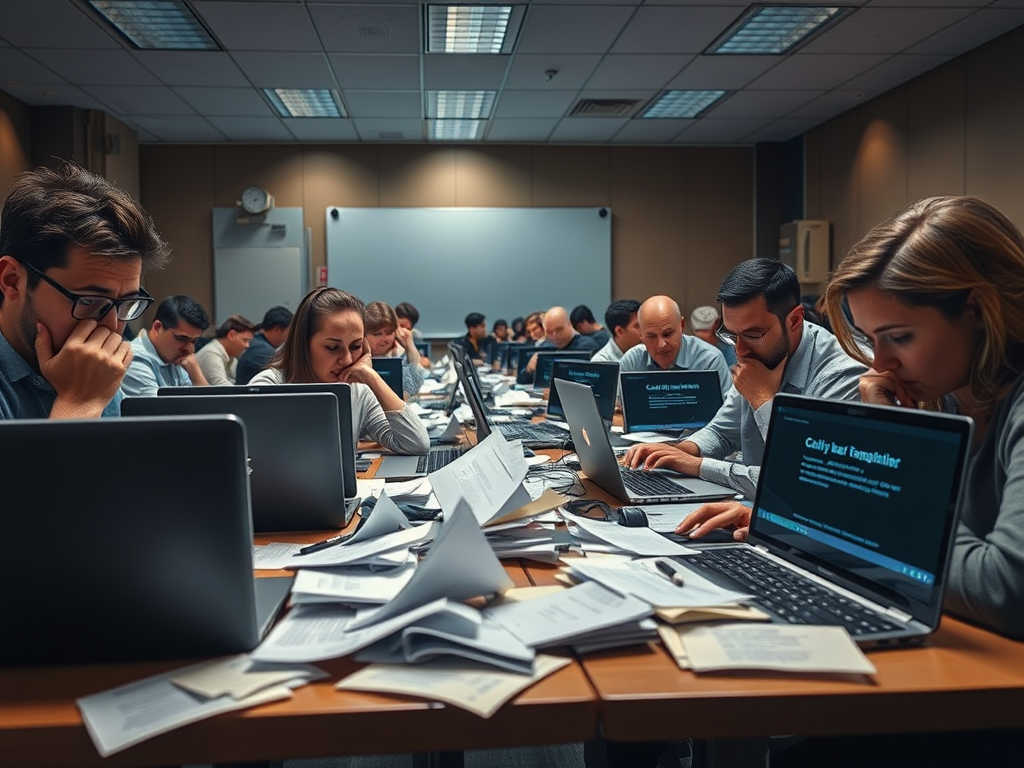

Problems With New California Bar Exam Enrage Test Takers and Cloud Their Futures

Even under typical conditions, the California bar exam is a grueling final challenge for aspiring lawyers before they can begin practicing. However, last week’s test proved to be even more nightmarish than usual. Candidates found themselves in a state of uncertainty due to technical failures, delays, and what many described as oddly worded questions that bore little resemblance to their preparation materials.
The chaotic rollout of the newly revamped exam—approved by the California Supreme Court in October and promoted by the state bar as a cost-saving measure—has sparked outrage among test takers and the broader legal education community. In response, California lawmakers have launched an investigation, and a lawsuit has been filed.
“Any attorney who has taken the bar exam will tell you how incredibly challenging and stressful the experience is,” said Erwin Chemerinsky, dean of the University of California, Berkeley, School of Law. “For test takers to endure all that, only to be forced to retake it due to the bar’s incompetence, is simply unacceptable.” Chemerinsky, along with other law school deans, had voiced concerns about the exam before its approval.

The exam’s flawed administration, conducted digitally, has left many test takers in a precarious situation, jeopardizing both their career prospects and personal finances. Many had taken weeks off work, sacrificed time with their families, and relied on passing the February test for job offers that required bar admission.
“I just feel cheated,” said Zack Defazio-Farrell, one of the test takers. “You invest a huge amount of money in preparation, you lose out on income during that time, and then this happens.”
Over the course of the two-day exam, candidates reported a range of technical issues. The first day consisted of five one-hour essay sessions and a 90-minute legal task section, while the second day involved 200 multiple-choice questions split into four 90-minute sessions. Many test takers experienced delays exceeding an hour just to access the exam, while some were unable to access it at all. Others encountered persistent system crashes, lagging response times, and a malfunctioning copy-and-paste feature.
In addition to technical problems, candidates found the questions themselves troubling. Some were poorly worded, missing key information, contained typos, or were simply incomprehensible. According to reports from the state bar, even on-site proctors frequently lacked answers to basic queries.
The company responsible for both the exam’s technology and proctoring, Meazure Learning, introduced remote testing, a departure from previous years. However, the company now faces a class-action lawsuit from test takers. Meazure Learning did not respond to requests for comment, but its website claims it has over three decades of experience in developing secure and reliable licensing exams.
The state bar, which projected the new exam would save up to $3.8 million annually, has since announced an investigation into whether Meazure Learning failed to meet its contractual obligations. A full review of how many test takers were affected was still ongoing as of Saturday.
State Senator Tom Umberg, chair of the judiciary committee responsible for overseeing the state bar’s funding, confirmed that an inquiry would be conducted. “We will conduct a thorough review to determine what went wrong and how to ensure this never happens again,” he said.
The redesigned exam was created by Kaplan North America, replacing the questions previously developed by the National Conference of Bar Examiners, which supplies bar exams in most U.S. states. The California state bar has maintained that Kaplan’s questions underwent the same level of scrutiny as past exam materials.
Russell Schaffer, a spokesperson for Kaplan, stated that the exam questions underwent a rigorous quality control process. He added that Kaplan was unaware of any typos in the questions it provided.
For decades, California’s bar exam has been known as one of the toughest in the country, with even top law graduates frequently needing multiple attempts to pass. Notable figures—including former governors Jerry Brown and Pete Wilson, as well as Vice President Kamala Harris—failed the exam on their first try. Although the passing score was slightly lowered in recent years, it remains among the most difficult bar exams in the U.S.
Concerns about technical issues were raised months ago after a pilot exam in November experienced glitches for some test takers. However, the state bar dismissed those problems as isolated incidents.
Perhaps anticipating potential problems, the bar offered a fee waiver for the next test date to anyone who withdrew from or failed the February exam. The bar exam is administered twice a year, in February and July.
In a statement on February 21, the board of trustees of the state bar acknowledged the botched rollout. “This new exam has not been implemented as it should have been, and we, along with the state bar leadership and staff, deeply apologize,” the board said. “Ongoing issues with test locations, scheduling, technical failures, and miscommunications have distracted applicants from their studies and caused unnecessary confusion.”
Out of the 5,600 individuals who registered for the February exam, 1,066 withdrew, according to the state bar.
By Friday, the bar announced that it was considering possible remedies for those affected by technical failures, including score adjustments. Chemerinsky has urged the bar to grant provisional licenses to test takers and revert to the previous exam format.
For candidates unable to complete the exam, the bar initially offered a retake this week. However, that opportunity was postponed after some test takers allegedly leaked the exam questions online.
For those who must now wait until July to retake the test, the delay offers little solace. Many fear it will have severe financial consequences, particularly for those who needed to be licensed by May when February’s results are released.
“If I have to wait until July, I probably won’t be living in California anymore,” said Alexandra Sennet, who has accumulated hundreds of thousands of dollars in law school debt. She explained that her job offer is contingent on being licensed by May.
Sennet also faces mounting medical bills from a spinal injury sustained in a car accident, which prevented her from taking the bar exam last July. The injury has limited her ability to work a steady job.
“I am literally relying on this to pay my bills,” she said. “This is my livelihood.”
For others, the delay poses challenges beyond financial struggles. Becky Hoffman, 38, pursued a law career to build a better future for her three children, sacrificing time with them throughout law school. In the weeks leading up to the exam, she wrote more than 45 essays and answered over 1,600 multiple-choice questions in preparation.
After the second day of testing ran late due to technical glitches, Hoffman stepped outside the testing center, where her wife and children were waiting to pick her up.
“I tried my best to stay strong and tell them, ‘It’s over, Mommy is done, and I’m so happy to finally have more time with you,’” she said. “But I don’t know if that’s true anymore.”




Leave a Reply