
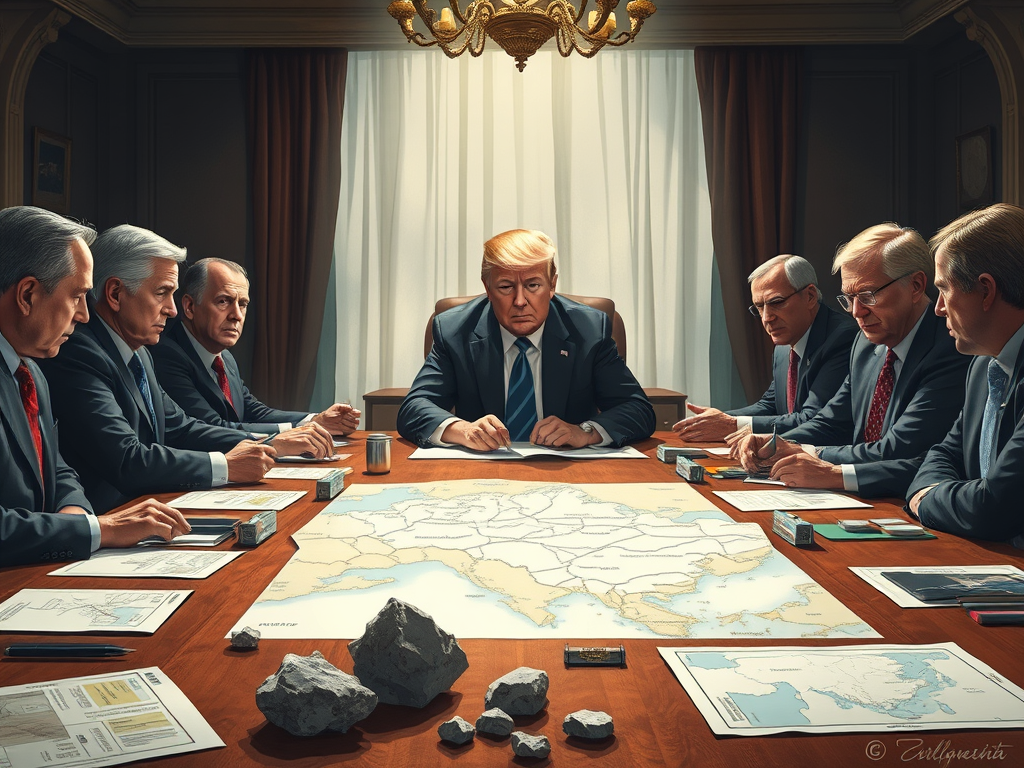

How Trump and Biden’s Focus on Minerals Became Core to U.S. Foreign Policy

President Trump’s sudden focus on Ukraine’s mineral resources seemed unexpected at first.
Earlier this month, he sent his Treasury secretary to Kyiv to negotiate with Ukrainian leaders and soon after, began applying public pressure in a manner that some critics likened to the tactics of a Mafia boss extorting money.
“I want security of the rare earth,” Trump declared.
However, Trump’s concern with critical minerals has been evident since 2017 when he issued an executive order on the matter during his first term. President Biden, too, has taken an interest in these resources.

Trump’s recent remarks regarding Ukraine’s mineral assets were not the first time he had hinted at acquiring the mineral resources of other nations. He had previously discussed securing mineral resources in Greenland and Canada. In fact, Canada’s Prime Minister, Justin Trudeau, revealed that Trump’s interest in Canadian minerals made his threats of annexation feel like a real concern.
Seizing control over mineral wealth from foreign countries has become a key foreign policy goal for Trump, reflecting some of the most imperialistic rhetoric of his presidency. This drive is reminiscent of historical empires that expanded their territories in pursuit of valuable resources.

After nearly two weeks of intense negotiations, U.S. and Ukrainian officials reached an agreement last Tuesday on a framework for sharing revenues generated from Ukraine’s critical minerals.
Critical minerals are non-fuel materials that are crucial for technologies like energy systems and are at risk of supply chain disruptions. The U.S. Department of Energy identifies these minerals, which include those used in electric vehicle batteries and missile systems, as essential to modern life. A list of 50 critical minerals was published by the U.S. Geological Survey in 2022, ranging from aluminum to zirconium.

For the past decade, the United States has been heavily invested in securing critical minerals, primarily due to competition with China.
Biden’s administration took steps to diversify the global mineral supply chain by creating international coalitions. These efforts aimed to ensure that critical minerals would not be monopolized by China. The U.S. even partnered with countries like Ukraine, Greenland, and Canada to secure these resources.

In fact, last fall, Ukraine and the U.S. nearly finalized a deal where Ukraine would have informed the U.S. about potential mineral projects in advance, giving American companies or their allies time to bid on contracts. The U.S. would also assist Ukraine with technical support in mapping and regulation.
Trump, however, took a more aggressive approach.
Jose W. Fernandez, a key figure in the Biden administration’s efforts on critical minerals, criticized Trump’s tactics. “These countries want investment, not a colonial relationship,” he stated, emphasizing that they prefer partnerships with American companies, not coercive deals.
Last September, Ukrainian President Volodymyr Zelensky introduced a “victory plan” against Russia, which included proposals for mineral partnerships. However, negotiations faltered when Ukrainian officials delayed the signing of agreements with the U.S. as Trump won the election.

Earlier this month, Zelensky rejected a proposal presented by Treasury Secretary Scott Bessent in Kyiv, which would have required Ukraine to share half of its resource revenues, including from minerals, oil, and gas, as well as earnings from ports and infrastructure.
Trump also demanded $500 billion from Ukraine, claiming that the U.S. was entitled to repayment for its aid during the Biden administration. Critics labeled these demands as greedy, colonial, and mercantilist.
Despite some of these demands being scaled back, the framework still includes vague references to security guarantees for Ukraine, which Zelensky has deemed essential for protecting the country against future Russian aggression. Trump, however, indicated that his guarantees would be minimal.
Abigail Hunter, of the Center for Critical Minerals Strategy, noted that countries view their natural resources as crucial to their sovereignty and development. Consequently, negotiations over these minerals are highly sensitive, as governments are wary of foreign control or exploitation.
Meanwhile, China continues to exert considerable influence over the global supply of critical minerals, refining a significant portion of the world’s supply. The U.S. relies heavily on imports, with China being the dominant producer of many key minerals.
Trump’s executive order in 2017 aimed to secure the U.S.’s supply of critical minerals and led to assessments by the U.S. Geological Survey in 2018 and again in 2022.
Several foreign leaders have attempted to leverage their countries’ mineral wealth in exchange for American military or economic support. In Afghanistan, former president Ashraf Ghani promoted the country’s mineral resources in hopes of securing U.S. military presence, but his efforts ultimately failed.
Trump’s attention to mineral resources continued in subsequent years. In September 2020, he issued an executive order calling for a reduction in the country’s dependence on foreign adversaries, particularly China, for critical minerals.

The coronavirus pandemic further emphasized the vulnerabilities of global supply chains, prompting both Trump and Biden’s administrations to focus more on securing critical minerals from reliable sources. Biden’s administration, for instance, sought to reduce the U.S.’s reliance on foreign minerals by addressing supply chain risks.
Last year, the State Department launched the Minerals Security Partnership, a coalition of 15 countries working to expand the global supply of critical minerals. This group, including Ukraine and Greenland, is collaborating to develop their mineral sectors.
Ukraine and Greenland have long been seeking foreign investments in their mineral industries, with Greenland recently hosting a forum to present projects to potential investors.
In his first term, Trump expressed interest in purchasing Greenland, largely influenced by business associate Ronald S. Lauder. Another of Trump’s allies, Howard Lutnick, has ties to mining projects in Greenland through his firm’s investments.
Both Trump’s administration and Indian officials have acknowledged the strategic importance of critical minerals, especially in the context of countering China’s dominance.
In a recent meeting with India’s Prime Minister Modi, Trump highlighted the opportunity for collaboration on critical minerals, framing it as part of a broader energy strategy.
As these discussions continue, it’s clear that critical minerals will remain a central issue in U.S. foreign policy, with various nations, including the Dominican Republic, being courted for their mineral resources.




Leave a Reply