
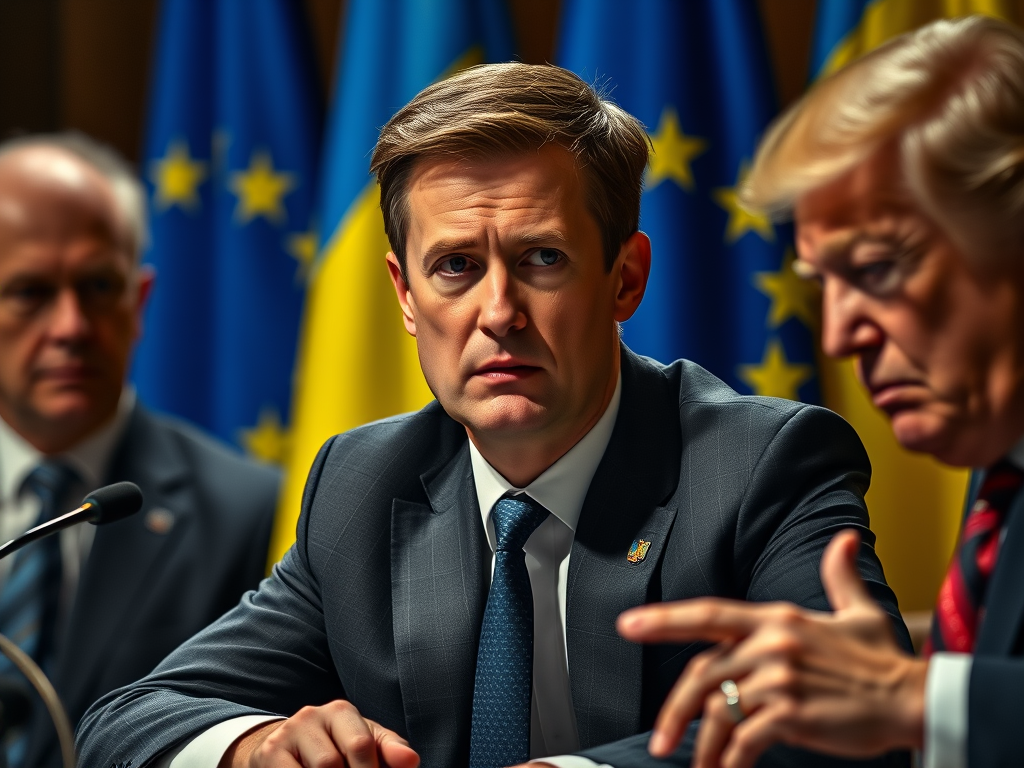

Facing Trump’s Hostility, Ukraine Weighs Its Options. But They Are Few.

Since Donald Trump took office, his increasingly hostile rhetoric towards Ukraine has forced the country’s leadership to face an uncomfortable truth: the U.S. can no longer be relied upon as a steadfast ally and may even become an obstacle in their efforts to resolve the conflict with Russia.
Over the past two weeks, Trump has initiated direct peace talks with Russia, sidelining Ukraine’s objections to being excluded from the discussions. He has called Ukraine’s president, Volodymyr Zelensky, a “dictator” and falsely accused the country of provoking the war that Russia began with its 2022 invasion.
As the war enters its fourth year, this growing tension has led Ukraine to reevaluate its influence over U.S. policy, questioning whether it still has any leverage, and has prompted the search for alternative ways to safeguard its interests.https://svtoday.org/2025/02/25/ukraines-shift-navigating-trump-and-european-alliances/

However, options are limited and none are particularly favorable, according to analysts and Ukrainian officials. One potential approach is to try to win Trump’s favor by offering lucrative economic deals, such as an agreement on minerals—one that officials claim has finally been reached after extensive negotiations.
If U.S. support diminishes, Ukraine may have to rely on holding out on the battlefield for as long as possible—perhaps only a few more months—hoping that Trump will eventually realize that peace talks cannot progress without Ukraine’s involvement.
In the meantime, Ukraine is shifting its focus toward Europe, positioning the continent as a new primary partner and potential security guarantor. Recently, President Zelensky has held multiple talks with European leaders about increased military aid, including the possible deployment of peacekeeping forces. On Monday, French President Emmanuel Macron made a case for Ukraine at the White House.

Nonetheless, “Ukraine should not expect U.S. support in negotiations,” warned Volodymyr Fesenko, a Ukrainian political analyst, in a recent Facebook post—a sentiment that would have been unthinkable just months ago.
Adapting to this new reality has proven difficult for Ukrainians, according to Alyona Getmanchuk, head of the New Europe Center think tank in Kyiv and a potential candidate for Ukraine’s next NATO ambassador. “We’ve grown accustomed to having the U.S. on our side, and we still need them to be fully supportive,” she said in an interview.
After Trump’s return to office in January, Ukraine hoped to leverage his business mindset to gain leverage. The country offered access to vital minerals used in modern technology manufacturing in exchange for continued American support.

But Trump flipped the proposal, demanding a $500 billion deal for Ukraine’s natural resources—minerals, oil, and gas—without offering anything in return. He framed this as “payback” for U.S. assistance, though the actual value of American aid to Ukraine so far is about $120 billion.
Ukraine has rejected several iterations of this deal, deeming them too burdensome. On Tuesday, officials announced that an agreement had been reached, but it remains unclear what Ukraine will receive in return.
The impact of this deal on Ukraine’s relationship with Trump remains uncertain. While it allows Trump to claim a major financial win, giving up revenue from natural resources could divert funds needed for Ukraine’s war effort and burden the country with future debt.
One possible advantage for Ukraine, experts argue, is Trump’s ego. The U.S. president has boasted about his ability to end the war quickly, but that cannot happen without Ukraine’s consent. This gives Kyiv some leverage.
“Without Ukraine’s approval, Trump won’t be able to fulfill his promise as the great peacemaker he claims to be,” said Getmanchuk. “He needs Zelensky to accomplish this peacekeeping mission.”
Ultimately, experts believe that Ukraine must decide whether to continue the fight. The key factor is whether it can withstand the battle long enough—potentially without U.S. support—to avoid accepting a deal with unfavorable terms.
Ukraine’s government has stated that it has enough resources to continue its fight through the first half of this year. However, structural challenges within its military, including a shortage of frontline soldiers, war fatigue leading to desertions, and coordination issues between brigades, have weakened its defense, which Russian forces are exploiting.
Nonetheless, military analysts highlight that Ukraine does have some advantages. The country has significantly ramped up its domestic weapons production, including nearly completing in-country production of drones—its primary tool for targeting Russian troops.
According to Solomiia Bobrovska, a member of the Ukrainian Parliament’s defense and intelligence committee, Ukraine’s defense industry now meets about 40 percent of the country’s weapons needs.
Nico Lange, a former German Defense Ministry official and senior fellow at the Munich Security Conference, believes that “holding the line and saying, ‘We will continue to defend ourselves,’ is what strengthens Ukraine’s position in this unfortunate situation.”
The most promising path for Ukraine seems to be its pivot toward Europe.
Zelensky mentioned last week that he has begun discussions with European leaders to have them fund Ukraine’s military efforts “if the United States decides not to.” Over the past few days, he has had numerous conversations with European counterparts, including a major summit in Kyiv on Monday.
Several European nations have already begun funding Ukraine’s domestic defense industry, and the European Union is considering a new support package for Ukraine, potentially exceeding €20 billion (about $21 billion).
France and Britain have also taken the lead in discussions about deploying European peacekeeping forces to Ukraine as part of a postwar settlement, aimed at deterring further Russian aggression. After Macron’s talks with Trump on Monday, British Prime Minister Keir Starmer is expected to advocate for this proposal during his visit to Washington this week.
However, Starmer has acknowledged that deploying European forces would not be feasible without a “U.S. backstop” to deter Russia, likely in the form of American air support. Furthermore, Ukrainians remember Europe’s failure to fulfill promises, such as delivering one million artillery shells by March of the previous year.
At a security forum in Kyiv last Friday, representatives from the European Union, NATO, Canada, and retired U.S. General David Petraeus agreed that Ukraine’s future strategy must involve multiple approaches: strengthening ties with Europe, boosting domestic weapons production, and, in the short term, mending relations with Trump.
However, Kyiv officials are not ruling out the possibility of Trump changing his stance and supporting Ukraine, especially if negotiations with Russia stall.
Trump’s recent barrage of statements—often delivered late in the day in Ukraine—has led to a new joke circulating in Kyiv’s political circles: “Better to fall asleep early than to listen to Trump on Ukraine.”




Leave a Reply