

U.S. and Ukraine Agree to Minerals Deal, Officials Say

Ukraine has agreed to allocate a portion of its mineral resources’ revenue to the United States, according to both Ukrainian and American officials on Tuesday. This decision follows sustained pressure from President Trump, which included a mix of threats and insults.https://svtoday.org/2025/02/25/ukraine-allocates-mineral-revenue-to-u-s-key-agreement-explained/
Details of the agreement remain unclear, and it’s still uncertain what Ukraine will receive in return after days of tense negotiations. Ukrainian President Volodymyr Zelensky has consistently demanded security guarantees in exchange for the mineral rights, as Russia’s war enters its fourth year.
Earlier drafts of the agreement reviewed by The New York Times did not include such security assurances. Trump had insisted on “payback” for past U.S. military aid to Ukraine, pushing the U.S.-Ukraine relationship into a more transactional, business-like model.
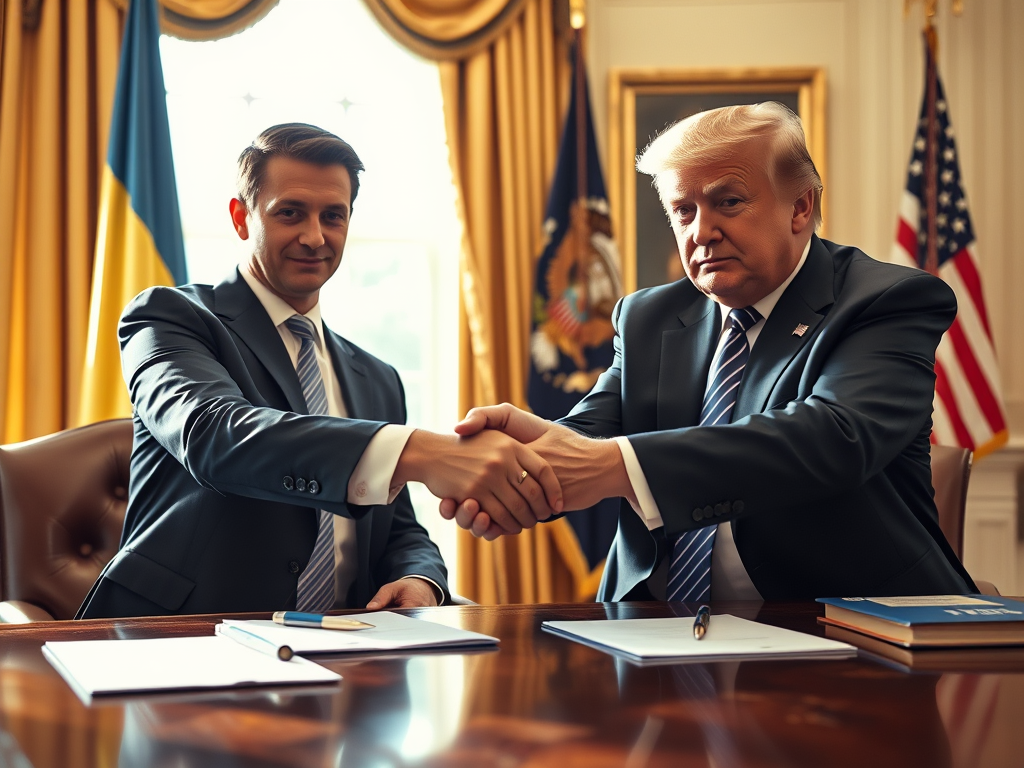
A final version of the agreement was sent to Ukraine on Tuesday, according to an American official. Treasury Secretary Scott Bessent and his Ukrainian counterpart are expected to sign it first, followed by a signing ceremony with Trump in Washington. Both U.S. and Ukrainian officials provided details anonymously about the private talks.
Speaking from the Oval Office, Trump said, “I hear he’s coming on Friday. Certainly, it’s OK with me if he’d like to. And he would like to sign it together with me. And I understand that’s a big deal, very big deal.”
Zelensky had insisted on signing the deal personally with Trump. However, he had previously rejected a draft due to the absence of specific U.S. security guarantees and the inclusion of a demand for $500 billion in mineral rights, along with other conditions Ukraine deemed unacceptable.
In recent days, Ukraine appeared to soften its stance after the U.S. removed some of the more stringent terms.
While the final details are still under wraps, the draft agreement discussed on Tuesday no longer includes the requirement for Ukraine to contribute $500 billion to a U.S.-owned fund. It also eliminates the provision requiring Ukraine to repay double the amount of any future U.S. aid—something Zelensky had equated to imposing long-term debt on his country.
Instead, the revised draft proposes that Ukraine contribute half of its future natural resource revenues, including those from critical minerals, oil, and gas, into a fund. The U.S. would hold the largest financial stake in this fund, according to American law, but not necessarily full ownership. Some of the fund’s proceeds would be reinvested into Ukraine’s economy.
The U.S. would also commit to supporting Ukraine’s future economic growth.
The negotiations surrounding mineral rights have taken place as Russia appears to be gaining ground in the war. Meanwhile, Trump has positioned himself in alignment with Russian President Vladimir Putin, while harshly criticizing Zelensky.
Trump has called Zelensky a “dictator” and falsely claimed that Ukraine instigated the war, despite it being initiated by Russia’s invasion in February 2022.
Trump has pressured Zelensky to finalize the deal, warning that Ukraine “better move fast or it’s not going to have a country left.” Zelensky responded by accusing Trump of being trapped in a Russian “disinformation bubble.”
This agreement illustrates Trump’s transactional approach to foreign policy, akin to his past efforts to leverage U.S. economic power to pressure allies like Canada and Colombia into compliance with his demands.
Critics argue that earlier versions of the deal failed to recognize the immense human cost Ukraine has already borne in the conflict to safeguard broader European security. By repelling Russia’s initial invasion, preventing Moscow from establishing a military presence on NATO’s western borders, and inflicting significant losses on Russia’s military, Ukraine has made substantial sacrifices.
Zelensky had proposed a resource-based deal last fall to secure more U.S. military support. However, when Treasury Secretary Bessent visited Kyiv on February 12, Zelensky rejected the terms.
“I am not signing something that 10 generations of Ukrainians will have to repay,” Zelensky said at a press conference. Yet, under mounting pressure, he admitted that Ukraine may have no choice but to accept the agreement.
The White House has argued that even without explicit security guarantees, American economic interests in Ukraine would serve as a deterrent to any future Russian aggression.
“What better could you have for Ukraine than to be in an economic partnership with the United States?” said Mike Waltz, U.S. National Security Adviser, last week.




Leave a Reply