
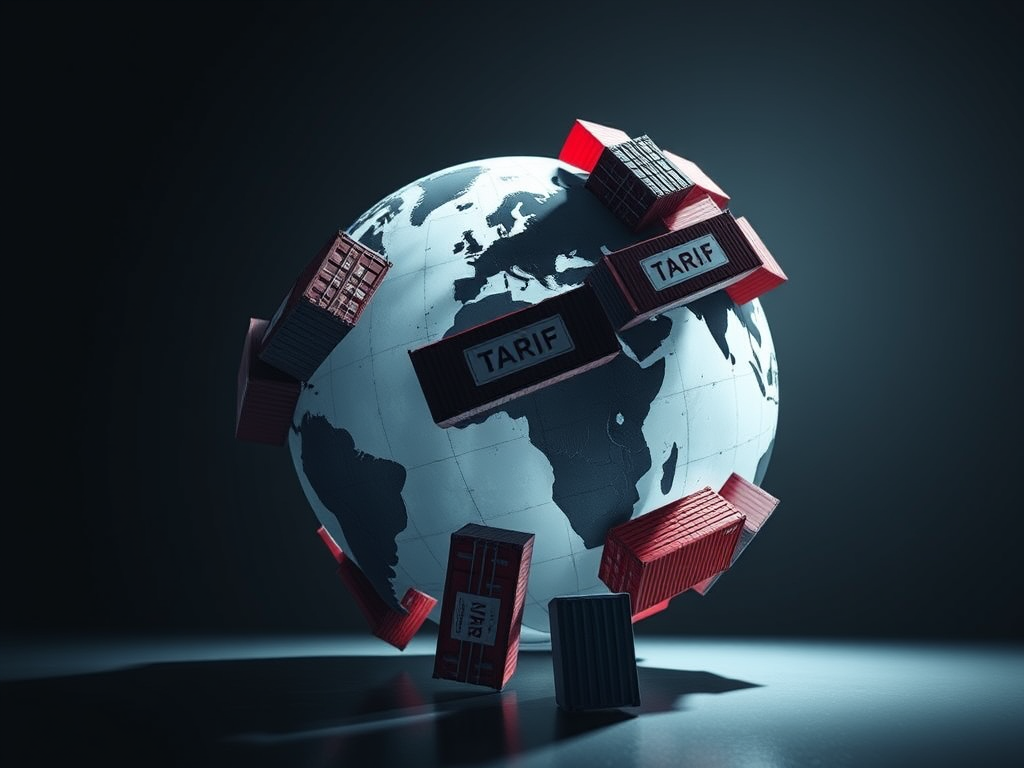

How Trump’s One-for-One Tariff Plan Threatens the Global Economy

The global economy was already facing a complex mix of challenges, including geopolitical tensions, a slowdown in China, and the growing complexities of climate change. Then, President Trump introduced a plan to disrupt decades of established trade policy.
By initiating a process to impose what he called “reciprocal tariffs” on American trade partners, Trump heightened uncertainty for international businesses and expanded the scope of his ongoing trade conflict.https://svtoday.org/
The basic premise behind reciprocal tariffs is simple: the same tariffs that American companies face when exporting to other countries should apply to imports from those countries as well. Trump has long advocated for this approach, framing it as a matter of fairness—counteracting the fact that many U.S. trading partners impose higher tariffs on American goods.
However, implementing this principle is far from simple. Calculating tariffs on thousands of products from over 150 countries presents an enormous challenge for a wide variety of companies, from American manufacturers relying on imported parts to retailers sourcing products from abroad.
“It’s a monumental task,” said Ted Murphy, an international trade expert at Sidley Austin law firm in Washington. “For each product, each tariff classification, you could have 150 different duty rates. It’s a vast and complicated system—from Albania to Zimbabwe.”
On Thursday, Trump signed an order directing his agencies to study how to move forward with reciprocal tariffs, raising the risk of higher costs for American consumers during a time of growing concerns about inflation. This also presents a challenge to the president’s promises to lower prices on essential goods, like groceries. Furthermore, it could delay the Federal Reserve’s plans to reduce borrowing costs.
The move also signals a shift away from the multilateral trade system that has dominated for decades, where agreements were overseen by the World Trade Organization (WTO). Trump appears to be ushering in a new era, one where international trade agreements are replaced by bilateral negotiations focused on national interests.
This shift could exacerbate existing strains on global supply chains, already under pressure from the ongoing trade war between the U.S. and China. Additionally, obstacles in critical shipping routes like the Suez and Panama Canals have pushed shipping prices to record highs.
Under the established WTO system, member countries agree on standardized tariffs for every type of good, with all members adhering to the same basic rate. These countries also negotiate treaties, either bilaterally or within regional trade blocs, to further reduce tariffs.
Trump has long criticized this system, arguing that the U.S. has been disadvantaged by trade deficits with countries like China, Mexico, and Germany. By announcing reciprocal tariffs, he signaled his intent to renegotiate trade terms to suit U.S. interests, without regard for existing agreements.
It seemed no accident that Trump made his announcement on the same day Indian Prime Minister Narendra Modi visited the White House. The U.S. runs a significant trade deficit with India, importing more goods than it exports, with a $45 billion shortfall last year.
Many of these imports—plastics and chemicals—face tariffs of under 6 percent when entering the U.S., according to World Bank data. By contrast, American products shipped to India face tariffs ranging from 10 to 30 percent.

If Trump’s administration were to reduce U.S. tariffs to match India’s, it would increase costs for American manufacturers that rely on these imported materials.
This pattern holds across various industries, from footwear in Vietnam to machinery and agriculture in Brazil, and textiles and rubber in Indonesia.
On Thursday, the IPC, a leading trade association for the electronics industry, warned that increased trade protectionism could harm the U.S. economy.
“New tariffs will raise manufacturing costs, disrupt supply chains, and drive production offshore, further weakening America’s electronics industry,” said IPC president John W. Mitchell.
Some analysts view Trump’s approach as a negotiating tactic aimed at pressuring other countries to reduce their own tariffs, rather than a signal that the U.S. will lift its tariffs. If this is the case, recalculating tariff rates could eventually lead to lower prices.

“There are many ways this could backfire,” said Christine McDaniel, a former Treasury official under President George W. Bush and a senior research fellow at the Mercatus Center at George Mason University. “But if Trump can get other countries to open their markets, there’s a narrow path where this could actually promote trade,” she added.
Others caution that negotiations could be more influenced by Trump’s allies’ interests than by national objectives. For instance, Tesla, the electric vehicle company led by Trump supporter Elon Musk, could receive exemptions from tariffs on key components.
This uncertainty has left U.S.-based companies trying to predict how events will unfold as they weigh the costs of importing materials or finished goods. As the saying goes, businesses crave certainty—but that’s becoming increasingly scarce.
Since Trump’s first term, when he imposed tariffs on Chinese imports—a policy President Biden has continued—companies have shifted some production out of China to avoid the tariffs.

Soaring shipping costs have also encouraged businesses to nearshore, or move production closer to the U.S., to reduce transportation expenses. Retail giant Walmart has shifted orders from Chinese factories to India and Mexico, while Columbia Sportswear has explored manufacturing in Central America. MedSource Labs, a medical device maker, moved production from China to Colombia.
Trump has challenged the wisdom of such strategies by threatening tariffs of up to 25 percent on imports from Mexico, Canada, and Colombia, though he has often delayed or abandoned these plans. He has imposed blanket tariffs on steel and aluminum, and 10 percent tariffs on Chinese goods. What’s next in this ongoing saga is a guessing game for corporate executives.
Some speculate that this uncertainty might be intentional. Trump has long argued that his ultimate goal is to force companies to establish factories within the U.S. to avoid tariffs. The more countries he targets, the greater the risk for companies that choose to invest in plants abroad.
The issue is that even U.S.-based manufacturers rely on global supply chains for parts and raw materials. Over a quarter of American imports consist of components and materials, and making these goods more expensive could hurt the competitiveness of domestic companies, threatening U.S. jobs.

Last week, Ford Motor Company warned that tariffs on Mexico and Canada would severely disrupt its supply chains.
“A 25 percent tariff across the Mexico and Canadian border would create a hole in the U.S. industry that we’ve never seen,” said Ford CEO Jim Farley.
For now, the business world is left to navigate Trump’s statements, trying to discern whether they are simply tactics or the start of significant changes.
On spreadsheets used by multinational companies, the tariff rates for every country seem poised for a major overhaul—though that might not happen.
“We take Trump seriously, but not necessarily literally,” said trade lawyer Ted Murphy. “He speaks in broad strokes, but we have to wait and see what actually unfolds.”




Leave a Reply