
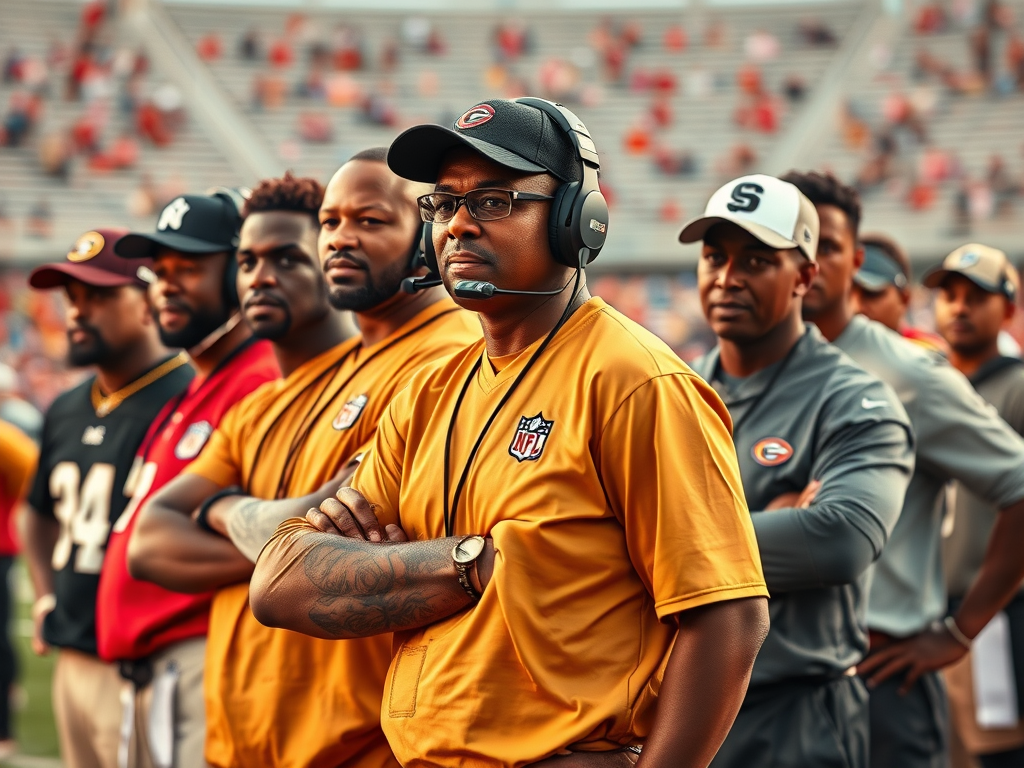

NFL’s progress with diversity in coaching ranks yet to translate to offensive coordinator

Until November 12, when the Chicago Bears promoted Thomas Brown to interim offensive coordinator, the NFL had not seen a single Black offensive coordinator. Later that month, after the Bears dismissed Matt Eberflus, they moved Brown to interim head coach and promoted Luke Beatty from wide receivers coach to become the only Black offensive coordinator in the league.https://svtoday.org/
“It’s kind of… sad,” Beatty remarked recently. “I definitely didn’t think we were still at that point.”
After the Bears’ coaching staff was let go following the 2024 season, Beatty became the receivers coach for the Las Vegas Raiders, bringing the number of Black offensive coordinators in the NFL back down to zero. With only one position remaining with the New Orleans Saints, Mike Kafka, part Puerto Rican, remains the only offensive coordinator of color in the league.
Many NFL executives remain hopeful that diversity in the offensive coordinator role will increase over time. Since the implementation of the Rooney Rule in 2003, the NFL has launched various programs aimed at enhancing diversity in coaching. While results have been slow, there is belief that these efforts are having a positive effect.
“I don’t think it means it’s not working,” NFL Commissioner Roger Goodell said when asked about the lack of diverse offensive coordinators. “These assistants are young, and they need exposure and experience to grow into offensive coordinators and eventually head coaches. It’s too early to say it’s not working, and I don’t accept that.”
After the firing of Jerod Mayo and Antonio Pierce, and the New York Jets hiring Aaron Glenn, the number of Black head coaches in the NFL has dropped to five: Todd Bowles, Raheem Morris, DeMeco Ryans, Mike Tomlin, and Glenn. Overall, there are seven head coaches of color, including Dave Canales and Mike McDaniel. While this represents progress—there were no more than three Black head coaches between 2019 and 2023—it has yet to be reflected in the offensive coordinator role.
“People of color don’t always get the same opportunities,” Beatty noted. “There are so many who have proven themselves. You hope that these biases will eventually disappear, just like they did with quarterbacks. When I was growing up, there were hardly any Black quarterbacks, but now the league is full of them. Hopefully, the same will happen in coaching.”
One challenge is the pathway to becoming an offensive coordinator, which often begins in the quarterback room—a position historically less accessible to Black individuals. However, the landscape has begun to change. Nearly two dozen quarterbacks of color started games last season, and a record number of nine quarterback coaches of color are currently working in the league.
“I knew when I entered the NFL that there weren’t many African Americans in the quarterback room,” said Kerry Joseph, the Bears’ former quarterbacks coach, who is Black. “You have to be prepared to embrace that challenge when you get those opportunities.”
Several diverse quarterback coaches worked with top quarterbacks this season, including Charles London (Seahawks), Thad Lewis (Buccaneers), Tee Martin (Ravens), and others.
In addition to these QB coaches, a number of diverse assistants from various roles had been considered for offensive coordinator positions, including Brown, Beatty, Nate Scheelhaase (Rams), Scottie Montgomery (Lions), Brian Johnson (Commanders), Marcus Brady (Chargers), Keenan McCardell (Vikings), and Troy Walters (Bengals).
Despite their success, the anticipated rise in the number of diverse offensive coordinators this offseason did not materialize.
“We hope what we’re seeing now is an anomaly,” said Jonathan Beane, NFL Senior Vice President and Chief Diversity and Inclusion Officer. “There’s no pipeline issue. There are strong, diverse candidates who are ready for offensive coordinator roles.”
During Jon Embree’s time in the NFL in the 1980s, coaching staffs often included only one Black assistant on offense and defense, and Black coordinators were rare. As Embree transitioned to coaching in the ’90s, he knew the challenges he would face.
“You understand it’s going to be uphill,” said Embree, now the Dolphins’ tight ends coach. “You just try to find a way to climb that hill.”
While Black offensive coordinators are still few, diversity among NFL defensive coordinators has steadily increased, with over a dozen holding those positions. Additionally, five of the seven head coaches of color have defensive backgrounds.
One factor in the disparity may be the greater diversity seen on defense, historically a more accessible area for Black players. Offense, often considered more analytical, is still seen by some as the “thinking” side of the game.
“Some people believe defense is more about aggression, whereas offense is thought to be more cerebral,” Beatty explained. “That’s clearly not true, but the perception remains. There are brilliant coaches at every position, and many are more than capable of being head coaches. But stereotypes still exist.”
Overcoming these stereotypes requires head coaches to build relationships with diverse assistants and move beyond outdated biases.
“When you’re a head coach, you’re going to hire people you trust,” McCardell noted. “That’s true in any industry.”
It would also help if head coaches were more open to hiring offensive coordinators from backgrounds outside of quarterbacks.
“Coaches are capable of being offensive coordinators; you just have to be willing to think outside the box,” Embree said. “It’s not necessarily a racial issue, but more about the copycat nature of the league.”

One exception to this mindset was former Buccaneers head coach Bruce Arians, who, during the team’s 2020 Super Bowl win, had three Black coordinators: Bowles (defense), Byron Leftwich (offense), and Keith Armstrong (special teams).
“That wasn’t by design,” Arians said. “They were just the best coaches I knew. We happened to win the Super Bowl. I thought other teams might follow suit.”
Arians believes that, given the right connections, any head coach can build a diverse staff, adding, “If you’re a head coach in the NFL, you should have the network to build a diverse team.”
Despite the disparity between the number of diverse quarterbacks and offensive coordinators, Arians remains hopeful that change will come.
“Eventually, the coordinator position will follow, and that will lead to more head coaching opportunities,” Arians said.
In response to protests and calls for change in 2020, many corporations, including the NFL, introduced diversity, equity, and inclusion (DEI) initiatives. While some of these initiatives have been rolled back, the NFL remains committed.
“We didn’t do this because it was a trend, and we’re not going to stop because it is,” said Goodell. “Our policies are designed to increase the number of people, especially people of color and women, who have opportunities in the NFL.”

The NFL has implemented programs like the Rooney Rule, which was expanded to include offensive coordinator, defensive coordinator, and quarterback coach positions. In addition, the league now requires at least one offensive assistant coach of color or woman per team, as well as other initiatives to develop diverse coaching talent.
“We’ve proven to ourselves that diversity makes the NFL better,” Goodell said.
Programs like the Bill Walsh Diversity Coaching Fellowship and the Quarterback Coaching Summit have been vital in fostering coaching diversity.
“I’ve been through pretty much all of them,” said Joseph. “It’s about intentionally using those programs to find talented coaches and give them a shot. But if these programs are short-lived, we miss an opportunity.”
Many believe the league could benefit from more sitting head coaches participating in diversity programs.
“It would be great if active head coaches attended the Accelerator program to see how candidates interact with staff and players,” McCardell said.

Some teams, like the Buccaneers, have taken matters into their own hands, creating initiatives like their coaching academy to give aspiring coaches a platform for hands-on experience.
Ultimately, while the NFL’s diversity programs have had a positive effect on head coaches and defensive coordinators, progress at the offensive coordinator level has been slower. Still, officials remain optimistic about the future.
“We’re confident that with our strong pipeline, progress will continue,” Beane said.
As the NFL strives to increase diversity, the ultimate hiring decisions lie with team owners, most of whom are still white. However, the league is committed to supporting the expansion of diverse coaching opportunities in the future.
“I believe if the league had more control over hiring, we’d see a different outcome,” said one NFL agent. “But right now, it’s still mostly wealthy white owners who feel more comfortable hiring people who look like them.”




Leave a Reply