
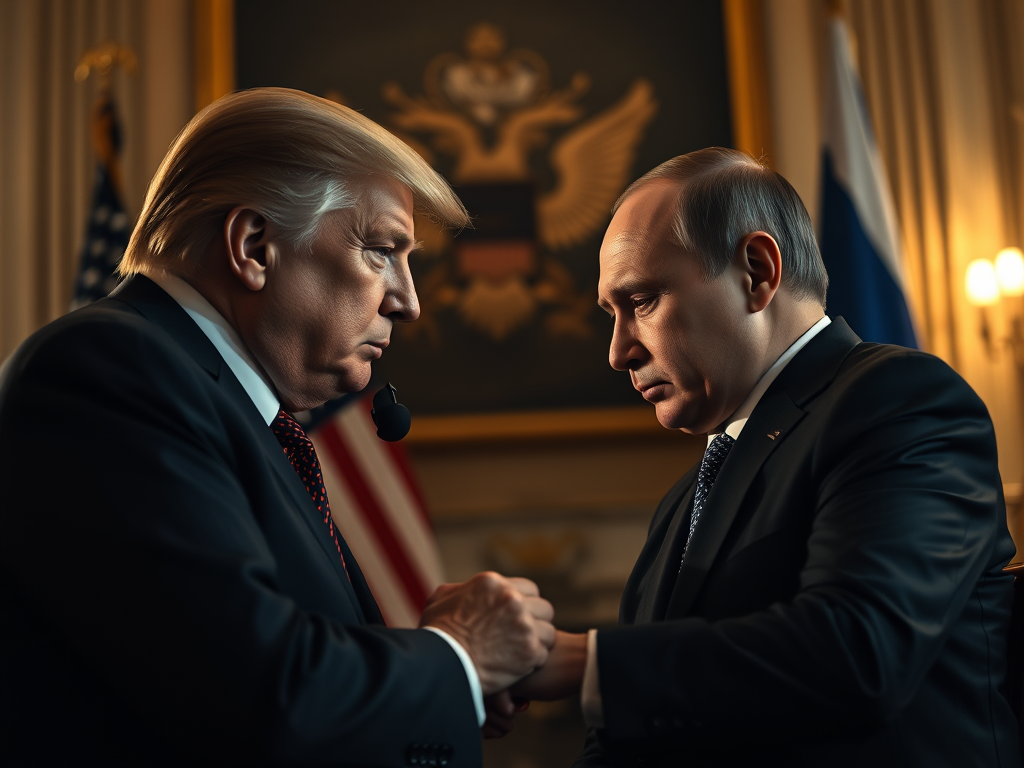

Trump Says Call With Putin Is Beginning of Ukraine Peace Negotiations

On Wednesday, President Trump revealed he had a “long and highly productive” phone conversation with Russian President Vladimir V. Putin, describing it as the start of negotiations aimed at ending the war in Ukraine.https://svtoday.org/
This marks the first confirmed talk between the two leaders during Trump’s second term, as he has emphasized to his advisors that securing a U.S.-backed resolution to the war, which Russia initiated, is a key priority for his administration.
“We discussed the strengths of our respective nations and the tremendous potential we could have by working together in the future,” Trump shared in a social media post. “But as we both agreed, the immediate goal is to stop the ongoing deaths in the Russia-Ukraine conflict.” (The death toll is estimated in the hundreds of thousands, not millions, as Trump suggested.)
For Putin, this call represented a significant shift, indicating the failure of Western efforts to diplomatically isolate him after Russia’s invasion of Ukraine nearly three years ago. Since Trump’s re-election last November, Putin has praised him, signaling Moscow’s hope that the new U.S. leader might alter Washington’s approach and reduce its support for Ukraine.
The discussion between Trump and Putin came one day after Russia agreed to release an American teacher in exchange for the U.S. sending back a convicted Russian cybercriminal.
Trump, who has long been concerned about the risks of nuclear conflict, has repeatedly sought to improve relations with Russia. At a summit in Helsinki, Finland, during his first term, Trump accepted Putin’s claim that Russia had not interfered in the 2016 U.S. election, a stance that contradicted the conclusions of U.S. intelligence agencies.
Trump’s presidential campaign last year included a bold pledge to end the Ukraine conflict in “24 hours,” a statement reflecting his confidence in his negotiation skills but also underscoring his commitment to securing peace.
His announcement of plans to work with Russia on a ceasefire comes amid fears in Ukraine that Trump’s growing rapport with Putin might sideline Ukraine in future peace talks.
Following his call with Trump, Ukrainian President Volodymyr Zelensky emphasized that he would be involved in the peace process, posting on social media that he and the U.S. president were “mapping out our next steps to halt Russian aggression and ensure a lasting, reliable peace. As President Trump said, ‘Let’s get it done.’”
Trump noted that his conversation with Zelensky “went very well,” adding that, like Putin, Zelensky was also committed to achieving peace. He stated that an initial meeting would take place on Friday in Munich, led by Vice President JD Vance and Secretary of State Marco Rubio.
However, Trump did not clarify Zelensky’s role in the talks he and Putin were initiating. Trump has long been skeptical of Ukraine’s government and has not shown a warm relationship with Zelensky.
Kremlin spokesperson Dmitri S. Peskov confirmed that the conversation between Trump and Putin lasted about 90 minutes. Peskov noted that the two leaders agreed to meet in person, with Putin inviting Trump to Moscow, which Trump also referenced in his social media post. Putin reportedly agreed with Trump that “the time has come for our countries to collaborate.”
On the topic of Ukraine, Putin told Trump that there was a need to address the “root causes of the conflict,” signaling that he would not accept a simple ceasefire and would likely demand broader concessions from Ukraine and the West.
The conversation between the two presidents occurred on the same day that U.S. Defense Secretary Pete Hegseth, speaking at NATO’s headquarters in Brussels, called it “unrealistic” for Ukraine to expect to restore its borders to what they were before Russia annexed Crimea in 2014. Hegseth also stated that the U.S. did not support Ukraine’s NATO membership as part of any feasible peace agreement.
Hegseth echoed Trump’s long-standing position that Europe should take greater responsibility for its own defense.
Trump later reinforced Hegseth’s comments, telling reporters that it was “unlikely” Ukraine would regain its pre-2014 borders, given that Russia had taken significant territory. However, he also indicated that some of that land could eventually be returned. Trump further argued that Ukraine’s NATO membership was not “practical.”
Despite this, Trump confirmed his intention to continue sending financial aid to Ukraine, stating it was crucial to “secure” that support. “If we don’t do this, Putin will claim victory,” Trump said, suggesting that the aid was an important leverage point in negotiations.
Trump indicated that Hegseth’s remarks had not undermined the negotiations with Russia, emphasizing his ongoing backing for Ukraine.
Following his call with Trump, Zelensky outlined a plan on social media that would ensure continued U.S. support in exchange for access to Ukrainian natural resources and the “preparation of a new agreement on security, economic cooperation, and resource partnership.”
The United Nations welcomed any efforts to facilitate peace talks between Russia and Ukraine. “We appreciate all efforts to resolve the war in Ukraine that involve both Russia and Ukraine,” said UN spokesperson Farhan Haq.
At a meeting of European foreign ministers in Paris, representatives from France, Germany, Poland, Italy, Spain, Britain, Ukraine, and the European Union affirmed their commitment to increasing support for Ukraine “in the face of Russia’s aggression.” The French Foreign Ministry said that Europe’s goal was to ensure Ukraine was in a strong position in any negotiations and that the country should be provided with solid security guarantees.
Trump’s social media post indicated that his negotiating team would include Senator Marco Rubio, CIA Director John Ratcliffe, National Security Advisor Michael Waltz, and Middle East envoy Steve Witkoff. Witkoff had just returned from Moscow, where he successfully retrieved American teacher Marc Fogel, who had been imprisoned in Russia for over three years.
Interestingly, Trump did not mention General Keith Kellogg, his appointed envoy for Russia and Ukraine. Kellogg, who has often advocated for a tougher stance on Russia, had previously suggested that Trump might increase sanctions to push for a peace deal.
White House Press Secretary Karoline Leavitt clarified that Kellogg remained “a critical part of the team” and was still very much involved in the administration’s efforts.
Trump had previously declined to confirm whether he had spoken to Putin before Wednesday, though several U.S. officials were unaware of any prior conversations.
While Trump has repeatedly praised Putin, calling him a “genius” after Russia’s invasion of Ukraine in 2022, he has shown a more critical stance in recent weeks, acknowledging that the invasion was a misstep for Russia.
“He’s not doing well, he can’t be happy about this,” Trump told reporters after his inauguration last month. “Russia is bigger, they have more soldiers to lose, but that’s no way to run a country.”




Leave a Reply