
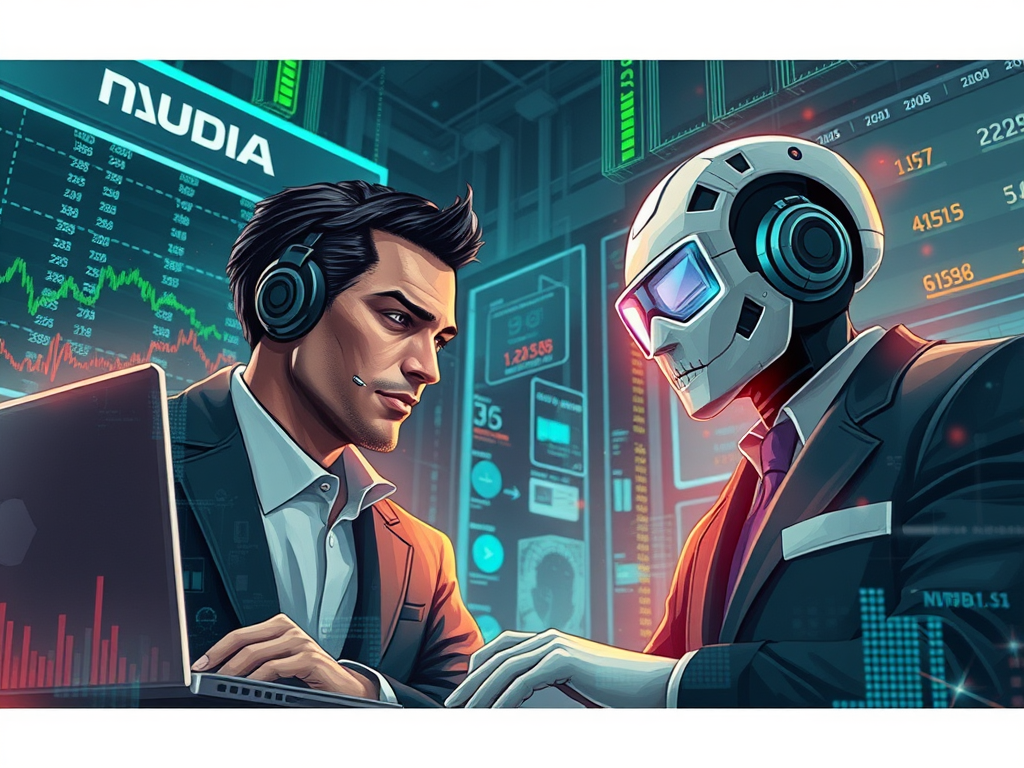


Is A.I. Really Worth the Hype?
A.I. chatbots can be entertaining, sometimes even practical, and until recently, they had a remarkable ability to captivate investors and drive the U.S. stock market.https://svtoday.org/
However, the emergence of DeepSeek, a Chinese start-up offering a high-performing yet relatively low-cost A.I. engine, has disrupted the market and added complexity to the ongoing A.I. narrative.

Investors are reassessing major players caught up in the A.I. frenzy, including Nvidia, Meta, Alphabet, Microsoft, Amazon, Tesla, and the privately held OpenAI. The belief that superhuman intelligence is just around the corner has fueled sky-high valuations, alongside growing concerns about the political and social risks associated with advanced artificial intelligence.
A key question now arises: Is the dominant U.S. approach to A.I. development—spending billions on chips and infrastructure—truly justifiable if similar advancements can be achieved at a fraction of the cost? DeepSeek’s cost-efficient breakthroughs bring renewed urgency to broader financial questions: What is the real value of A.I. companies, and what will be A.I.’s ultimate economic impact?
Daron Acemoglu, recipient of the 2024 Nobel Prize in Economic Sciences, offered his perspective. “There’s a lot of hype in the industry,” he remarked during a phone interview. While he acknowledged that A.I. companies have made notable progress, he pointed out that many financial and economic projections are based on highly speculative, and sometimes exaggerated, forecasts.
As an MIT economist studying the influence of technological advancements on global economies, Professor Acemoglu remains skeptical of the more extreme A.I. claims. He sees A.I. as a significant innovation, with an economic impact comparable to that of the telephone—certainly meaningful, but not revolutionary.
His advice? Don’t get carried away just yet. He doubts that artificial general intelligence—capable of outperforming humans across all tasks—will materialize anytime soon. Over the next decade, he predicts, productivity gains from the spread of powerful yet limited A.I. models will expand the U.S. economy by just about 1%, equating to an annual growth rate of roughly 0.1%.
That doesn’t sound like an economic game-changer, I pointed out.
“Well, it’s not insignificant,” Acemoglu responded, “but it’s one or two orders of magnitude smaller” than what A.I. enthusiasts would have people believe. Of course, he added, if a company does achieve true artificial general intelligence in the coming years, his estimates will prove overly conservative.
Unwavering Optimism
As earnings season unfolds on Wall Street, several U.S. companies investing heavily in A.I. have presented overwhelmingly optimistic—and often self-serving—outlooks on the technology’s future.
After reviewing transcripts and listening to discussions between top executives and analysts, it became clear that the most grandiose vision came from Tesla’s CEO, Elon Musk. Taking a break from his involvement in government projects, Musk discussed Tesla’s earnings, acknowledging that the company faces a challenging year in meeting production and profit targets. However, he was emphatic about Tesla’s A.I. potential.
“There is no company in the world better at real-world A.I. than Tesla,” Musk declared. Once its vehicles receive regulatory approval for “full self-driving”—which, he assured, would happen this year (a claim he has repeatedly made for years)—the value of Tesla’s fleet would increase tenfold.
Furthermore, Musk predicted that Tesla would eventually produce millions of A.I.-powered Optimus robots, paving the way for Tesla to become “by far the most valuable company in the world.” He elaborated, stating that Tesla could surpass the combined worth of the next five largest companies, driven primarily by autonomous vehicles and humanoid robots.
Not everyone shares Musk’s confidence. Since January 24, when DeepSeek’s A.I. advancement began rattling the market, Tesla’s stock has declined by 11%.
Other A.I.-focused companies have also taken a hit.
Nvidia, whose chips power many advanced A.I. models, has seen its stock drop by 9%. Aswath Damodaran, a finance professor at New York University known for analyzing tech companies, noted that DeepSeek’s efficiency suggests a reduced need for high-end chips in many A.I. applications. This, he argued, limits the growth potential of Nvidia’s high-end chip market, making the stock less valuable than previously thought—even after its recent decline.
Similarly, stocks of nuclear energy providers such as Constellation and Vistra, which had surged based on expectations of rising A.I.-driven electricity demand, fell as projections for energy consumption were revised downward.
The performances of Meta, Alphabet, and Microsoft—each investing billions into A.I. research—have been mixed since DeepSeek’s debut. Alphabet and Microsoft have lost ground, while Meta has gained 11%. Given their vast product portfolios and differing A.I. strategies, these companies remain difficult to evaluate. Nevertheless, their leaders have reaffirmed commitments to massive A.I. investments, aiming to secure a competitive edge and integrate A.I. more deeply into consumer offerings. Alphabet, for example, recently announced a substantial increase in capital expenditures, planning to spend $75 billion in 2025—up from $52.5 billion last year. This A.I.-driven spending surge, coupled with weaker cloud computing sales, likely contributed to Alphabet’s stock decline.
The Military Factor
One A.I.-driven company that has defied market trends this month is Palantir. Though not a household name, its technology is widely used by corporations, the U.S. military, law enforcement agencies, and U.S. Immigration and Customs Enforcement—sectors that have enjoyed steady growth under both Democratic and Republican administrations.
Palantir’s Chief Technology Officer, Shyam Sankar, acknowledged that DeepSeek’s innovation has made basic A.I. more affordable. However, he emphasized a larger geopolitical concern: “We are in an A.I. arms race with China.”
Palantir’s CEO and co-founder, Alexander Karp, has been vocal about the company’s role in bolstering U.S. military dominance. “We are making America more lethal, ensuring that our adversaries think twice before acting against American interests,” he stated bluntly.
For those following executive compensation trends, Karp and Musk previously appeared together in a June report on the highest-paid CEOs of U.S. public companies. SEC filings, which now require universal disclosure of “compensation actually paid,” revealed that Musk earned $1.4 billion in 2023, while Karp collected nearly $1.1 billion. Both executives remain deeply entangled with A.I. and, in unique ways, the U.S. government.
The A.I. Investment Landscape
According to Professor Damodaran, A.I. companies should be evaluated in tiers. Those embedding A.I. chatbots into widely accessible consumer services will benefit from lower-cost, commoditized A.I., while firms developing cutting-edge A.I. for military, corporate, and scientific applications may continue commanding premium valuations. Meanwhile, infrastructure providers like Nvidia stand to gain from diverse market demands—but not all A.I. ventures will necessitate massive investments in top-tier chips.
Given the complexity and uncertainty surrounding A.I., Nobel laureate Acemoglu suggests long-term investors take a diversified approach while the current A.I. hype cools down.
“I maintain a balanced portfolio,” he said. “I have tech stocks, healthcare stocks, real estate stocks—everything. I don’t go out of my way to pick Tesla or any other single company. I’m an index fund kind of guy, and I stick to that strategy.”




Leave a Reply