
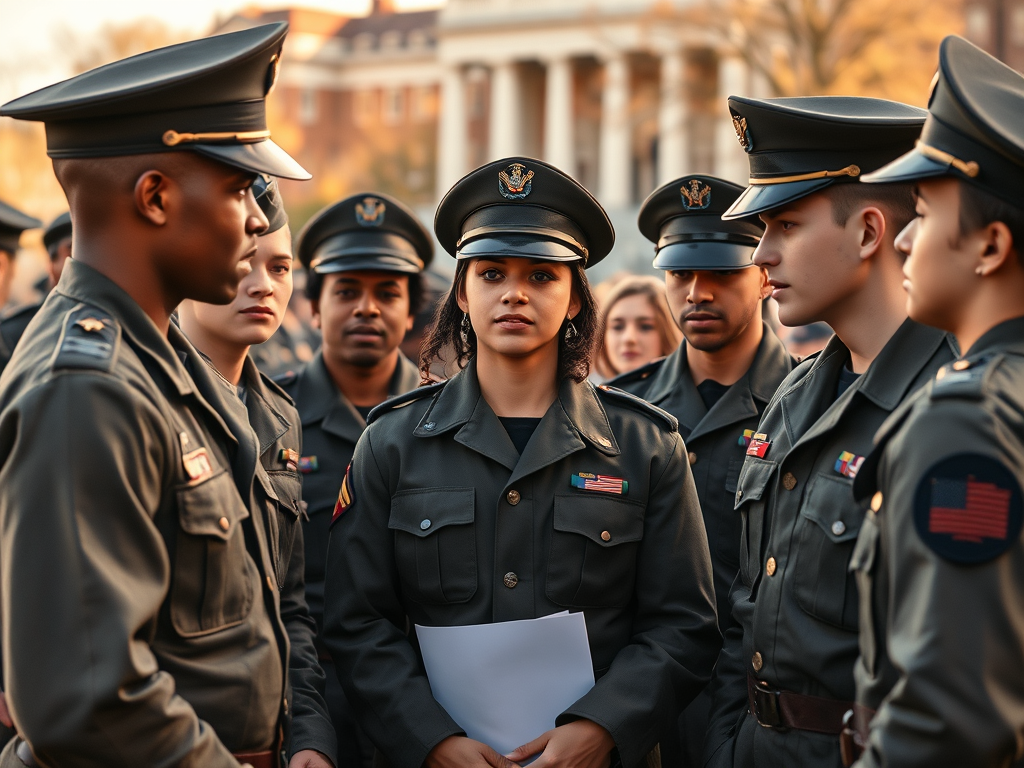

The Military Led Diversity Efforts. West Point’s Club Ban Is a Shift.

In 2015, while attending the United States Military Academy at West Point, Vincent Vu played a key role in establishing the Vietnamese-American Cadet Association. Reflecting on his time as a cadet, Vu acknowledged the challenges of adapting to West Point’s culture, particularly as someone without a military background.
However, he emphasized that the academy’s affinity groups were far from exclusionary. On the contrary, they provided crucial support, helping cadets like him integrate into West Point’s rigorous environment and, ultimately, the Army. These organizations, Vu noted, played a significant role in shaping him into a better officer.
“West Point was probably the first place where I found a supportive community that embraced my identity and who I am,” said Vu, a former air defense artillery officer who is now in his second year of law school at Wake Forest University.https://svtoday.org/
Yet, these affinity groups—centered around race, ethnicity, gender, and sexual orientation—have come under fire due to an executive order signed by President Trump on his first day in office.
The order mandated the dismantling of diversity, equity, and inclusion (D.E.I.) initiatives across the federal government and in federally funded programs, aligning with Trump’s vision of a “colorblind and merit-based” society. His administration swiftly moved to target individuals and programs perceived as advocates of such policies.
In response, West Point announced on Tuesday that it would immediately dissolve 12 affinity groups, including the Vietnamese-American Cadet Association, while reviewing the status of others.
This decision sparked widespread criticism, prompting the academy to reconsider its stance. By Thursday, officials suggested they might reinstate at least some of the disbanded groups.
Military historians have long pointed out that the armed forces have often led the way in advancing racial equality. Eliminating support structures like these, they argue, could undermine decades of progress.
“A military force is far more effective when its demographics mirror those of the broader society,” said Diane M. Ryan, a retired Army colonel and associate dean at Tufts University. Ryan, who previously taught psychology at West Point, also served as the faculty advisor for the Corbin Forum, a club dedicated to promoting female leadership.
In recent years, the federal government has echoed this sentiment in legal battles over the academy’s race-conscious admissions policies. Officials have maintained that fostering a diverse officer corps is essential for effective military leadership, as it ensures representation among those who command the nation’s troops.
The conservative-majority Supreme Court found this reasoning compelling. In its 2023 ruling that struck down affirmative action in college admissions, the court notably carved out an exception for military academies, citing their “potentially distinct interests” in considering race as a factor. However, it left the final decision to future legal challenges.
Despite this, the new administration has moved quickly to reshape policy.
Within a day of Trump’s inauguration, U.S. Coast Guard Commandant Adm. Linda L. Fagan—the first woman to lead a branch of the armed forces—was dismissed. Among the reasons cited for her removal was an alleged “excessive focus” on diversity, equity, and inclusion.
Shortly after, Trump issued an executive order disbanding all government D.E.I. offices, reversing Biden-era policies designed to prevent discrimination and promote diversity within federal agencies. In a subsequent memo, Defense Secretary Pete Hegseth denounced D.E.I. initiatives as incompatible with the values of the Department of Defense.
Hegseth also launched a task force to eliminate any remnants of D.E.I. offices, arguing that such programs undermined meritocracy, perpetuated unconstitutional discrimination, and advanced radical ideologies related to systemic racism and gender identity.
Further reinforcing this stance, Hegseth declared an end to identity-based observances such as Black History Month and Women’s History Month within the Defense Department. He prohibited the use of government resources for cultural awareness months, extending the policy to the 160 schools that serve children of military families worldwide.
Pentagon-run schools, which educate approximately 67,000 students from preschool to high school on military bases across the U.S. and abroad, will no longer recognize cultural awareness months under the new directive, a spokesperson confirmed. The news was first reported by Stars and Stripes.
Additionally, the agency overseeing these schools is reviewing student organizations and library materials to ensure compliance with the administration’s new mandates.
The Naval Academy has stated that it is also reassessing student clubs, though it has yet to dissolve any. Meanwhile, the extent to which other military academies are taking similar actions remains unclear.
Following the backlash over West Point’s decision, the academy scrambled to mitigate the fallout.
Chad Foster, the deputy commandant who signed the order, posted on social media that officials were working to revise club charters or integrate them into academic departments, allowing them to continue operating in some capacity.

“Of course, I’ve enjoyed being called a Nazi and receiving death threats during this typical internet outrage cycle,” Foster wrote, adding, “Rest assured, we are developing a process for thorough review and potential reinstatement of these organizations.”
According to Foster, the 12 clubs were specifically targeted for elimination because they had been directly affiliated with the now-defunct D.E.I. office.
Many of these organizations hosted events such as luncheons, lecture series, and off-campus excursions. Despite their focus on specific communities, participation was open to all cadets, regardless of race, gender, ethnicity, or sexual orientation. Dr. Ryan noted that approximately 20% of attendees at Corbin Forum events were men.
A memo issued by Colonel Foster on February 4 formally declared the clubs “disbanded,” prohibiting them from conducting even informal activities using government time, resources, or facilities.
West Point’s communications office later clarified that, in accordance with Department of Defense guidance, official resources would no longer be allocated for cultural observances or awareness events. However, cadets could still engage in such activities independently, outside of duty hours.

Among the 12 groups affected were the Asian-Pacific Forum Club, the Contemporary Cultural Affairs Seminar Club, the Latin Cultural Club, and the National Society of Black Engineers Club.
The academy reassured cadets that over 100 other student organizations remained available and that religious programs were not impacted by the policy change.
Alex Morey, vice president of campus advocacy at the Foundation for Individual Rights and Expression, stated that her organization was monitoring West Point’s actions for potential First Amendment violations.
Molly Shannon, a 2016 West Point graduate, recalled finding invaluable mentorship through the academy’s chapter of the Society of Women Engineers. Upon learning that the group was among those to be eliminated, she described feeling devastated, saying, “I know how important that community was for me.”
The Corbin Forum also faced dissolution, despite its deep historical significance for female cadets. Established in 1976 alongside the first class of women admitted to West Point, the group had provided a space for mentorship and support for decades. Dr. Ryan, who advised the forum from 2008 to 2017, expressed frustration over the administration’s justification for the changes.
“The argument being made is that these groups are ‘divisive,’” she said. “But I’d argue the opposite. We’re not excluding people—we’re inviting them in.”
Reflecting on her own experience, Ryan noted that she entered the military through the Reserve Officers’ Training Corps because, in the early 1980s, she was unaware that women could attend West Point. “That’s why representation matters,” she emphasized.
Meanwhile, West Point officials appeared to be in damage control mode. Colonel Foster assured the public that they were “working hard to ensure everything is properly aligned” so cadets could still access professional and personal development opportunities.
“No one enjoys delivering bad news to young people—trust me,” he wrote on LinkedIn.



Leave a Reply