

Young Aides Emerge as Enforcers in Musk’s Broadside Against Government

At the conclusion of his third week of aggressively reshaping the federal government, Elon Musk sat down for a 90-minute briefing with Vice President JD Vance to discuss his ongoing efforts to dismantle bureaucracy. He wasn’t alone.https://svtoday.org/
On Thursday morning, in Mr. Vance’s formal ceremonial office in the Eisenhower Executive Office Building beside the White House, Musk was joined by a group of young aides. Their presence within federal agencies has been a clear signal of the sweeping changes to come.
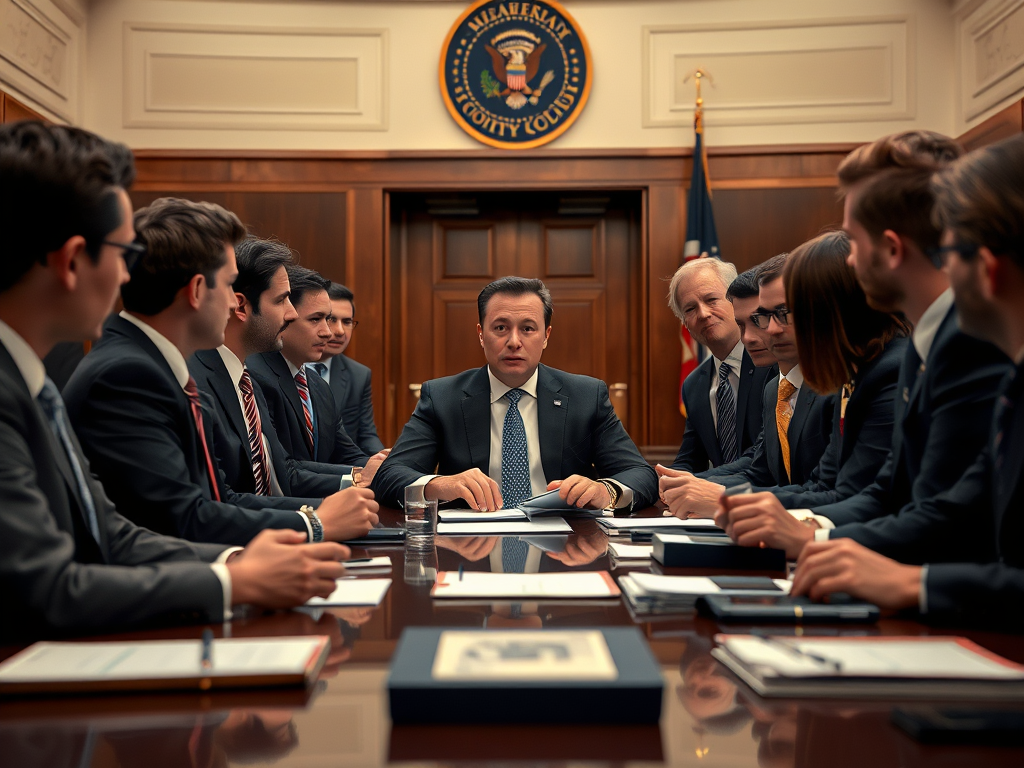
Throughout the government, civil servants have watched as these young recruits—who make up what Musk has dubbed the Department of Government Efficiency—have rapidly inserted themselves into operations. While Musk himself has been making high-profile moves in Washington, these aides have been acting as his enforcers, arriving at agency headquarters with black backpacks and ambitious directives.
Although Musk is accompanied by some seasoned operatives, the bulk of his aggressive overhaul of the federal bureaucracy is being executed by a group of male engineers—many of them fresh out of college, with at least one as young as 19.
Unlike most young professionals in Washington, who typically handle routine administrative tasks assigned by senior officials, Musk’s recruits have been given the authority to upend existing systems.
Among the roughly 40 members of this team, fewer than half have prior connections to Musk, and many lack government experience, according to a New York Times investigation based on public records, internal government databases, and over 20 sources familiar with their activities. These individuals spoke anonymously, fearing retaliation.
Some of the recruits previously interned at Musk’s companies, while others have worked for him for up to two decades. Regardless of their backgrounds, they all appear to embody his “shoot-first, aim-later” approach, overwhelming the bureaucracy with abrupt and forceful actions.
One notable member is a 23-year-old who once used artificial intelligence to decipher the word “purple” from an Ancient Greek scroll. He has quickly gained access to at least five federal agencies, including the Centers for Medicare and Medicaid Services, where he has sought entry into sensitive databases. He was also part of the team that effectively shut down the United States Agency for International Development (USAID), working alongside a 19-year-old former Northeastern University student who was previously fired from a data security firm following an internal leak investigation, as first reported by Bloomberg.
In just the past week, Musk’s aides have descended upon multiple departments, including Education, Energy, Housing and Urban Development, Health and Human Services, Transportation, and Veterans Affairs, as well as the National Oceanic and Atmospheric Administration, the Federal Emergency Management Agency, and the Consumer Financial Protection Bureau, according to individuals familiar with their actions.

Musk has publicly praised his team as talented and relentless, defending their work as essential to eliminating what he sees as government waste and left-wing ideology.
“Time to confess,” he posted on X this week. “Media reports saying that @DOGE has some of the world’s best software engineers are in fact true.”
Musk did not respond to requests for comment.
On Friday, former President Trump told reporters he was “very proud of the job this group of young people—generally young people, but very smart people—is doing.”
“They’re doing it at my insistence,” he added. “It would be a lot easier not to do it, but we have to break some of these things apart to uncover the corruption.”
Despite their sweeping influence, the identities of Musk’s team members have been kept under wraps, emerging only as they demand information and access from career officials.
Such secrecy is unusual for government employees. Barring those involved in classified or intelligence work, the names of public employees are typically accessible.

White House spokesman Harrison Fields stated that the cost-cutting team has undergone the same vetting process as other federal employees but declined to specify what that process entailed or whether Musk’s aides have security clearances.
The Times identified members of Musk’s initiative through internal emails, as well as interviews with government employees who have interacted with them. None of Musk’s aides responded to requests for comment.
According to Musk’s allies, this secrecy is necessary to prevent team members from becoming targets.
Several aides have actively sought to keep their names out of government databases, fearing exposure. Others have attempted to erase their online footprints, scrubbing résumés and social media profiles.
When news outlets such as Wired have reported on their identities, online investigators have scrutinized them closely. Musk has falsely claimed that revealing their roles is a “crime,” and X has removed posts and suspended accounts that publicized their names.
One team member, Marko Elez, a 25-year-old former X employee, resigned on Thursday after The Wall Street Journal reported that he had previously posted racist remarks on X, including one stating that “you could not pay me to marry outside of my ethnicity.” Elez, who had worked at both X and xAI, Musk’s artificial intelligence company, was one of two Musk-affiliated staff members who had gained access to the Treasury Department’s restricted payment system.
Before resigning, Elez had been invited to Musk’s meeting with the vice president, according to documents reviewed by The Times. On Friday, Musk called for The Journal reporter who exposed the story to be fired and announced that Elez would be reinstated—a move supported by both the president and vice president.

“We shouldn’t reward journalists who try to destroy people,” Vance wrote on X.
A spokesman for Vance declined to comment.
While some of Musk’s top advisers have extensive experience, including figures like Brad Smith (a health care entrepreneur and former Trump administration official), Amy Gleason (a former U.S. Digital Service official), and Chris Young (a Republican political strategist Musk hired last year), much of the day-to-day disruption is being driven by a younger cohort.
Washington is a city where much of the work falls on twentysomethings. But in this case, Musk’s young recruits—who have taken to shutting down government websites, demanding access to internal systems, sending late-night emails, and asking veteran employees to justify their jobs—are operating with an unprecedented level of authority. Many have been working around the clock, pulling all-nighters as they dig into agency operations.
Last week, a group of Musk’s aides arrived at USAID headquarters, carrying backpacks filled with multiple laptops and phones, demanding access to financial and personnel records. By Friday night, a dozen of them remained in the office, fueled by bulk-ordered coffee. The following day, the agency’s website went dark.
At the Education Department, as many as 16 team members appear in employee directories, including Jehn Balajadia, Musk’s longtime assistant.

At the Office of Personnel Management, some of Musk’s coders have been sleeping overnight in the building, surviving on pizza, Mountain Dew, Red Bull, and Doritos while working what Musk has described as 120-hour weeks.
Over at the General Services Administration, another key hub for Musk’s aides, beds have been installed on the sixth floor, with security guards blocking access to the area.
The contrast between the newcomers and government veterans is stark. Senior officials in suits now find themselves working alongside young aides clad in jeans, sneakers, and T-shirts—sometimes topped with blazers. One aide was spotted wearing a navy-blue baseball cap with “DOGE” embroidered in white.
Tensions have emerged. A coder on Musk’s team reportedly referred to federal employees as “dinosaurs,” while some career staff at the personnel office have taken to calling the new arrivals “Muskrats.”
As they assess agency operations, Musk’s aides have been conducting 15-minute video interviews with federal employees. Their questions have been pointed, sometimes asking who they would fire if forced to choose. In some cases, the interviewers have refused to turn on their cameras or provide their full names, fueling suspicion.
One young adviser, introducing himself only by his first name, described himself as an “adviser to government leadership” and a startup founder. He pressed an employee to identify their “highest impact” contributions and list any technical “superpowers.”
With many of Musk’s aides holding multiple roles across agencies, and even their department head, Steve Davis, remaining officially unannounced, their presence in government remains both extensive and elusive.




Leave a Reply