
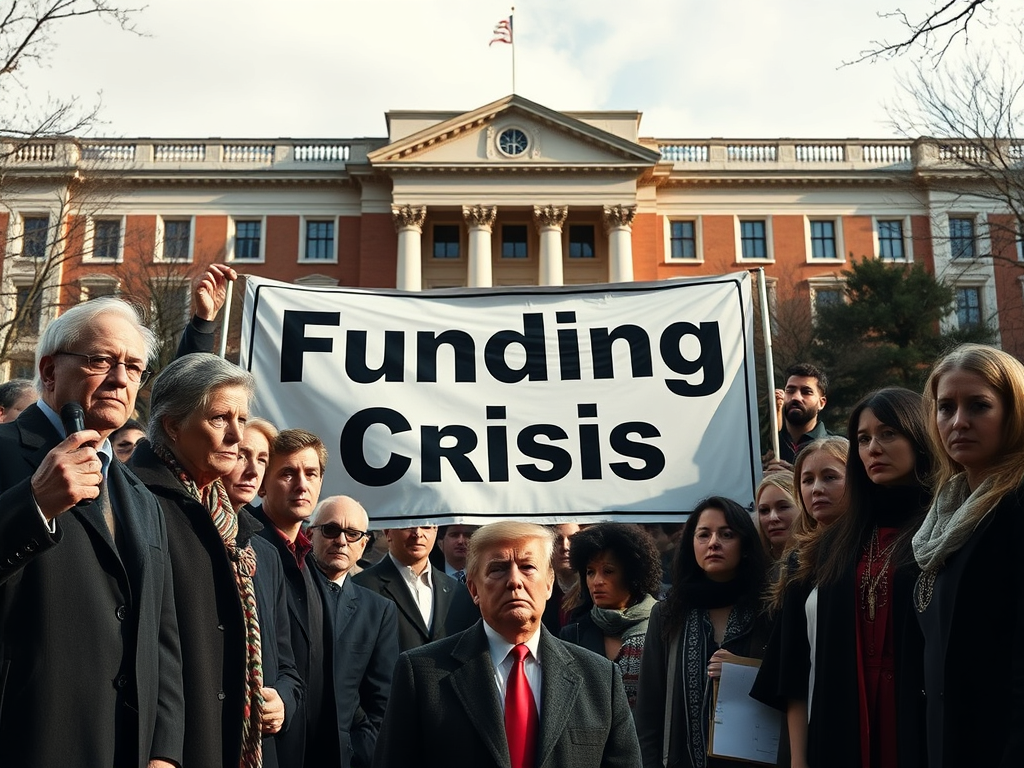

Trump Orders Could Drain Millions From Universities, but Few Protest Openly

The early weeks of President Trump’s second term have thrown American universities into turmoil, with disruptions that could undermine the financial stability of higher education in the U.S.
As the administration moves to dismantle diversity programs and slash foreign aid, university leaders and their legal teams worry that millions of dollars in federal funding could ultimately disappear. Some research projects, particularly those tied to the U.S. Agency for International Development (USAID), have already been suspended, prompting program directors to prepare for layoffs.
Despite these threats, universities have largely remained silent. Faculty and administrators appear hesitant to challenge a president known for retaliating against opponents and already taking steps to restrict funding. Many believe that avoiding public attention is the safest course of action.https://svtoday.org/
Those who have spoken out have done so cautiously, crafting measured statements that acknowledge their concerns while stopping short of direct opposition. In some cases, researchers and university officials have been pressured into silence, with government directives warning them against speaking to the press while funding remains uncertain.
“It’s a difficult and unpredictable time, and that combination is almost paralyzing,” said Ted Mitchell, president of the American Council on Education, which represents over 1,600 colleges and universities.
Dr. Mitchell described the current atmosphere as fostering “a reluctance to speak out due to fear of consequences,” calling it “a rational fear.”
The administration’s recent threat to freeze trillions of dollars in federal grants and loans has posed a significant risk to universities, though legal challenges have left the fate of the plan uncertain. Other orders—such as suspending foreign aid and barring federal funds from being used for diversity, equity, and inclusion initiatives—continue to send shockwaves across campuses.
During his campaign, Mr. Trump and members of his administration targeted elite universities, despite Trump’s own ties to the University of Pennsylvania and Vice President JD Vance’s law degree from Yale. However, the administration’s new policies are affecting institutions far beyond the Ivy League.
The University of Georgia, for instance, which houses the Feed the Future Innovation Lab for Peanut, redirected questions about funding pauses to the state’s higher education system. That system, led by Sonny Perdue—Trump’s former agriculture secretary—did not respond to interview requests.
USAID also declined to comment on reports that researchers had been instructed to avoid speaking to the media. The agency, established in 1961, has become a center of uncertainty, with top officials placed on leave and Elon Musk, who has advocated for $1 trillion in federal spending cuts, declaring that the administration intends to shut it down. (It remains unclear whether Trump or Musk actually have the authority to do so.)
On Monday, after employees at USAID’s Washington headquarters were instructed to stay home, Secretary of State Marco Rubio announced that he was temporarily overseeing the agency.
Some of the hesitation from universities stems from confusion. In recent days, university lawyers have scrambled to interpret abrupt stop-work orders, trying to determine whether institutions can legally fund their own research projects that previously relied on federal support.
Even if permitted, this option would only be viable for a handful of universities. For most, long-term sustainability depends on continued federal funding. In the 2023 fiscal year alone, the federal government allocated nearly $60 billion to university research.
During a Faculty Senate meeting streamed online Monday, Jennifer L. Mnookin, chancellor of the University of Wisconsin-Madison, advised faculty to “hold off” on non-essential spending to help ensure financial stability.
“The transition has created enormous uncertainty, compounded by rapidly changing information,” she said. “It has introduced potentially significant risks to key aspects of our mission, as is the case for our peer institutions nationwide.”
For now, universities are employing subtle strategies to protect their funding, including lobbying congressional representatives and enlisting Republican-aligned advocates in Washington.
“These are different times,” said former Senator Trent Lott, a Mississippi Republican who turned to lobbying after leaving Congress. “Everyone is trying to figure out how things will unfold and what actions they should take. It’s a new team in charge, and people will have to adjust accordingly.”
Universities anticipated changes to the academic research landscape after Trump’s election, but the abruptness of the administration’s early moves has been particularly jarring, said Jeffrey P. Gold, president of the University of Nebraska.

“The speed and scale of these policy shifts have been the biggest surprises,” he noted in an interview, warning that further delays and budget cuts could severely impact many projects.
Critics of Trump’s cost-cutting measures have attempted to counter his rhetoric by highlighting the broader consequences of these policies.
Mark Becker, president of the Association of Public and Land-grant Universities, argued that eliminating USAID research funding would damage America’s global standing and competitiveness.
“We urge the administration to restore USAID’s vital research efforts to ensure American prosperity and security,” he said. “By equipping our scientists to address global challenges, we can sustain U.S. leadership for generations to come.”
Becker is one of the few academic leaders who have publicly pressured the administration over these potential cuts.
Meanwhile, congressional Democrats have sharply criticized the turmoil that they attribute to the administration’s actions in higher education.
Representative Nikki Budzinski, a Democrat representing a district that includes the University of Illinois Urbana-Champaign, said she had been in “regular contact with the university since the freeze and the subsequent confusion surrounding it.”
“It’s creating widespread panic,” she added. The university confirmed that its Soybean Innovation Lab, which supports agricultural development in 31 countries, was recently informed that its funding had been suspended. Since 2013, the lab has received more than $50 million in federal support.
Republicans believe that, even if some funding cuts affect their communities, voters—particularly in conservative states—may be willing to accept them.

“Nebraskans generally support greater efficiency in government,” said Tom Osborne, a Republican who led the University of Nebraska’s football team to three national championships before serving three terms in Congress. “But cuts can still cause some discomfort here and there.”
Osborne predicted that many voters wouldn’t notice the impact of certain funding reductions.
“From what I’ve seen in the news and in conversations with people here,” he said, “there hasn’t been much discussion about it.”
However, the effects are already being felt on some campuses.
At Iowa State University, at least 11 employees rely—at least in part—on funding from a USAID grant supporting curriculum modernization in Kosovo. The program grew out of a decade-long “sister-state” partnership between Iowa and Kosovo.
“We’ve been instructed not to move forward with any activities related to the project,” said Curtis R. Youngs, a professor in the Department of Animal Science involved in the initiative.
The grant, valued at $4 million over five years, is relatively small by USAID standards, Dr. Youngs noted, but remains “significant from our perspective.”


Leave a Reply