
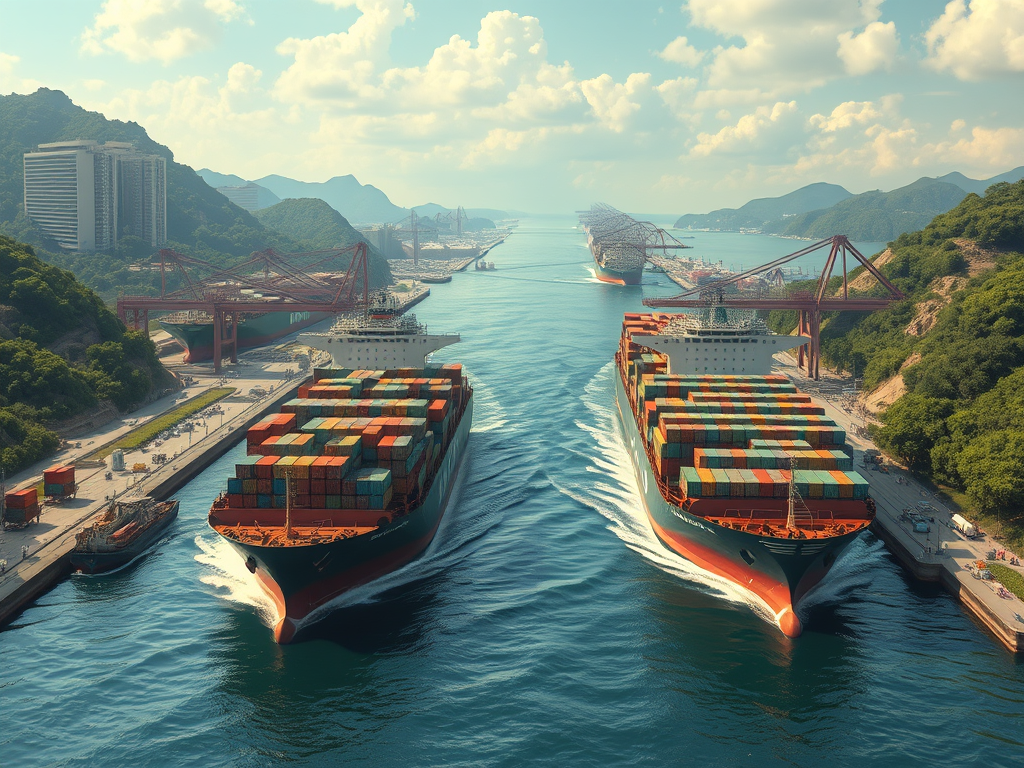

Trump, the Panama Canal and the Hong Kong Firm at the Heart of a Showdown

Former President Donald Trump’s assertion that China exerts control over the Panama Canal has thrust a Hong Kong business magnate and his corporate empire into the spotlight amid rising tensions between the United States and China.https://svtoday.org/
The conglomerate in question, CK Hutchison Holdings, is one of the most valuable publicly traded companies in Hong Kong, with some of the world’s largest investors among its shareholders. A subsidiary of the group, Hutchison Ports, has maintained a presence in the Panama Canal since 1997.
Among Panama’s five major ports, Hutchison’s facilities are the most significant, strategically positioned at both ends of the canal. Data from the Panama Maritime Authority indicates that last year, Hutchison’s ports handled 39% of the cargo containers passing through the canal—one of the world’s most crucial trade routes. Other ports in the region are operated by companies from Taiwan, Singapore, and a U.S.-Panamanian joint venture.
The company’s involvement in the canal raises lingering concerns in Washington about Beijing’s growing influence over Hong Kong, a semi-autonomous region of China. The Trump administration has argued that China could leverage its ties to a Hong Kong-based company like CK Hutchison to pressure Panama into restricting U.S. trade access through the canal.
Who is CK Hutchison, and who is the tycoon behind it?
CK Hutchison was founded by billionaire Li Ka-shing, an iconic figure in Hong Kong’s business world. A high school dropout, Mr. Li, now 96, transformed a modest plastic flower business into a global empire spanning infrastructure, finance, retail, and telecommunications.
Hutchison Ports, a Singapore-listed subsidiary of CK Hutchison, operates the Balboa and Cristóbal ports, located on the Pacific and Atlantic sides of the Panama Canal, respectively. The company has a global workforce of 30,000 employees and manages 53 ports across two dozen countries. Its major shareholders include BlackRock and Vanguard, two of the largest asset management firms in the world.
For decades until his retirement in 2018, Mr. Li ran his business differently from mainland Chinese firms, taking advantage of Hong Kong’s open market and distinct legal framework. Like many Hong Kong entrepreneurs, he cultivated relationships with China’s top leadership and invested heavily in the mainland.
However, in recent years, Mr. Li has occasionally voiced concerns about Beijing’s increasing grip on Hong Kong. During the 2019 pro-democracy protests, when authorities responded with force and Beijing called on Hong Kong’s elite to support its stance, Mr. Li urged restraint.
Since then, he has divested much of his real estate portfolio in China and shifted some of his investments to Europe—a move that has drawn criticism from Chinese nationalists.
What role does Hutchison Ports play in the Panama Canal?
Hutchison Ports has managed the Balboa and Cristóbal ports since 1997, when Panama granted it a 25-year concession. Notably, it is the only port operator in which the Panamanian government holds a stake, receiving both revenue payments for container movements and dividend payouts.
However, the extension of Hutchison’s port concession, renewed for another 25 years in 2021, has now come under scrutiny.
Panama’s authorities have pledged to conduct an audit to ensure the company is accurately reporting its revenues, payments, and contributions to the state. On January 21, nearly a dozen auditors arrived at Hutchison’s offices to begin their review.
Additionally, two Panamanian lawyers have filed a lawsuit challenging the contract between Panama and Hutchison, claiming it violates the country’s constitution. In response, China’s government stated that it “believes Panama will provide a fair business environment for all enterprises, including those from Hong Kong.”
Both Hutchison Ports and its parent company, CK Hutchison, have declined to comment despite multiple inquiries.

Why is a Hong Kong company being labeled as Chinese?
The classification of CK Hutchison as a Chinese entity stems from Hong Kong’s unique political status and the evolving perception of its legacy corporations.
Under British rule for over 150 years, Hong Kong was handed back to China in 1997 under the promise that it would retain “a high degree of autonomy.” However, that changed in 2020 when Beijing imposed a national security law following large-scale pro-democracy protests.
Since then, Beijing’s firm control has largely dismantled political opposition, diminishing the characteristics that once set Hong Kong apart from mainland China—such as its independent business environment and vibrant civic society.

During his presidency, Donald Trump signed an executive order revoking Hong Kong’s special trade and immigration status under U.S. law. President Joe Biden has since extended this policy. Meanwhile, Hong Kong authorities have made efforts to publicly reaffirm their alignment with Beijing.
“Everything must now be labeled as ‘Hong Kong, China,’” remarked David Webb, a veteran investor in Hong Kong. “It’s no surprise that companies from Hong Kong are increasingly regarded as Chinese.”
How is mainland China involved in Panama?
The Trump administration’s concerns over China’s influence in Panama tie into broader anxieties regarding China’s Belt and Road Initiative—a global infrastructure project through which Beijing has funded and built large-scale developments worldwide.
In 2017, Panama became the first Latin American country to formally join the Belt and Road Initiative.

Following a recent visit by U.S. Secretary of State Marco Rubio, Panama’s President José Raúl Mulino announced that his government would not renew the Belt and Road agreement. However, China has already been scaling back its overseas lending in recent years.
According to AidData, a research initiative at William & Mary in Virginia, China has committed $669.7 million in grants and loans to Panama—roughly half the amount received by its neighbor, Costa Rica. The most significant Chinese financing in Panama was a $200 million loan from China’s state-owned Export-Import Bank to a privately owned Panamanian bank in 2019.
China had initially planned more extensive investments following President Xi Jinping’s visit to Panama in 2018. However, momentum stalled after Juan Carlos Varela, the Panamanian president who had championed stronger ties with Beijing, left office in 2019.




Leave a Reply