
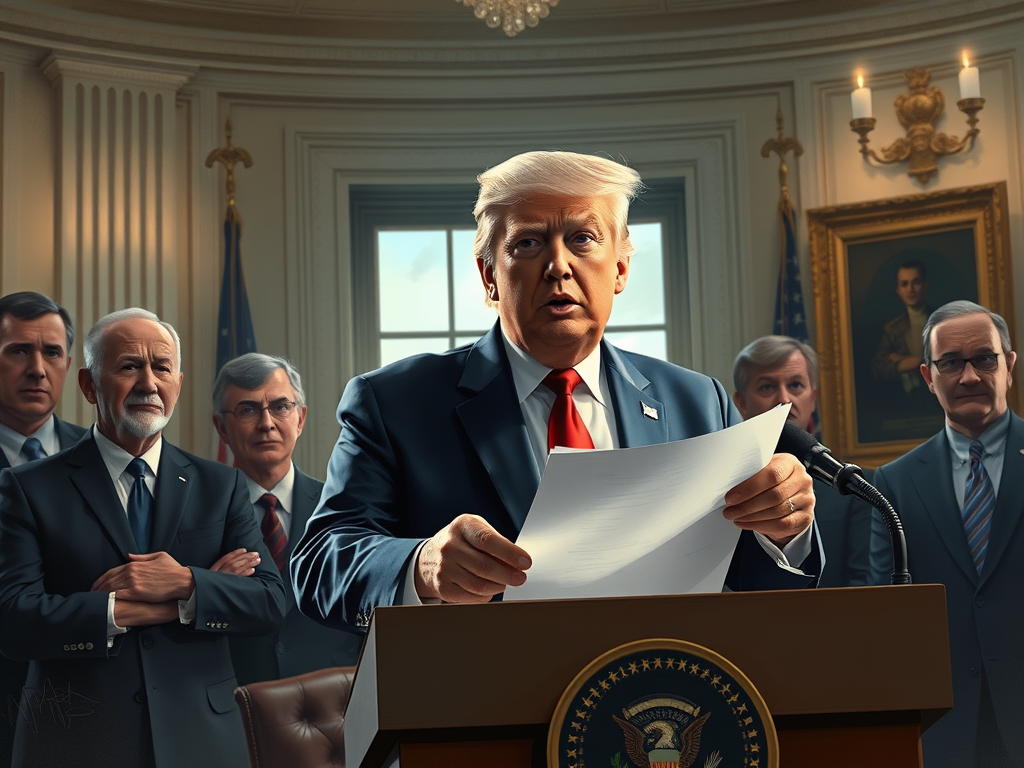

Inside Trump’s Hastily Written Proposal to ‘Own’ Gaza

When President Trump revealed his plan for the U.S. to take control of Gaza on Tuesday, it took even top White House and government officials by surprise.https://svtoday.org/
Although his announcement appeared formal and carefully planned — he read it from a sheet of paper — sources familiar with the discussions revealed that his administration had not conducted any preliminary assessments to determine the viability of the idea.
This proposal caught not just American officials off guard; it was just as unexpected for the Israeli delegation visiting Washington. Prior to their joint news conference on Tuesday, Trump surprised Prime Minister Benjamin Netanyahu by revealing his intention to announce the Gaza ownership plan, according to two individuals briefed on their interactions.

Within the U.S. government, there were no discussions with the State Department or the Pentagon — a usual step for any major foreign policy proposal, especially one of such a significant scale. No working groups had been set up, and the Department of Defense had not provided any estimates regarding troop numbers, costs, or logistical considerations.
In essence, there was little more than an idea in the president’s mind.
Unlike past presidential foreign policy announcements, the concept of U.S. control over Gaza had never been discussed publicly before that Tuesday. However, privately, Trump had been mulling over the idea for weeks. His thinking intensified after his Middle East envoy, Steve Witkoff, returned from Gaza last week, painting a grim picture of the situation there.
Despite this, neither the White House nor the Israeli government anticipated that Trump would announce the plan when he did. The idea was swiftly met with criticism from the Arab world, including from Saudi Arabia, a key ally of the U.S. On Wednesday, White House press secretary Karoline Leavitt attempted to soften some of Trump’s remarks, particularly those about Palestinians being relocated. She emphasized that Trump merely wanted Jordan and Egypt to temporarily host Palestinians and downplayed the idea of U.S. financial involvement, even though Trump had suggested long-term U.S. ownership of Gaza.

Leavitt also insisted that the president had not committed to deploying U.S. troops, despite Trump’s statement: “We’ll do what is necessary. And if it’s necessary, we’ll do that.”
It remains unclear if Trump had discussed the plan in detail with the Israelis. The Israeli embassy did not respond to inquiries seeking clarification.
The proposal raised numerous questions: How would it be executed? How many U.S. troops would be needed to clear out Hamas, debris, and unexploded ordnance? What would be the cost to rebuild Gaza? How could such a move be justified under international law? And what would happen to the two million refugees?
In the hours following the announcement, U.S. officials struggled to provide concrete answers. The reason for their lack of clarity soon became apparent: there were no real details to offer.
On Wednesday, Trump’s national security adviser, Mike Waltz, appeared on “CBS Mornings” to defend the Gaza proposal. However, it quickly became evident that the plan was more of a concept rather than a fully developed policy, echoing Trump’s past descriptions of vague policy ideas. Waltz defended the boldness of Trump’s proposals, asserting that they could prompt the region to find their own solutions.

Trump had been pressing Jordan and Egypt to accept Palestinians from Gaza for weeks, but both nations’ leaders have refused. While forcibly removing Palestinians would violate international law, Trump suggested that they would be eager to leave Gaza, as the area had become uninhabitable. He hinted that they could return eventually.
Trump made these statements while standing next to Netanyahu, whose military campaign had devastated Gaza following the October 7, 2023 terrorist attacks, which created the very conditions Trump referred to.
“The U.S. will take over the Gaza Strip, and we will do a job with it, too,” Trump stated. “We’ll own it and be responsible for dismantling all of the dangerous unexploded bombs and other weapons on the site. Level the site and get rid of the destroyed buildings. Level it out.”
Netanyahu, who has been working to expel Hamas from Gaza since the deadly attacks, seemed pleased with Trump’s remarks.
However, several U.S. officials expressed reservations about the proposal. Two sources close to Trump insisted that the idea was solely his own, and one said they had not heard him mention U.S. troop involvement prior to the announcement.
Senior officials in the U.S. government, who spoke on the condition of anonymity, acknowledged that they were still trying to understand the origin of the idea and considered it highly unrealistic, even for Trump.
The proposal clashed with Trump’s past criticisms of nation-building efforts in the Middle East. His suggestion that the U.S. take responsibility for one of the world’s most devastated areas also came while his administration was scaling back U.S.A.I.D., the agency responsible for foreign development assistance.

Trump’s foreign policy has never fully aligned with the isolationist views held by some in his party. He had initially supported the Iraq war before condemning it and has made controversial statements about extracting resources from conflict zones, such as taking oil from Iraq. During his second term, his imperialistic tendencies became more apparent, with proposals like buying Greenland and making Canada the 51st state.
Trump’s Middle East envoy, Witkoff, is also a real estate developer, as is his son-in-law, Jared Kushner, who worked on Middle East policy during Trump’s first term. Last year, Kushner had floated the idea of exploiting Gaza’s prime waterfront for development.
Some advisers to Trump speculated that the Gaza ownership idea would fade away as Trump realized its impracticality, and by Wednesday afternoon, that seemed to be happening.
Daniel B. Shapiro, a former U.S. ambassador to Israel, warned that even suggesting the idea could have dangerous consequences: “The U.S. taking over Gaza, at massive cost in dollars and troops, is as likely as Mexico paying for the wall or the U.S. seizing Iraq’s oil.”
Shapiro cautioned that extremists in Israel and terrorist groups might take the idea seriously and act on it, risking the safety of U.S. personnel and jeopardizing any potential progress toward Saudi-Israel normalization.
In response, Trump’s team pointed out that many officials had warned of violence in the Middle East when Trump moved the U.S. Embassy to Jerusalem in 2017, and that he had brokered peace deals between Israel and several Muslim-majority nations through the Abraham Accords.
Despite the skepticism, Trump’s Gaza proposal was praised by hard-right figures in Israel and some members of the pro-Israel community in the U.S. David Friedman, Trump’s former ambassador to Israel, described the plan as “brilliant and out of the box,” suggesting it could change the dynamics in the region.
Friedman argued that the real challenge was finding someone who could govern Gaza without threatening both its residents and Israel. He suggested that after rebuilding Gaza, the area could be developed into a thriving market-driven region — including the prospect of “25 miles of sunset-facing beachfront,” a vision straight out of the real estate world.




Leave a Reply