
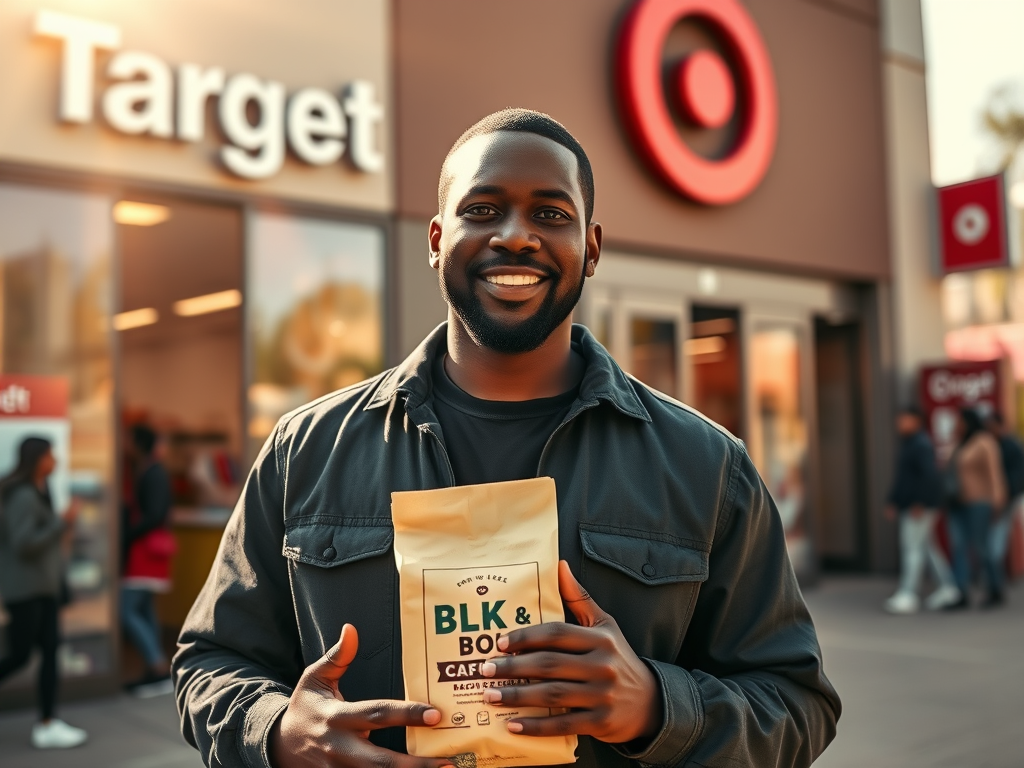

Pernell Cezar’s coffee company, BLK & Bold, started with just three employees, operating out of the back of a brewery. His breakthrough came when he secured a meeting with a buyer at a Target Black History Month expo. By January 2020, his Rise & GRND roast was stocked on Target shelves.
Target Went All In on D.E.I.; Its Sudden Pullback Has Black Sellers Reeling

Just five months later, the killing of George Floyd in Minneapolis sparked nationwide protests for racial justice, leading corporations across America to reassess their diversity efforts. Major retailers swiftly introduced initiatives to support small businesses, particularly Black-owned ones, giving them opportunities to enter the market.
In 2021, Amazon launched its Black Business Accelerator, while Sephora, which already had a similar program, shifted its focus to Black, Indigenous, and other founders of color. Minneapolis-based Target introduced Forward Founders, an initiative aimed at educating emerging brands on how to break into major retailers—an effort Mr. Cezar played a key role in shaping.https://svtoday.org/
However, on January 24, Target announced the conclusion of its three-year diversity, equity, and inclusion (D.E.I.) objectives, rebranding its Supplier Diversity team as Supplier Engagement. A new message on the Forward Founders webpage indicated that the program was “evolving.”
Mr. Cezar, whose coffee is sold in 1,500 Target stores, was disappointed. He noted that suppliers like him were not informed ahead of time and were left uncertain about how these changes might impact their businesses. (Target later clarified that there would be no immediate effect on its existing supplier relationships.)
“This leaves us asking, ‘What happens next?’” Mr. Cezar remarked. “Trust isn’t built overnight.”
Target’s decision aligns with a broader trend of corporations scaling back their D.E.I. initiatives, including Amazon, Walmart, and Meta. This shift gained momentum after the Supreme Court’s 2023 ruling against race-conscious college admissions policies, further fueled by conservative legal challenges and social media backlash. The election of President Trump accelerated this retreat—just days into his presidency, he ordered federal agencies to investigate private companies for what he deemed unlawful D.E.I. programs, signaling a shift in civil rights enforcement.
Corporations are now adopting more ambiguous language in their restructuring, often replacing “D.E.I.” with terms like “belonging.” The practical implications remain uncertain, leaving Black entrepreneurs like Mr. Cezar in a difficult position—should they speak out or stay silent?
Calls for a Boycott
Target’s announcement, coming just a week before Black History Month, struck a nerve with Black entrepreneurs. The company had long fostered an ecosystem to support Black-owned businesses, even before 2020, and had set a goal of featuring 500 Black-owned brands in its stores by the end of this year.

In response, groups such as Black Lives Matter Minnesota, the Racial Justice Network, and the Minnesota chapter of the Council on American-Islamic Relations called for a national boycott. “We encourage everyone to buy directly from Black-owned businesses through their websites rather than shopping at Target,” said Monique Cullars-Doty, co-founder of Black Lives Matter Minnesota.
However, Black business owners held differing views on the boycott.
Tabitha Brown, whose brand sells home goods like mugs and organic popcorn at Target, posted a social media video warning that a boycott could hurt Black entrepreneurs. “I understand the frustration, but if we all stop shopping, our sales will drop, and our businesses will suffer,” she explained, suggesting that consumers could instead support brands that align with their values. (Ms. Brown did not respond to requests for comment.)
Danielle Coke Balfour, founder of Oh Happy Dani, took a different stance. Last week, she announced on Instagram that she had begun the process of withdrawing her products from Target shelves.
“This was not an easy decision, especially since many of you first discovered Oh Happy Dani in Target aisles,” her company stated. “But our brand has always been rooted in the very principles that Target has recently chosen to step away from.” Surprisingly, her online sales surged after she decided to leave the retailer.
Kristen Jones Miller, co-founder of the beauty brand Mented, previously participated in one of Target’s accelerator programs. She emphasized that Black-owned brands never received special treatment—they were held to the same performance standards as any other supplier.
Calling Target’s decision “shortsighted,” Ms. Miller pointed out that the retailer benefited from these partnerships just as much as the brands did. “Our customers were thrilled to find us in Target stores for the first time,” she said.
A Growing Legal Risk
In recent years, conservative groups have intensified their opposition to corporate D.E.I. policies. Online activist Robby Starbuck has led boycott threats against companies like Lowe’s and Tractor Supply for their so-called “woke” policies. Meanwhile, America First Legal, an organization founded by former Trump advisor Stephen Miller, has sued corporations over diversity initiatives, arguing they violate anti-discrimination laws. The National Center for Public Policy Research has pressured companies like Costco to reconsider their D.E.I. efforts through shareholder proposals, though Costco’s shareholders rejected one such motion in January.

The same organization pushed a similar proposal at Target, claiming the retailer’s partnership with the Human Rights Campaign—a nonprofit that evaluates corporate L.G.B.T.Q. policies—led it into controversial activism. In 2023, backlash over Pride Month merchandise resulted in consumer boycotts and a decline in sales. Though Target’s shareholders rejected the proposal in June, the company later announced it would stop sharing data with the Human Rights Campaign and reassess its corporate partnerships.
Stefan Padfield, executive director of the Free Enterprise Project at the National Center for Public Policy Research, described Target’s recent actions as “significant.” He argued that D.E.I. policies constitute “blatant discrimination based on race and sex” and predicted that supplier diversity initiatives would soon disappear due to the legal risks they pose.

Legal challenges have already begun. Last Friday, a police pension fund in Riviera Beach, Florida, filed a lawsuit against Target, alleging the company misled shareholders about the financial risks of its diversity efforts. Target has yet to respond to the lawsuit.
Jonathan Butcher, a policy fellow at the Heritage Foundation and author of Restoring Equality in Employment: Sinking the D.E.I. Ship, welcomed Target’s move but remained cautious. “The real question is whether they’ll follow through or try to circumvent these changes while maintaining a D.E.I. agenda,” he said.
Still, Butcher acknowledged that corporations can create initiatives to support small businesses without explicitly tying them to diversity. “It’s entirely reasonable for a company to develop programs that assist small businesses of all backgrounds,” he noted.
An Uncertain Future

When Target launched its Forward Founders program in 2021, it aimed to help “historically under-resourced founders” build generational wealth. Participants gained access to Target buyers, marketing experts, and a chance to pitch their products for in-store placement.
Navigating the retail industry without such resources can be challenging, Mr. Cezar explained. “Without institutional knowledge, it’s like the wild, wild West,” he said.
Black-owned businesses, which tend to be smaller and less capitalized than their white-owned counterparts, face additional hurdles. Research from the Stanford Institute for Economic Policy Research found that Black entrepreneurs invest money into their businesses at a slower rate over time, limiting their growth potential.
For Patrice Chappelle, founder of the skincare brand MelanBrand Skin, the uncertainty surrounding D.E.I. rollbacks is concerning.
Chappelle, who launched her company in 2023 to create better skincare options for her son, had set her sights on getting her products into major retailers like Target and Walmart. She enrolled in various business programs, including one run by TJX, the parent company of T.J. Maxx and Marshalls, which focuses on female entrepreneurs.
Now, she’s questioning her next steps. “As an emerging brand, I can’t help but worry,” she said. “I see my fellow founders—some of whom I know personally—struggling with these changes. They’re in a tough spot.”




Leave a Reply