

Trump Holds Off on Tariffs, but Paves the Way for Future Trade Action

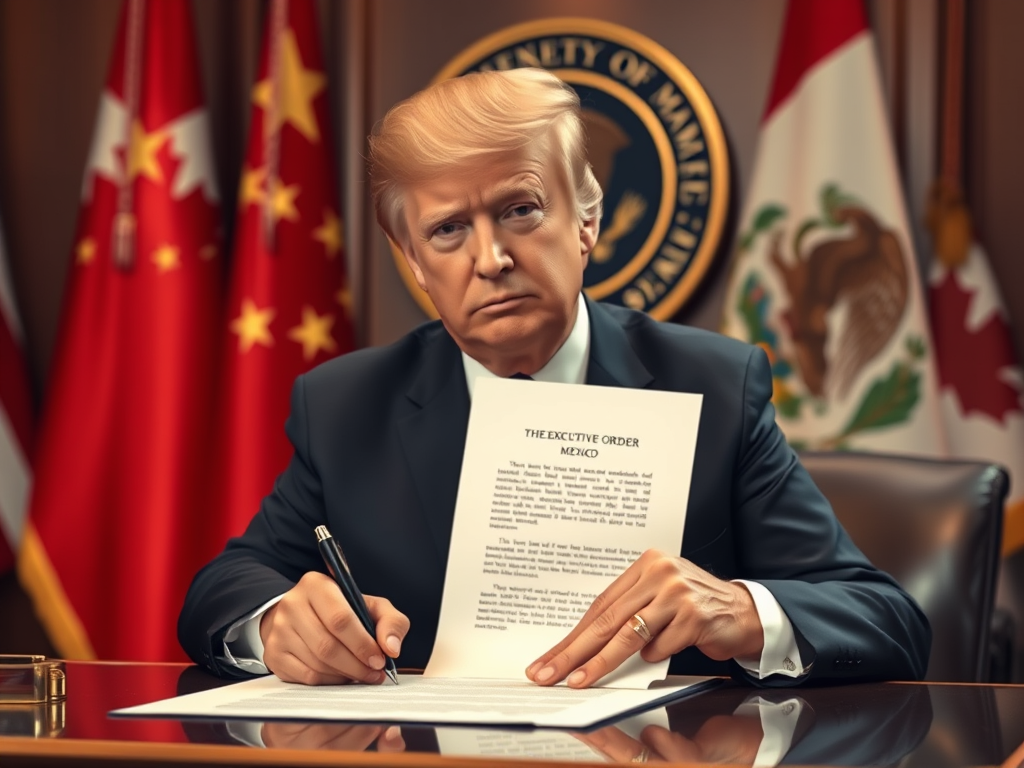
President Trump has decided not to immediately impose tariffs on imported goods this Monday but will instead sign an executive order directing federal agencies to begin investigating a wide range of trade issues. This inquiry could eventually lead to new taxes on goods from countries such as China, Canada, Mexico, and others in the coming months.https://svtoday.org/
This decision indicates that Trump is taking a more cautious approach toward fulfilling a key campaign pledge to use tariffs to reshape America’s trading relationships. It also postpones potential trade conflicts with foreign governments, many of which had promised to retaliate with their own tariffs in response to U.S. levies.
The executive order will direct federal agencies to focus on a broad set of trade issues, including trade deficits and agreements made with China, Canada, and Mexico. This may pave the way for Trump to apply tariffs for various reasons, potentially disrupting international supply chains and escalating global trade tensions in the near future.
The order will instruct federal agencies to review unfair trade practices and currency manipulation, and to assess whether foreign governments are adhering to the terms of the two trade deals Trump signed during his first term. Additionally, the order will require a study on the viability of establishing an “External Revenue Service” to manage the collection of tariffs and duties.
Trump will also call for an investigation into tariffs imposed by the U.S. for national security reasons, as well as the use of a trade exemption called de minimis, which allows low-value goods to enter the U.S. duty-free. This loophole has enabled significant volumes of Chinese goods to avoid the tariffs Trump enacted during his first term. The Wall Street Journal previously reported on the details of the executive order.
Though Trump has chosen to delay implementing tariffs at this stage, his advisers maintain that he remains more convinced than ever of their potential benefits.
Trump and his team are reportedly considering a mix of strategies, including a universal tariff on foreign imports, higher tariffs specifically targeting China, and separate measures aimed at addressing trade relations with Mexico and Canada, potentially imposing taxes on those nations as well.
In his inauguration speech on Monday, Trump vowed to “immediately begin overhauling our trade system to protect American workers and families.” He predicted that tariffs would bring in “massive amounts of money” for the U.S. Treasury and promised that “the American dream will soon be back and thriving like never before.”
Trump has long praised tariffs for their ability to support U.S. manufacturing, generate revenue to fund tax cuts, and provide leverage in trade negotiations with other countries.
Although trade policy is technically under the jurisdiction of Congress, various laws grant the president broad powers to impose tariffs. These powers allow the president to defend U.S. national security, address unfair trade practices, and respond to international emergencies.
While Trump and his advisers continue to debate the most effective way to impose tariffs, they believe they have the legal authority to use any of these methods.
Some U.S. manufacturers credit the tariffs imposed during Trump’s first term — which President Biden has kept in place — with helping them compete against countries like China. However, economists and many businesses argue that tariffs can harm the economy by raising the cost of imported goods and provoking retaliatory measures from other governments, which can hurt U.S. exports.
Trump’s executive order will keep foreign governments on alert in the coming weeks as they work to strengthen ties with his administration and attempt to dissuade him from targeting their exports.
Canadian officials have already drawn up a list of U.S. products they plan to tax in retaliation if Trump’s tariffs are imposed, including items like Florida orange juice, Tennessee whiskey, and Kentucky peanut butter. Mexico, the European Union, and other governments have also threatened retaliatory tariffs.
During his first term, Trump shook up the U.S.’s global trade relationships by imposing tariffs on foreign washing machines, solar panels, metals, and a variety of products from China. These actions nearly doubled the average tariff rate on imported goods, though U.S. tariffs still remained relatively low compared to global standards.
Economists have raised concerns about Trump’s plan to expand these tariffs. They argue that while tariffs may benefit certain protected industries, they also have negative side effects for the broader economy, including higher costs for households and businesses that rely on imported products.
Lydia Cox, an economist at the University of Wisconsin-Madison, referred to tariffs as “a pretty blunt instrument” during a forum hosted by Harvard Kennedy School. While she acknowledged potential benefits for protected industries, Cox noted that tariffs often lead to significant collateral damage.




Leave a Reply