
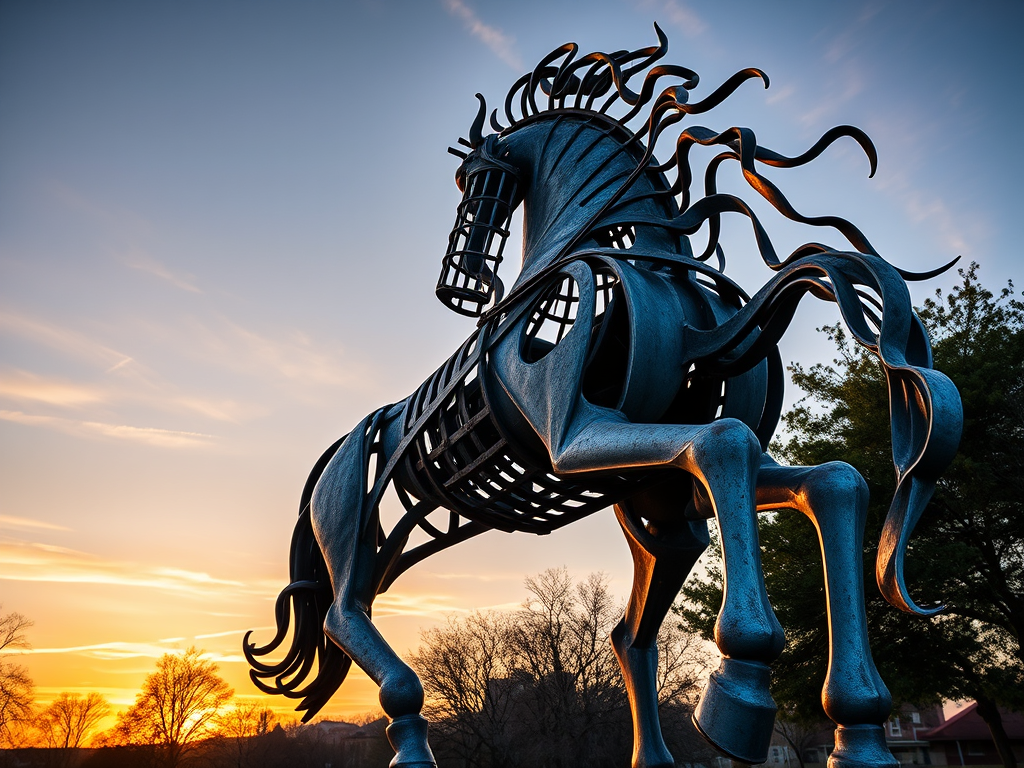

In Athens, Georgia, the most iconic sculpture is surprisingly not a bulldog, but rather an 11-foot-tall welded steel horse. This abstract creation, a twisting labyrinth of undulations and crescents, was designed by Chicago artist Abbott Pattison in 1954 during a visit to the University of Georgia. The sculpture, initially known as “Steel Horse” and later “Pegasus,” is better known as the “Iron Horse.”
The Exile and Rebirth of the South’s Storied ‘Iron Horse’


When the massive piece was first unveiled on the university campus, lifted by a crane from the Fine Arts Building basement, it was unlike anything the campus had ever seen. With its cage-like middle section of sharp ribs, flat Cubist surfaces, and wavy mane and tail, it was unmistakably a horse—though not in the traditional sense. The reaction from students was immediate and intense, with many expressing their disdain for what they saw as a perplexing and unsettling work of art.https://svtoday.org/


In recent years, the sculpture, which had been removed from a cornfield for conservation, showed signs of decades of neglect. It was missing 32 parts, scarred by graffiti, and bore a bullet wound in its neck. Its hooves had rusted to the color of Georgia clay.
Public art on college campuses often becomes a battleground for broader societal debates, and the Iron Horse was no exception. The reasons behind its vandalism remain unclear, but one thing is certain: the sculpture became a symbol of contention.
“It’s wrapped in mystery and misunderstanding,” said Donald Cope, a designer and metal fabricator who worked on the sculpture’s restoration. Cope, along with conservator Amy Jones Abbe, spent six months meticulously repairing the sculpture, restoring its original appearance for the first time since its unveiling.

For art historians, the Iron Horse is a pioneering piece of modern steel sculpture in the South. David Raskin, a professor at the School of the Art Institute of Chicago, notes that it could serve as an ideal “pivot point” in discussions of modern versus traditional art.
The controversy surrounding the sculpture started immediately after its installation. On its first night on campus, a mob of students vandalized the piece, covering it with graffiti, shoveling manure beneath it, and even hanging balloons from its hind legs. Tires were set on fire underneath the sculpture, prompting the fire department to intervene.

“There was a strong reaction against modernism, which many people simply didn’t understand,” said William U. Eiland, former director of the Georgia Museum of Art. He pointed out that the period in which the sculpture was unveiled was fraught with tension, including the Red Scare and the struggle for civil rights. Some speculated that the sculpture’s Cubist design evoked Picasso’s “Guernica,” adding fuel to the fire of controversy.


However, not everyone saw the vandalism as a serious political statement. Don McMillian, a veterinary student at the time, later described the incident as nothing more than a prank, one typical of college antics from that era. Pattison, however, was deeply offended by the attacks on his work, which he described as a painful experience.
After the incident, the sculpture was hidden from view for several years, stored in a barn. Eventually, it was relocated to the farm of L.C. Curtis, a horticulture professor, where it remained for decades, slowly becoming an unlikely local landmark.

Today, the Iron Horse has transformed from a controversial and neglected piece into a symbol of the community. It’s featured in local murals, brochures, and visited by football fans and tourists alike. Even McMillian returned to see it years later, reminiscing about the prank.
After the Curtis family sold the farm to the university in 2013, the sculpture was officially donated to the institution in 2023, with the stipulation that it be restored. The restoration, funded by private donations, included a fresh coat of black paint and a new plinth made of Georgia granite.
Despite the restoration, some feel the sculpture should be relocated to the main campus where it was originally intended to be displayed. Harry Pattison, the artist’s son, expressed his belief that his father wanted the sculpture back on campus, where it could be better preserved and appreciated.

Over the years, the sculpture has been subjected to various forms of mischief, from paint and graffiti to symbolic acts by rival football fans. Despite this, the Iron Horse has become a beloved icon, with its quirky history and enduring presence serving as a testament to the sometimes controversial nature of modern art.
For those who worked on its restoration, including Cope and Abbe, the goal is to ensure the sculpture is now seen in a more respectful light. “We hope people appreciate it for what it is,” said Abbe, who previously worked at the Metropolitan Museum of Art. “Even if it came from a place of affection, it deserves to be admired in a different way.”
Now standing proudly atop its new granite base, the Iron Horse seems to be entering a new chapter in its life—one where it is valued not just as a roadside oddity, but as a significant piece of modern art. As Cope put it, “It’s the price of celebrity,” with the sculpture now receiving the attention and admiration it once lacked.



Leave a Reply