
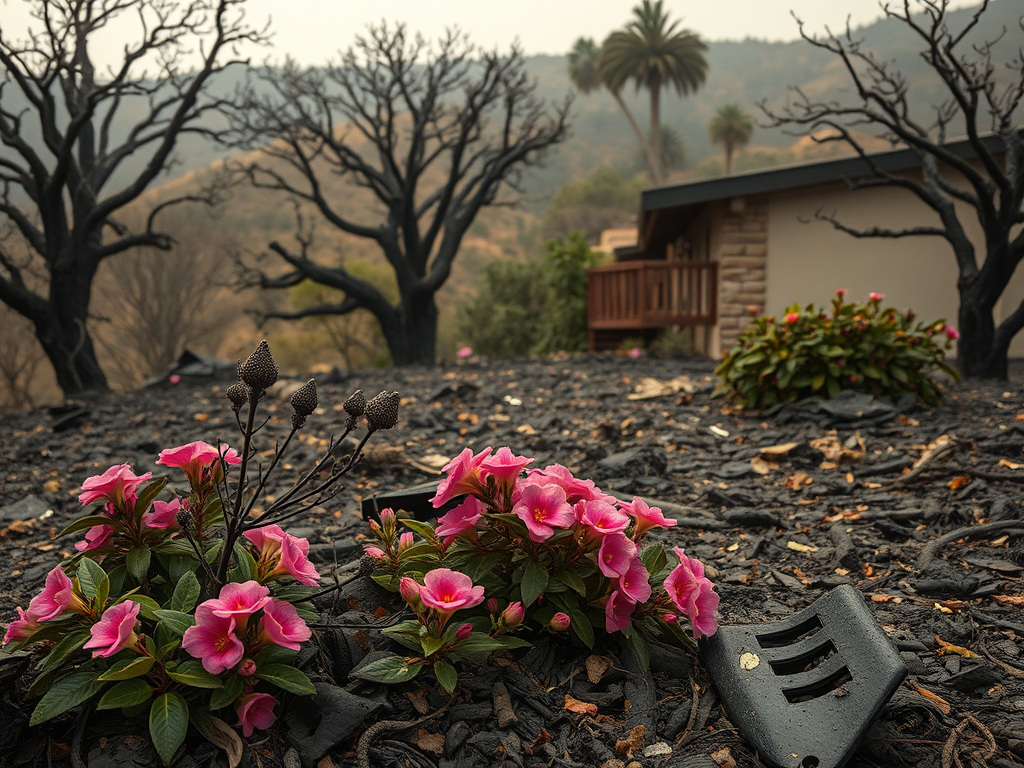

Roya Lavasani spent almost 30 years creating a home and a business for her family on a quiet Malibu street just off the Pacific Coast Highway. Together with her husband, Majid Amirani, she owned a four-unit condo, living in one and renting out the other three, generating around $150,000 in annual rental income.
They Escaped the Wildfires. Now, They’re Facing Personal Costs

The property featured a vivid display of pink flowers outside the entrance, orchids both inside and out, and a variety of fruiting trees—including apple, loquat, nectarine, peach, and avocado—surrounding the building. Ms. Lavasani was known to climb these trees and tend to them with care.https://svtoday.org/
But last week, all the years of meticulous attention and steady income were wiped away when the Palisades fire destroyed their property. This fire, now one of California’s most devastating, was part of a wave of blazes that have torn through Los Angeles County over the past week, forcing nearly 200,000 people to evacuate.
Many residents chose to leave, driven out by the smoke-filled air or the fear that their homes—even those outside the official evacuation zones—might not be safe. For each person, the decision to evacuate was a balance between personal safety and the financial consequences of abandoning their homes, potentially for good.
Some losses are impossible to measure. For Ms. Lavasani, it’s the photo albums of her two grown daughters, Xena and Rezvon, that she grieves most. She had hoped to save them as the fire approached.
“I was terrified of losing those memories,” Ms. Lavasani, 57, shared. “All of those memories—gone.”
Tricia Wachtendorf, director of the Disaster Research Center at the University of Delaware, explained that researchers categorize the financial impact of evacuating a disaster into three phases. First, the preparation stage, where supplies are gathered before disaster strikes. Then, the immediate needs—restocking essentials, dealing with disruptions to work and income. Finally, there are the long-term costs involved in recovery, like rebuilding homes and replacing furniture.
However, personal costs also run parallel to these financial losses, affecting a person’s mental health, a child’s education, a mother’s memories, and the very fabric of community life.
Although leaving their home saved the Amirani family, it also set them on a long and uncertain road to recovery. As fires continue to rage, and evacuees wait for updates on their neighborhoods, families like the Amiranis wonder what they can salvage—and at what cost.
What Was Saved
When firefighters arrived on January 7, urging the family to evacuate, Mr. Amirani, 64, and his daughter, Rezvon, 24, quickly grabbed the most important items: passports, critical documents, jewelry, electronics, and their pet pygmy goat, Coco, who had been a birthday gift to Rezvon when she turned 15.
Ms. Lavasani stayed behind, hoping to protect their home further and retrieve a few more belongings. But when the flames approached, they came at her like “fireworks at my head,” she said. She fled, only able to take what she was wearing, shielding her face with the hood of her sweatshirt. She escaped with some burns.
Meanwhile, Marcell Scott opened his door in Pasadena to welcome relatives and friends fleeing the Eaton fire in Altadena. Similar to the Palisades fire, the Eaton fire spread quickly, forcing people to make split-second decisions about what to grab. Mr. Scott’s family, deeply rooted in Pasadena, had some homes survive the blaze, but one aunt and her three children lost everything, left with only the few items they could carry.
“Some packed only a day’s worth of belongings, others just a few days’ worth. No one knew the fire would destroy everything overnight,” said Mr. Scott, 33. “Everyone thought they would return to their homes—none of them knew.”
What Can Be Replaced
As the destruction became apparent, Los Angeles County set up evacuation shelters where residents could rest, get a meal, and begin sorting out paperwork. The Amiranis are staying at one such shelter at the Westwood Recreation Center, living out of two borrowed campers parked outside. Coco, their goat, is uneasy around other animals, so the family takes turns sitting with her in the parking lot.
The shelter provides basic supplies, including stacks of bottled water. Still, the family has also picked up some items from CVS, including medical tape to treat Ms. Lavasani’s burns. They’ve even received gifts from strangers who saw them on the news, like a new pet bed for Coco.
While evacuees’ immediate needs can be extensive, it’s also when help is most readily available, according to Ms. Wachtendorf. Many people, not directly affected, jump into action, raising funds or donating supplies. However, Ms. Wachtendorf cautioned that donations of goods often lead to waste and may not meet the actual needs of those displaced.

Mr. Scott spent part of the weekend volunteering at a distribution center run by WalkGood LA, a nonprofit based in Arlington Heights. Initially collecting supplies, the organization shifted to requesting cash and gift cards to better assist evacuees.
“There are a lot of people without fire insurance, and it’s going to be a nightmare for them to get any financial support,” said Marley Ralph, co-founder of the organization.
Thousands of people have launched fundraisers, waiting for insurance companies and government assistance. The Amiranis are among those seeking help. They have set a goal of $35,000—what Fritz Porter, Ms. Lavasani’s son-in-law, described as “a drop in the bucket” compared to the total cost—but enough to help the family get out of their campers and start paying rent while they await a more permanent solution (they’ve raised about $25,000 so far).
Though the family hasn’t yet been allowed to return, they’ve seen photos of the damage to their home. The new roof they recently installed for $60,000 has collapsed, and the trees Ms. Lavasani nurtured are now charred skeletons. She estimates that rebuilding will take years, and in the meantime, they will lose rental income. They’ve applied for aid from FEMA and filed an insurance claim, but they fear the insurance may not be able to handle the enormous losses caused by these fires. For now, their focus remains on getting back to their property. Beyond that, everything is uncertain.
“My husband is nearly a senior, and I’m 57,” Ms. Lavasani reflected. “This is not the time to start rebuilding our business.”
What Was Lost
As the smoke from the fires still lingers over her community, Ms. Lavasani spoke about the future—not the immediate concerns of where she would sleep in the coming week or how she and her husband would rebuild, but about the grandchildren she hopes to one day hold and the memories of their mothers that will never be seen by future generations—lost forever in photo albums.

Lui Elliot, 30, who grew up in Altadena, spoke of his close-knit neighborhood, where it was common for neighbors to chat over backyard fences. His house, which he was in the process of making his own, was another casualty of the Eaton fire. Among the losses were family photos and an extensive vinyl record collection his late father, a musician, had curated over the years.
Yet, Mr. Elliot’s greatest loss is not just the physical things but the sense of community. He and Mr. Scott, both from Altadena, expressed concern that the area’s history, especially its roots in the Black community, could be lost in the long and costly rebuilding process. Although most of their neighbors plan to rebuild, the financial burden and lack of infrastructure may hinder that effort.
“The water is tainted, there’s no power, and the sewer system is likely destroyed,” said Mr. Elliot. “We can have all the money we need, but without infrastructure, we can’t rebuild.”




Leave a Reply