
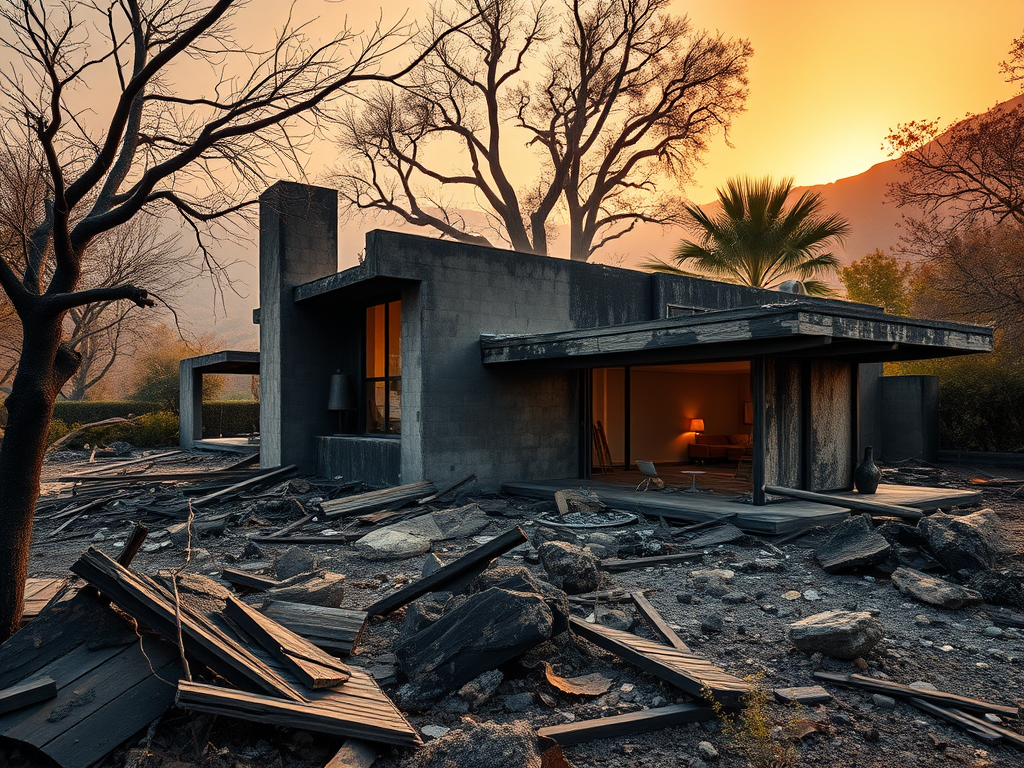

More than a week after the catastrophic fires in Los Angeles began, the scale of the destruction to the region’s architectural heritage is becoming increasingly evident. According to Adrian Scott Fine, president and CEO of the Los Angeles Conservancy, these fires have resulted in the loss of more historically significant structures than any previous single event. The Conservancy has recorded the destruction of over 30 notable buildings on its website, a number that continues to rise as officials, property owners, and others access the affected areas to evaluate the damage.
The Design Legacy of Los Angeles That Fell to the Fires

The devastation has tragically highlighted the incredible diversity of Los Angeles’s architectural styles, spanning Modernist, Beaux-Arts, Spanish Revival, Craftsman, Art Deco, Victorian, Postmodern, and contemporary designs.https://wordpress.com/
“That’s what made the Palisades and Altadena so unique,” said Fine. “Their mix of styles was fascinating and endearing, giving these areas their distinctive character that people cherished.”
The fires were both ruthless and unpredictable. While celebrated architect Ray Kappe’s 539 W Rustic Road home in Rustic Canyon was scorched but remained standing, his Keeler House, just 10 minutes away, was completely destroyed. Remarkably, one of the region’s most famous modern homes, Charles and Ray Eames’s Case Study House #8, survived. Despite some fallen branches and a coating of fire retardant on its iconic glass windows, the house remained largely unharmed.
“We are extremely fortunate,” said Lucia Dewey Atwood, executive director of the Eames Foundation and granddaughter of the Eameses.
Ken Bernstein, manager of the city’s Office of Historic Resources, reflected on the overwhelming loss, noting the completeness of the destruction in many cases. While the historic Will Rogers Ranch House was confirmed lost last week, here are 10 other beloved landmarks that have succumbed to the flames:
Benedict and Nancy Freedman House (Richard Neutra, 1949) – Pacific Palisades


Designed by Richard Neutra, a luminary of midcentury Modernist architecture, this compact home embraced Southern California’s seamless indoor-outdoor living. Its open design blurred the lines between nature and the interior, a hallmark of Neutra’s work. Originally created for two writers, the house was expanded in 2014 by architect Peter Grueneisen, adding a partial second story with breathtaking ocean views.
Park Planned Homes (Gregory Ain, 1946-48) – Altadena


Altadena lost several significant midcentury modern landmarks, including Gregory Ain’s socially progressive Park Planned Homes. These prefabricated residences were designed to foster both privacy and community, with each home opening onto a private yard. Laura Begley, a recent homeowner in the area, described it as a tranquil and welcoming neighborhood. Tragically, only six of the original 28 homes survived.
708 House (Eric Owen Moss, 1982) – Pacific Palisades

Eric Owen Moss’s 708 House was a playful, experimental design featuring angular lines and bold elements, including a graphic facade that showcased the address in vibrant, unconventional ways. Moss considered this structure an “oddity,” emphasizing its unique blend of styles and creative whimsy.
Pasadena Waldorf School/Scripps Hall (Charles W. Buchanan, 1904) – Altadena

A prime example of Craftsman architecture, Scripps Hall served as a family residence before becoming the K-8 campus for Pasadena Waldorf School. Its Japanese-influenced design and Asian-inspired landscaping created a serene and distinctive environment, treasured by students and staff alike.
Nature Friends Clubhouse (Sierra Madre Canyon, 1924)

Modeled after an Austrian alpine chalet, this charming clubhouse embodied community spirit and connection to nature. Over the decades, it hosted artists, theater groups, and yoga retreats. Zak Clark, director of Nature Friends LA, has vowed to rebuild the clubhouse with more durable materials, ensuring its legacy continues.
William D. Davies Memorial Building (Charles H. Kyson, 1934) – Altaden


Constructed during the Great Depression by the Works Progress Administration, this timber and cobblestone structure was a centerpiece of the community. Its rustic charm made it a popular venue for concerts, weddings, and other events.
Altadena Community Church (Harry L. Pierce, 1947) – Altadena


This Spanish Colonial Revival church featured stunning stained-glass windows crafted by Judson Studios. Its intricate design and spiritual significance made it a cherished landmark in the community.
Pacific Palisades Business Block (Clinton Nourse, 1924)


A hallmark of Spanish Colonial Revival architecture, this building was integral to the original development plan for Pacific Palisades. Once painted pink, it served as a vibrant marketplace and community hub.
21640 Pacific Coast Highway (Buff and Hensman, 1969) – Malib


This beachside home by Buff and Hensman combined midcentury design with a casual, luxurious aesthetic. Its large windows framed panoramic views of the Pacific, making it a quintessential Malibu retreat.
Corpus Christi Church (AC Martin, 1965) – Pacific Palisades


Designed by AC Martin, this expressive modernist church featured a striking parabolic shape that connected congregants in both form and function. The innovative design was a modern tribute to timeless architectural principles.
As the region mourns the loss of these architectural treasures, efforts are underway to preserve what remains and rebuild with resilience and respect for the past.




Leave a Reply