
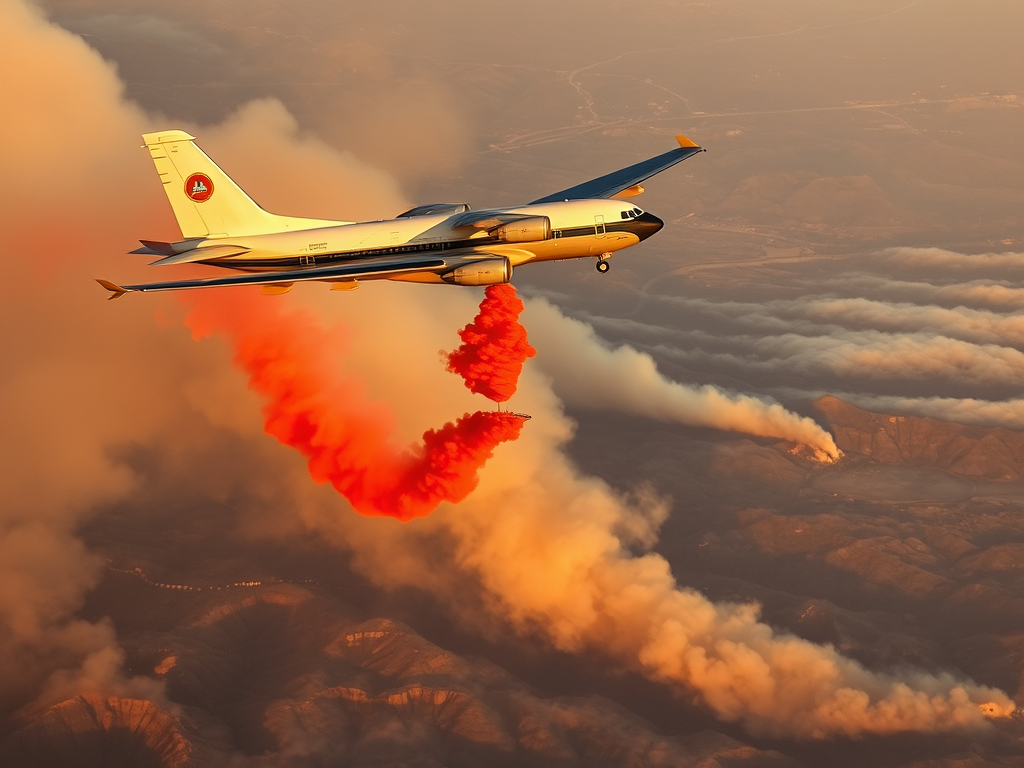

A NASCAR driver’s father is helping fight the L.A. fires in a 400,000-pound airplane

Captain R.K. Smithley pauses, carefully choosing his words. He’s been asked to describe the experience of flying a DC-10 just a few hundred feet above the ground at 170 mph while carrying an 85,000-pound load. All this, while navigating strong winds, uneven terrain, other aircraft, and dense smoke from the wildfires he’s working to combat.
It’s a job that demands a unique kind of individual, one with exceptional qualifications—and Smithley fits the bill.
“Some people can adapt to this, and some can’t,” says Smithley, father of NASCAR Xfinity Series driver Garrett Smithley, in an interview with The Athletic. “You need to be a bit of a psycho—if I’m being honest—to thrive in this environment. You have to excel at putting retardant exactly where it’s needed, even in extremely challenging conditions, like what we’ve faced here in California.”https://wordpress.com/
He adds, “We’re flying a 400,000-pound airplane, hugging a mountainside at a 10-degree nose-down pitch—a maneuver the airlines consider an emergency descent. For us, it’s just another day.”
Currently stationed in Southern California, Smithley is flying up to six missions daily to drop fire retardant and contain the flames ravaging the region. For the 65-year-old, who’s been a pilot since 1983 and spent the past 11 years flying air tankers into wildfire hotspots across the U.S., this work is second nature. In 2024 alone, he completed missions in nearly a dozen states.
But this particular mission is extraordinary. Fires that erupted last week in the Los Angeles area—specifically the Palisades and Eaton fires—are among the most devastating in California’s history. Together, they’ve scorched 38,000 acres, claimed 24 lives, destroyed thousands of homes, and forced over 100,000 residents to evacuate, according to Cal Fire.
Strong winds, with gusts reaching 100 mph, initially grounded the New Mexico-based aerial firefighting company 10 Tanker, where Smithley works. But since returning to the skies on Friday, Smithley and his team have made numerous successful drops of fire retardant.
The operation involves a complex coordination of tanker planes, scooper planes that collect water from large bodies, and helicopters carrying water buckets. Smithley’s DC-10, a repurposed commercial airliner fitted with three massive tanks, plays a critical role. Every flight is meticulously planned, from routes to drop zones. Even the fire retardant’s reddish-pink hue is designed for maximum visibility from the air and ground.
“On one of the Palisades fire missions, we arrived late in the day. That’s when we managed six flights,” Smithley recalls. “We were fifth in line to drop. So we either held position or entered a large left-hand holding pattern—amusingly similar to NASCAR, where it’s always left turns. We circled the fire, keeping an eye on each other to avoid collisions and stay in formation.”
Smithley’s NASCAR analogy comes naturally, as motorsport has always been a passion of his—a passion he passed down to his son Garrett. Now 32, Garrett has made 266 starts at NASCAR’s national level and will compete full-time in the Xfinity Series in 2025. Discussions about Garrett’s races often come up among the 10 Tanker crew, particularly since the NASCAR season overlaps with their “fire season” from March to November. Smithley even snapped an aerial photo of California Speedway during a recent flight and texted it to Garrett.
“This job feels like the pre-race adrenaline at a NASCAR event,” Smithley says. “Garrett’s signing autographs before his race, and as soon as the green flag drops, the heart rate spikes. For us, it’s the same—we load the retardant, get the call, and head out to fight the fire.”
Firefighting is in Smithley’s blood. Growing up in Pennsylvania, he spent 20 years as a volunteer firefighter, following in the footsteps of his father and grandfather. But combining firefighting with aviation wasn’t part of his original plan. After high school, he decided to pursue a career as a pilot, attending Embry-Riddle Aeronautical University in Florida, near Daytona International Speedway. Over the years, he flew various aircraft, including military transports, before transitioning to his current role.

The work is demanding and unpredictable. Based in Chuckey, Tennessee, Smithley is on standby to deploy whenever and wherever wildfires need aerial support. When the Los Angeles fires broke out last week, he anticipated being called to Southern California—and he was right.
“When I arrived, I hadn’t flown since November, so the first flight was tense,” he admits. “Flying in some of the busiest airspace in the country, over fires that killed 20-plus people and destroyed 5,000 structures, is no small task. By the second flight, things felt less intense. By the third, we’d figured out the route and situational awareness, much like Garrett learns tracks in NASCAR.”
This January deployment was a first for Smithley, and the devastation he witnessed left a deep impression.
“As we approached the Pacific Palisades and Altadena fires, we flew over neighborhoods reduced to ash and foundations,” he says. “It’s sobering—thinking about the lives lost and the thousands of people who’ve lost everything. It’s hard to process, but in the fire traffic area, you set those emotions aside and focus on precision. At the hotel later, watching the news coverage, it all hits you again. It’s heartbreaking.”
Even with its challenges, Smithley finds fulfillment in his work. He knows he’s making a difference, one flight at a time.





Leave a Reply